We Celebrate Charity. We Tolerate Business: Rethinking the Missional Dimension of BAM
I’m not a provocateur by nature. Most people (who don’t ride in a car with me) know me as measured and careful with what I say and how I say it. But one of my favorite “poke the bear” statements when I’m talking to a roomful of missions-minded Christians is this:
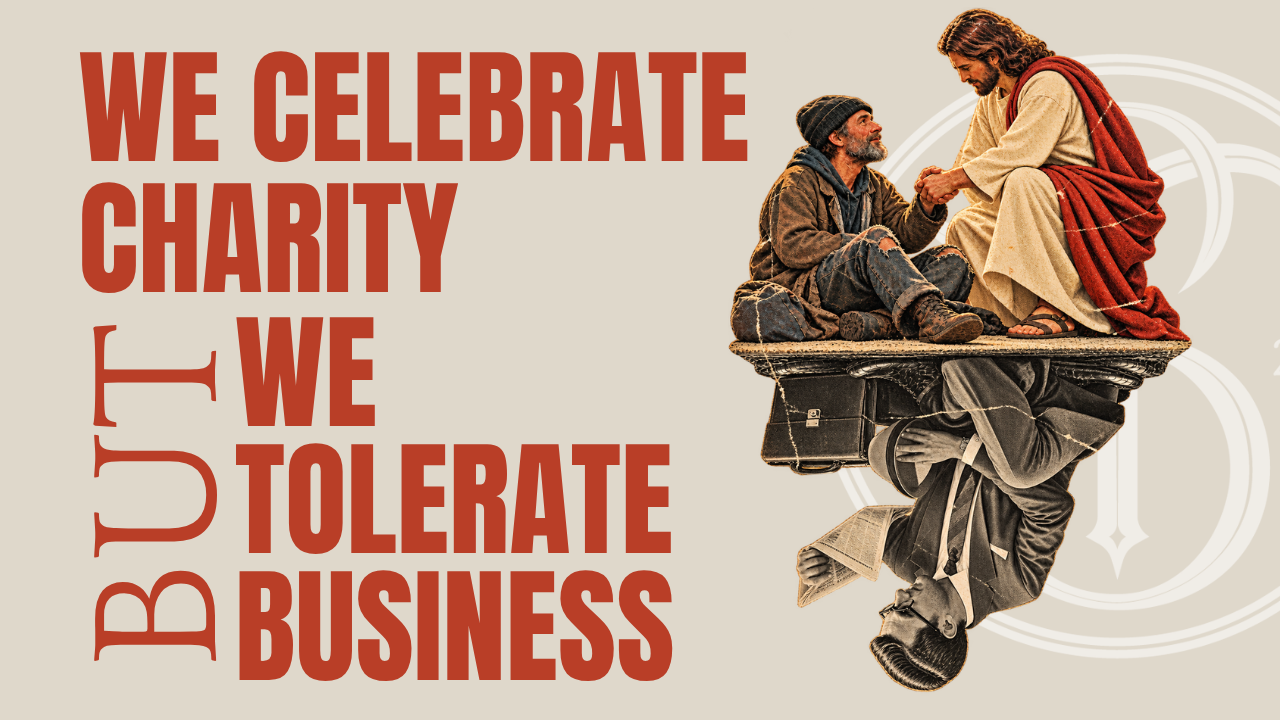
We understand how Christians can honor God and love their neighbors through acts of charity. But I believe we can honor God and love our neighbors through acts of commerce as well.
Did that make one of your eyebrows raise, too? Maybe or maybe not. But I have found many Christ-followers struggle with this idea. Before you burn me as a heretic, I’m not talking about business’s sin-distorted counterfeit. I’m talking about the marketplace being actively redeemed toward its original design by the finished work of Jesus. Those acts of commerce. That kind of business.
Feeding the hungry obviously looks like loving your neighbor. Giving money to someone in need is clearly Kingdom-oriented. But what about creating a sustainable job, building a healthy company, producing something genuinely useful that solves a real problem? What about paying people fairly, investing in the development of employees, creating economic value, or serving customers exceptionally well?
Here’s what we need to admit: We have inherited categories that make charity feel sacred while commerce feels spiritually neutral at best—and let’s be honest—secular and suspicious at worst.
But what if business isn’t merely something worldly that Christians can leverage for Kingdom purposes? What if business itself can (and should) be an expression of God’s Kingdom purposes in the world?
Newbigin’s Distinction
British missionary and theologian, Lesslie Newbigin, gave me language for exploring this exact question. Newbigin spent almost four decades serving as a missionary in India, and when he returned to Britain, became an influential voice in missiology. Having been gone for nearly 35 years, he had a unique and intense ability to examine Western culture through the eyes of an outsider.
Newbigin’s central concern was that the Gospel had been relegated to a private religious truth. But the Gospel he knew and proclaimed was meant to be a public truth that speaks to the whole of life. He articulated two key concepts that have helped me clarify some mushy ideas about business and the marketplace that had been rolling around in my brain for years: Missional dimension and missional intention.
Let’s unpack those concepts as Newbigin saw them:
MISSIONAL DIMENSION: Because the church itself embodies God’s mission, every aspect of believers’ and the believing community’s life carries a witnessing quality simply through its existence as God’s visible means of carrying on his mission in the world. It is the way the everyday life and activity of God’s people bears witness to God’s Kingdom simply by faithfully embodying what God intends human life to be.
MISSIONAL INTENTION: An action of the Church in going out beyond the frontiers of its own life to bear witness to Christ as Lord among those who do not know Him, with the intention of bringing them from unbelief to faith. This is the deliberate movement toward those who do not know Christ with the explicit purpose of Gospel proclamation, conversion, discipleship, and incorporation into the Christian community.
I think this distinction exposes the core tension at the heart of the modern Business as Mission movement, and it calls back to the kind of Gospel-redeemed business I described earlier—a marketplace being redeemed toward its original design under the lordship of Jesus Christ. If Newbigin is right, we have an incredible opportunity to proclaim the Gospel through the marketplace while fully embracing its missional dimension in Gospel-deprived communities across the globe.
We Celebrate Charity, We Tolerate Business
In traditional missions work, the missional intention is obvious. In fact, it’s how we define the Great Commission. We send missionaries to proclaim the Gospel, make disciples, plant churches, and reach the unreached places with the Good News of Jesus.
This is good. This is the point.
But when business enters the conversation, we often treat it differently. It’s a visa strategy, an access mechanism, a funding source, or a relational platform from which the real ministry can happen.
We recognize the missional intention surrounding the business while overlooking the missional dimension of the business itself. Business is embraced as a secular platform for the Gospel, but not as a redeemed expression of God’s work in the world through His people. And this really short-circuits the possibilities business and the marketplace bring to global missions.
Why do we struggle to see the missional dimension of business the same way we can see it in other expressions of missions?
If a missionary enters a community to drill wells for clean water, open a school, or operate a medical clinic, we don’t discard that work as a secular mechanism we are simply using for gospel proclamation. We instinctively recognize that clean water, education, and treating the sick are in alignment with God’s heart for His creation.
But we treat business differently. And yet, a business can create meaningful employment, solve real problems for people, create economic stability, and contribute to the growth and flourishing of a community. We can’t lose our ability to see something sacred here!
It’s easy to see the missional dimension of a hospital: care, healing, dignity, restoration. And through that dimension we can engage with intention—deliberately making Christ known where He is not known. A clean well project can have both. A school can have both. Why can’t a business?
It’s time we extend the same theological and missiological imagination to the business world that we’ve long applied to hospitals, schools, clean water, and other compassion ministries.
Two BAMs Walk into an Unreached People Group
Let’s do a little thought experiment here.
BAM #1—Dimension without Intention: Imagine a genuinely excellent business being operated by a group of Christ-followers in an area of the world with little to no access to the Gospel. It’s producing something valuable, contributing to the local economy, creating jobs with fair wages, making legitimate profit, and operating with integrity.
We should celebrate this! It is not spiritually meaningless. It glorifies God and reflects His intentions for work, dignity and image bearing capacity, stewardship, creativity, and flourishing. It possesses a very real missional dimension. But…
Nobody intentionally proclaims Christ.
Nobody makes disciples.
Nobody establishes Christian community.
Nobody plants the Church.
Is that good Kingdom work? Absolutely it is! There is an undeniable representation of God’s Kingdom in this community. This isn’t bad. It’s most certainly the opposite.
But is it, by itself, a Great Commission missions strategy? This is where Newbigin’s distinct terminology matters. Good business cannot simply be re-labeled as “missions” because Christians are doing it well.
BAM #2: Intention Without Dimension: Now let’s flip it. A business is established in an area desperately in need of the Gospel, but nobody sees the business as a sacred part of God’s Kingdom. It’s simply a secular necessity being leveraged as cover for missionary presence.
The stated goal of the business is to obtain visas, establish residency, and create credible presence in the community. But the business isn’t embraced as part of the ministry work, it’s simply a necessary access point for the “real” ministry work.
This BAM has strong missional intention that aligns completely with the stated outcomes of most missions agencies. And this is good! These believers desperately want people to know Jesus. And yet something vital has been lost.
If business is merely camouflage for the real ministry, we’ve reconstructed the sacred/secular divide and lost the vital missional dimension of the work itself.
I Have a Both/And T-Shirt
People who know me know that I have an almost pathological attraction to nuanced and both/and answers. My team here at The Stone Table actually bought me a t-shirt with the words “both/and” across the front. I wear it with pride!
A robust and effective missiology of BAM needs both missional dimension and missional intention.
Our conviction at The Stone Table is that healthy BAM missiology is rooted in a healthy work theology. This means championing the non-negotiable intention of missions work to proclaim the Gospel, make disciples, and plant the Church while simultaneously and fully embracing the dimension of business as a sacred part of God’s Kingdom work in the world.
These aren’t competing objectives! They don’t exist on opposite ends of a sliding scale where adding more of one leads to less of the other. They are designed to work hand-in-hand to make Jesus known in all the earth.
Our Intention Is Vital
There are nearly 4 billion people in the world without meaningful access to the Gospel. So, when we’re talking about Gospel access, missional intention must be kept at the forefront.
A Kingdom business can contribute tremendous good to a community without ever making Jesus known. God’s design for the marketplace matters, human flourishing matters. But these things aren’t synonymous with intentionally preaching the Gospel.
That’s why I believe Newbigin’s distinction protects us from falling off either side of the horse. Reducing business to a secular platform misses the robust missional dimension of the marketplace. But calling every Christian business activity “missions” misses the missional intention of the Church.
The future of BAM can’t be “how little actual business do we have to do so we can accomplish the ministry.” Nor should it be “if Christians run great Kingdom businesses we are accomplishing the Great Commission.”
Instead, what would happen if we took both seriously—redeemed Kingdom businesses that embrace God’s sacred design for everyday work, that are economically sustainable, culturally valuable, and run with excellence, while at the same time are intentionally obsessed with Gospel access for all people everywhere?
We can love our neighbors through charity. And yes, we can love them through commerce (put that eyebrow down). Our BAMs can possess a robust missional dimension without the people operating them losing their non-negotiable missional intention.
To date, we have worked hard to make sure BAM doesn’t lose that missional intention, and this is vital. But I believe the next stage of maturity for BAM will require us to recover the fullness of its missional dimension as well.

Erik Cooper
Erik began his career in the business world before spending twelve years in full-time ministry, serving on staff at a large suburban church and later as a church planter in downtown Indianapolis. Today, he serves as the President of a family of business-oriented nonprofit organizations that work together to mobilize the marketplace to make Jesus known in the world. He leads The Stone Table, which equips marketplace believers and invests in global mission initiatives, and Community Reinvestment Foundation, a nonprofit real estate company providing high-quality affordable housing in Indiana and directing its profits to missions through The Stone Table.