

HISTORY OF BAM: ORIGINS, MANIFESTO, AND THE DIVIDE
For days the discussions stretched late into the night. Drafts were written, revised, and intently analyzed. Words were chosen carefully. Diverse opinions had to be honored. Intense discussions arose from every corner of the room. Their decision here would pave the way for generations to come.
Seventy men and women were locked in the room and forced to come to a decision.
Slowly, line by line, a shared articulation emerged.
Unity was paramount.
Words mattered.
Contributors signed their names.
The manifesto was finished.
A movement was born.
One might picture the solemn signing of the Declaration of Independence or the painstaking drafting of the Universal Declaration of Human Rights. Yet the scene described here is neither Philadelphia in 1776 nor the halls of the United Nations.
It is the story of the monumental creation of the BAM Manifesto in 2004, forged through months of preparation and finalized under the auspices of the Lausanne Forum—a defining moment in the emergence of the modern business as mission movement.
(An imaginative retelling based on the facts of LOP No. 59, 2005 & Creed Or Conversation Starter, Plummer)
ORIGINS OF BAM
The concept of integrating business with mission is not a new idea. In fact, it can be traced all the way back to Genesis, when God gave His original commission to man:
“Be fruitful and multiply. Fill the earth and subdue it.” (Genesis 1:28)
The intertwining of service and blessing through economic activity, or business, have always been woven together, from the Creation Mandate to the Great Commission, to fill the earth, to spread out and go, to make disciples of all nations.
In more recent history, the early church often carried the gospel along trade routes (LOP No. 59, 2005), and we see that trade and the spread of the gospel were always closely linked.
Gene Daniels puts it this way, “It is no coincidence that throughout history ideas and technologies have spread along trade routes, and that merchants have been among their primary transmitters.” (Daniels, 2011)
TENTMAKING
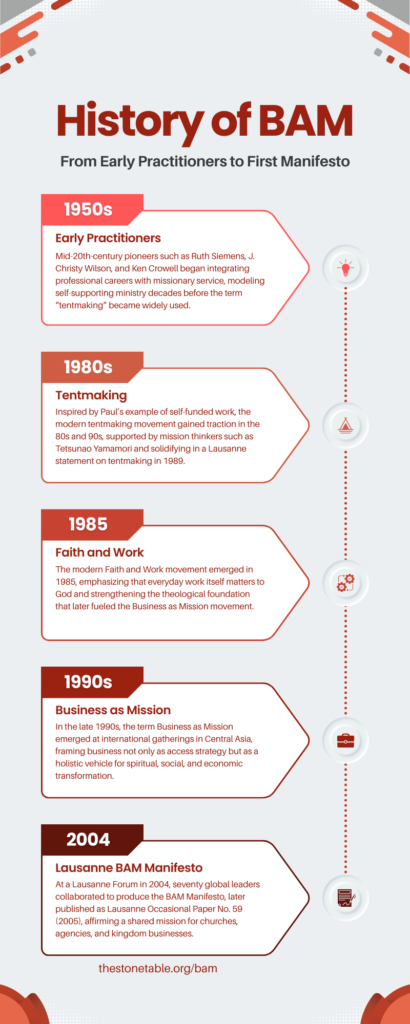
The precursor and original catch-all terminology for BAM, the term “tentmaking” began to gain traction in the 80’s and 90’s as early pioneers were inspired by Paul’s tentmaking model. Charting the Course, Plummer & The Emergence of the BAM Movement, Rundle).
Dr. Steve Rundle catalogs the names of Ruth Seimens, J. Christy Wilson and Ken Crowell in the as the earliest (albeit reluctant) pioneers of tentmaking, originally planning to serve as traditional missionaries, but circumstantially moved to consider the life of Paul (The Emergence of the BAM Movement, Rundle).
These pioneers set out as early as the mid-1900s, decades before tentmaking began to have significant traction in broader mission circles. They saw their work as self-supporting, integrated, and a sacred expression of the business skills that God had given them.
Yet it wasn’t long before this definition of tentmaking was swallowed up by the old way of doing things. Rundle writes,
“This new generation of tentmaker was encouraged to raise donor support (to create a system of accountability and prayer support) and find tentmaking “platforms” that would not require too much time and thus distract them from their ministry goals. For the average Christian, there was no longer much of a difference between a tentmaker and a donor-supported missionary, except that missionaries operated openly in their host country, and tentmakers had to be more discreet about their true purpose for being in the country. Despite some efforts to clarify, and other attempts to defend a more biblical perspective on tentmaking, confusion over the definition and purpose of tentmaking continued to grow” (The Emergence of the BAM Movement, Rundle).
Concurrently, Tentmaking began to gain traction in academia. Dr. Tetsunao ‘Ted’ Yamamori, long-time missions leader, academic, and International Director of Lausanne from 2004-2006, wrote on tentmaking in his 1987 book “God’s New Envoys.” The first Lausanne Statement on tentmaking emerged at the 2nd congress in 1989, and Patrick Lai’s monumental work on the subject was finally published in 2006.
SACRED-SECULAR DIVIDE
As early as tentmaking was considered, the sacred-secular dichotomy was there. Business was viewed with great suspicion, and questions about time management, sources of income, and accountability were at the forefront of everyone’s minds. (The Emergence of the BAM Movement, Rundle)
Modern expressions of the divide were reinforced by twentieth-century moments such as the Scopes Trial, while its intellectual roots reach back to Enlightenment thought, Reformation difficulties, and even earlier philosophical traditions.
Søren Kierkegaard writes, “The Reformation abolished the monasteries; yet, instead of making everyone a monk, it made Christianity easier.” (Attack on Christendom, 1854-1855)
In other words, rather than elevating everything to be sacred, we made most things secular – a mistake that would echo in the missiology of generations to come.
Even on the other side of the world in Korea, BAM was emerging almost entirely separately from the Western concepts. With its own terms such as “Biznary” (combining “business” and “missionary”) there were those in the movement who joked that putting business and missions together was a “devilish idea like the snake in the garden.” It was a great irony that “BAM” in Korean sounded just like “snake” (Charting the Course, Plummer).
FAITH AND WORK
What began in the mid-20th century as a tentmaking movement quickly evolved into something much bigger. By the mid-1980s, the modern Faith and Work movement was taking shape in Western Christendom, emphasizing not only evangelism in the workplace but also the theological conviction that work itself matters to God (God at Work, Miller).
At nearly the same time, largely independent conversations within the emerging Business as Mission movement were reaching similar conclusions. While Faith and Work thinkers articulated the intrinsic value and cultural influence of everyday work, BAM practitioners were demonstrating that business itself could serve as a holistic vehicle for spiritual, social, and economic transformation.
BUSINESS AS MISSION
Concurrently, the late 1990s saw the emergence of the term “Business as Mission” at two conferences in Central Asia. Mark Markiewicz, then National Director of YWAM UK, gave a presentation on two grocers that changed the course of a nation and “affirmed the missional legitimacy of business on those grounds alone.” And other conclusions were made such as:
- The intrinsic value of work
- The holistic potential of BAM beyond mere evangelism
- The refuting of a sacred vs secular dichotomy
- And rhetoric for the clergy-laity hierarchy undermining the diversity of body of Christ in God’s mission in the world
THE BAM MANIFESTO
What began in a corner in Central Asia quickly took shape at the 2004 Forum for World Evangelization in Pattaya, Thailand. Monumentally, Business as Mission was commissioned as issue No. 30 of 31 key issues. 1530 leaders from 130 nations gathered together to address the concerns holding back the evangelization of the nations.
70 of these leaders, missiologists, businesspeople, church leaders, and academics, gathered together to form the Lausanne BAM Manifesto. Their work was published in 2005 as Lausanne Occasional Paper No. 59.
What was their conclusion about BAM? That “churches, mission agencies and kingdom businesses have the same purpose: to bring glory to God’s name among all nations.”
THEN AND NOW
Twenty years ago, around 90 people were involved in the BAM consultation in Pattaya. In 2024, nearly half of the total attendees at Lausanne 4, 2,400 people were interested in a workplace track. (A New Interactive Tool, 2025)
Twenty years ago, there were 10 BAM related books and maybe 20 articles in total. Today there are nearly 1,000 resources on the BAM Resource Center and today there are nearly 200 organizations represented in the BAM Ecosystem Map. (A New Interactive Tool, 2025)
The movement has grown.
The problems are largely the same.
And the conclusion remains.
The language has developed since that first meeting in 2004. When asked about the missiological basis for BAM, we now say more succinctly, it is about,
“The Whole Church, taking the Whole Gospel to the Whole World.” (Three Wholes, Lausanne, 2010)
Download this graphic here.
[This is part 1 of 2 in a “History of BAM” series. Click here for Part 2.]

Jon B
Jon has spent his career as a serial entrepreneur and business consultant both in the US and abroad in missions contexts. From a young age he has worked to marry a calling to missions and gifting for business. He is currently the Director of Transformational Business Development at The Stone Table and Coach Coordinator for OPEN USA.