
Defining BAM: Navigating Terminology in a Decentralized Movement
“What do you mean by Business as Mission?”
It’s not a silly question.
In fact, sometimes it is the only way to start a conversation with someone about BAM. The phrase sounds simple enough. Business. Mission. Put them together and surely we all know what we mean.
Except we don’t.
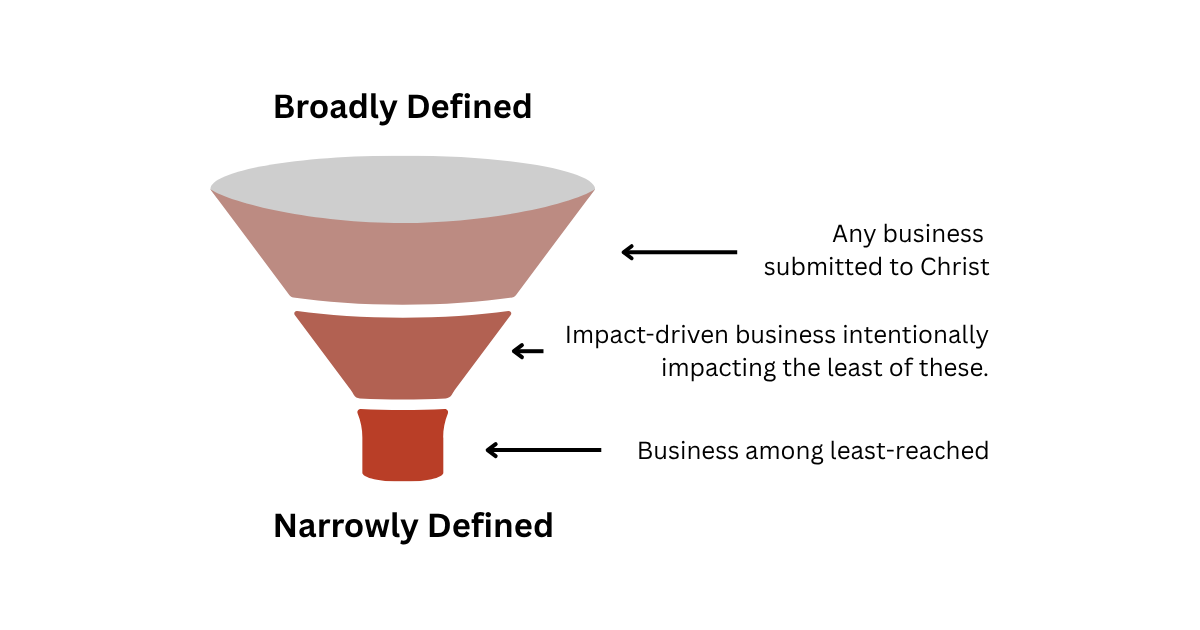
For some, Business as Mission means creating a legitimate business in a restricted-access country so workers can live among people who may otherwise never encounter the gospel. For others, it means equipping local entrepreneurs to build God-honoring companies in their own communities. For some, BAM is closely tied to poverty alleviation, job creation, clean water, microfinance, trafficking prevention, or other forms of social transformation. For others, it includes any company, anywhere, that is intentionally run under the lordship of Christ.
- Some define BAM by location: business among least reached people groups, business in the 10/40 window, or business in economically developing or under-resourced contexts.
- Some define BAM by impact: gospel access, poverty alleviation, job creation, clean water, or lives changed.
- Some define BAM by theological framework: any business intentionally submitted to Christ, any owner claiming to be a Christian, or a business that is run by Christian principles.
To some it is incredibly specific: Real business among UPGs
To others it is incredibly broad: Any business anywhere that is run with Christian values
No wonder the language gets crowded.
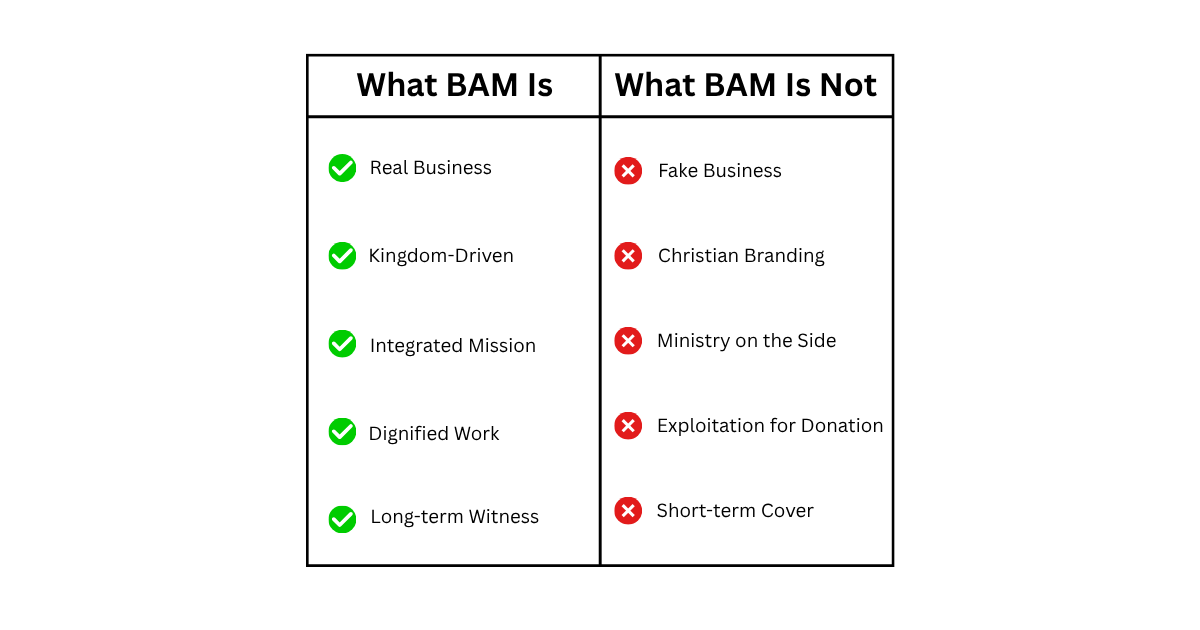
It is for this reason that we developed the following diagram on our website:
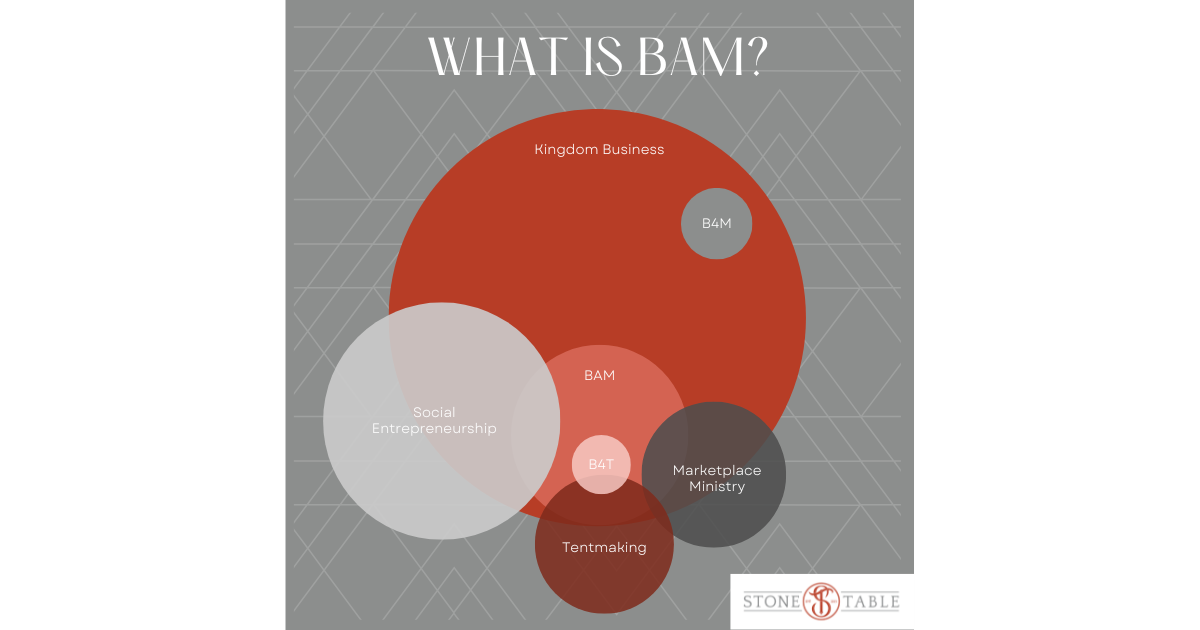
Read the full list of definitions at https://www.thestonetable.org/bam/
But while our Business as Mission page is intended to provide a frame of reference and key definitions on the subject, it is by no means exhaustive.
One Idea. Many Terms.
Business as Mission is not a centralized movement with one headquarters, one credentialing body, and one universally enforced definition (see more on the history of BAM). It is more like a river system: tributaries from frontier missions, tentmaking, entrepreneurship, impact investing, integral mission, theology of work, social enterprise, and economic development have all flowed into the same channel.
Each stream brings its own vocabulary.
That is why you may hear terms like:
- Business as Mission.
- Business as a Mission.
- Business for Transformation.
- Great Commission Companies.
- Missional Enterprise.
- Marketplace Ministry.
- Transformational Business.
- Redemptive Entrepreneurship.
- Business as Integral Calling.
- Tentmaking.
- Faith-Driven Entrepreneurship.
The terms are not random. They came from different streams within the larger movement. Some came from frontier mission strategy. Some came from economic development. Some came from the faith-and-work movement. Some came from entrepreneurs asking what it would mean for Christ to be Lord not only of their private beliefs, but of payroll, product, profit, ownership, and place.
The movement grew, not because of a unified theory from a central body of researchers and experts. Rather, it emerged as entrepreneurs and missionaries around the world responded to real opportunities and real constraints. Many were trying to gain legitimate access to hard places. Others were trying to reform a broken theology that had separated “business” from “ministry.” Still others were trying to reclaim what should have remained central to all believers: that whatever we do, whether in word or deed, can be done to the glory of God. (Colossians 3:17)
It wasn’t until the 2004 Lausanne Forum that a group of believers finally came together to form a common language. Out of this process came the BAM Manifesto, followed later by the BAM Global Think Tank work and their partnership with Lausanne. Together, these efforts have helped establish a widely used definition that can be summarized this way:
“For-profit, sustainable business that intentionally integrates a Kingdom of God purpose, aiming for holistic transformation (economic, social, spiritual, and environmental) with an emphasis on the poor and least-reached populations”
Defined, Redefined, and Misused.
As with all language owned by no one, BAM has been defined, redefined, stretched, and sometimes misused.
First, Business as Mission has inherited some of the same definitional baggage as the word “missions” itself. Denny Spitters and Matthew Ellison make this point in When Everything Is Missions: when the word “missions” expands to include every act of Christian obedience, it becomes harder to name the specific work of crossing cultures to proclaim Christ where he is not known.
BAM faces a similar tension. If every Christian-owned business is BAM, then what do we call the work of moving cross-culturally to build a business among least-reached peoples and vulnerable communities?
Another debated term is business for missions. Even the earliest Lausanne papers agreed that, while generous giving is good, BAM must be more than business for the sake of funding missions. It asks whether the way money is made is itself faithful to Christ. A company cannot mistreat workers, damage communities, exploit creation, or worship profit, and then baptize the whole enterprise by giving a percentage to missions.
And that’s just terminology. There are all sorts of misunderstandings when it comes to the definitions themselves.
One common misunderstanding is that BAM is all about creating fake businesses. In fact, BAM should be about doing excellent business as a witness to the love of Christ shining through us.
On the flip side, others have claimed that BAM rejects the idea of business as a platform for mission because it overemphasizes actually doing business. BAM does not object to business creating legitimate access, credibility, relationships, and long-term presence. In many places, real business opens doors that traditional missionary structures cannot.
In other words, BAM may create access, and BAM may generate resources, but it cannot be reduced to either access or funding. The business itself must become part of the witness.
What We Can Agree On
There are lots of things that perhaps we will never find a consensus on. That’s okay. My mother once wisely told me that “God gave us our differences to show us what love is.”
I’m still marinating in that one.
We have our differences, but there are a few things we can agree on.
First, BAM involves real business. It is not pretend business, decorative business, or a thin religious disguise taped over an unrelated activity. It must create value, serve customers, employ people, manage risk, and operate with integrity in the marketplace.
Second, BAM carries Kingdom purpose. Profit matters, but profit is not the final god. A BAM company asks what it means for Christ to be Lord over ownership, strategy, hiring, culture, product, pricing, partnerships, and long-term impact.
Third, BAM seeks holistic transformation. The movement has often described this through multiple bottom lines: spiritual, economic, social, and environmental. In other words, BAM is not satisfied with a business that makes money while damaging people, exploiting creation, or remaining silent about Christ. Nor is it satisfied with spiritual language that ignores whether the business is actually viable, ethical, or good for the community.
Fourth, BAM tends to lean toward places of greater need. Technically, any business can be offered to God. But historically, BAM has had a particular concern for least-reached peoples, under-resourced markets, marginalized communities, and places where traditional missionary presence may be difficult or impossible.
That is where the tension lives.
Conclusion
Loren Cunningham wrote in “The Book That Transforms Nations” that the people of God are far less diverse than the sum of our denominations. In many cases, new denominations and new definitions are attempts, however imperfect, to recover something important that has been diluted, neglected, or lost. We are fallen humans. We’re good at losing our way.
But the Spirit of God is far better at drawing us back.
Praise be to God.
People will continue to invent new terms. Some will clarify. Some will confuse. Some will be necessary because old words have become too broad to carry their original meaning.
But underneath the vocabulary, something real is happening.
God is stirring entrepreneurs, workers, investors, missionaries, churches, and local believers to recover a truth we should never have lost: business belongs to Christ.
It can create dignified work, open doors for gospel presence, repair broken communities, and display a foretaste of the Kingdom among people and places too often forgotten.
So when someone asks, “What do you mean by Business as Mission?” they are not slowing down the conversation.
They are helping us begin it.

Jon B
Jon has spent his career as a serial entrepreneur and business consultant both in the US and abroad in missions contexts. From a young age he has worked to marry a calling to missions and gifting for business. He is currently the Director of Transformational Business Development at The Stone Table and Coach Coordinator for OPEN USA.