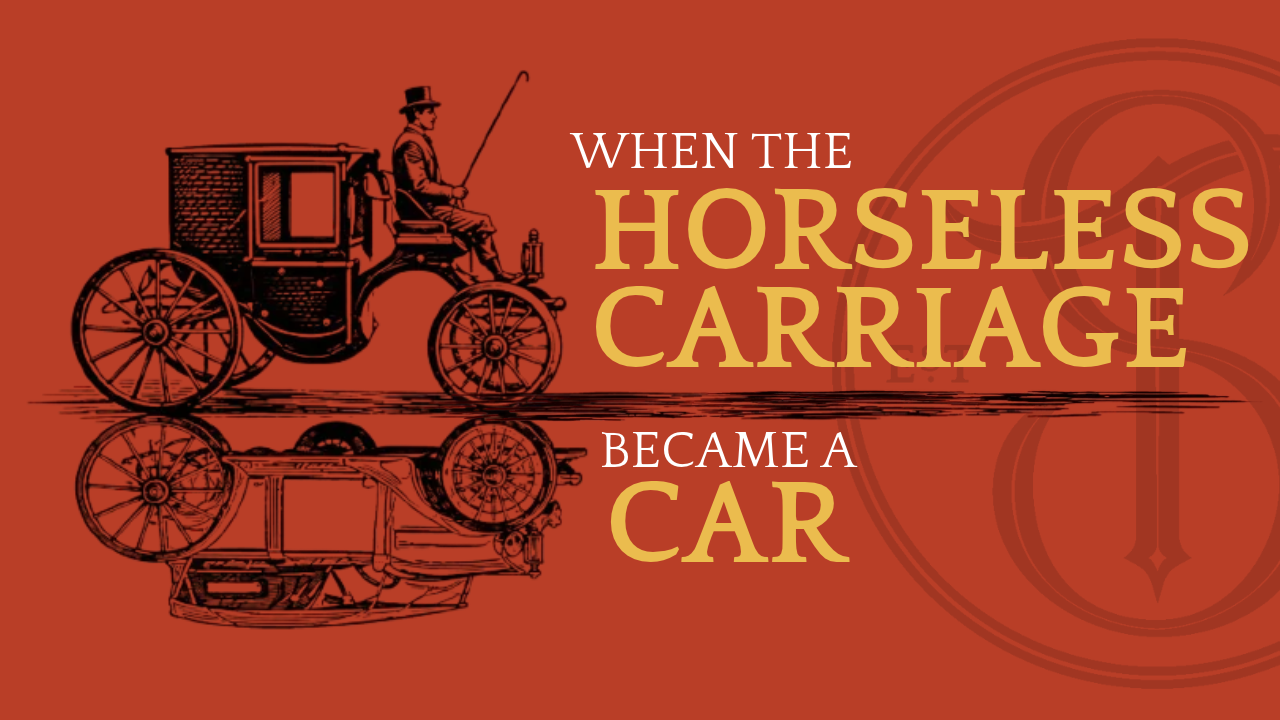
When the Horseless Carriage Became a Car
Four terms, four organizations, and the changing language of Christian business
On Thanksgiving morning in 1895, six strange vehicles lined up in snow-covered Chicago to show the world that the horse’s days were numbered.
The Chicago Times-Herald had organized a race to Evanston and back. Eighty drivers had entered the race, but a reliable Lake Michigan snowstorm had narrowed the lineup to four gasoline-powered and two electric-powered buggies. Only two vehicles would finish the race that day.
But getting these machines down the road was only one of the intrigues of that blizzardy Thanksgiving Day. Another had occupied the newspaper’s readers before the drivers ever reached the starting line.
What were people supposed to call them?
The “horseless carriage” seemed to be an obvious choice. Everyone knew what a carriage was. Take away the horse, put some machinery underneath, and there it stood. The name gave people a familiar history to begin with, even as the invention threatened to change what familiar looked like.
Other names were circulating too. Motor carriage. Automobile. Motorcar. But the Times-Herald decided the question deserved a competition of its own. It invited readers to submit names for a grand prize of five hundred dollars.
The award was given to “Motocycle,” a clever name for sure, but one that history would soon forget. As it turns out, vocabulary cannot be bought.
Over time, “horseless carriage” began to sound like a description from another world. People who had grown up with automobiles hardly needed to be told what was missing from the front. They simply got into the car.
What’s in a Name?
There is another history being written today that feels oddly reminiscent of this – that of the world of Christian business. It may be far less known, but I believe for those of us who spend our time within it, the implications are huge.
Nearly a century after that pivotal race in Chicago, believers in the business world were asking a similar question. What do we call this new machine in the mission world – this intersection of faith and work, business and mission?
It wasn’t long before business as mission became the dominant terminology, though there were many other contenders.
But I think there may be a deeper question at play in the BAM movement, one that also unfolded in the early days of the horseless carriage.
It made sense to call it horseless when everyone knew the carriage, and it makes sense to call it business as mission when everyone knows what those two things are, but what happens when a generation is born and raised that no longer struggles with the separation of those categories? What happens when you introduce a category of people who may dislike the idea of calling things missions – not because they are anti-mission but rather because they believe that everything they do should be missional?
Will Gen Z Call It BAM?
I believe that future generations will approach this vocabulary differently. In 2025, Deloitte ran a survey that found that 89 percent of Gen Z respondents considered purpose important to their job satisfaction and well-being. Many young adults already expect their work to connect with their values and contribute to something meaningful.
Here at The Stone Table, we are increasingly talking to young people who say they care much less about their earning potential or career advancement. More and more, their priorities have shifted toward the purpose and meaning that an employer can offer them.
This begs the question: will younger Christian entrepreneurs need the same language their predecessors needed to bring business and mission together? Or will it be a given? What one generation experienced as a breakthrough, another may receive as a starting assumption. Perhaps “business as mission” will feel odd. Or maybe younger generations will feel that any term makes too much of what our natural posture should be as a Christian in the business world.
There is another reason to pay attention to the language. Barna’s research on missions terminology found that young Christians who objected to certain expressions were not necessarily withdrawing from missions. Some had more personal experience with missionaries and international mission trips than those who had no such objections. Their discomfort with the words could coexist with a willingness to participate in the work.
And even Mats Tunehag, the chairman of BAM Global and a leading expert on Business as Mission, has said, “BAM is like a scaffolding that you’ve needed as you build a new paradigm. Once the new paradigm is built, you take away the scaffolding… my dream is that we can eventually take all the scaffolding down.”
These trends should cause us to lean in with curiosity. Perhaps a young entrepreneur who hesitates at “missions” will begin a conversation about “redemptive entrepreneurship” or “transformational business.” Perhaps another will discover through a faith-driven community the very calling that an earlier generation found through BAM.
We do not yet know which words they will carry forward, but we can watch and learn to communicate on equal footing.
The language is far less important than the ideas behind it. The question for mission agencies and Christian businesspeople alike is not “which term will prevail” so much as “how will we communicate with the next generation?”
In the words of Larry Sharp, a wise forerunner in business as mission movement, “You can call it missionary work or marketplace evangelism—or you can just call it what Jesus told us to do.”
The Communities Behind the Words
But the story goes beyond terminology.
I have written previously about the convergence of the BAM and faith-and-work movements and the vocabulary that has emerged around them: Faith Driven Entrepreneurship, Redemptive Entrepreneurship, Business for Transformation, and Business as Mission.
These terms do not exist in a vacuum. Behind the words are communities, and behind those communities are organizations that have helped steward both the language and the movements themselves.
BAM Global – Business as Mission
I have speculated about the endurance of the term ‘Business as Mission’ among young people, but whatever happens to the terminology, the impact of BAM Global and businessasmission.com over the past decade is unmistakable. Behind them is a movement that continues to grow.
Founded in 2014 by Mats Tunehag and Jo Plummer, and later joined in leadership by João Mordomo, BAM Global’s consultations and research have shaped a widely shared understanding of Business as Mission: real, profitable businesses pursuing Kingdom purpose through spiritual, economic, social, and environmental transformation.
Today, this definition is used by Lausanne in addition to the BAM Global Partner Networks.
Together with businessasmission.com, a resource hosting website, BAM Global has developed over 35 research reports, 25 regional networks, 800 members on a secure online platform, BGlobal, and multiple annual events hosting 550 attendees in 2024. Businessasmission.com is also home to over 950 resources and the recent BAM Ecosystem Map developed in partnership with The Stone Table.
OPEN – Business for Transformation
In contrast, OPEN brings that gospel access focus into sharper view, all the while making the distinct decision to shed traditional missions language. Pioneered by Patrick Lai in 1999, its network includes over 350 members doing business or taking jobs as expats in the unreached world.
Today the OPEN Network is largely responsible for convening those in the Business for Transformation movement. OPEN itself describes this movement as profitable businesses among least-reached peoples with explicit goals of evangelism, church planting, and discipleship.
Its network and affiliates are unique in their emphasis on expat resources alone. Where BAM Global commonly emphasizes a quadruple bottom line, OPEN describes a double bottom line of economic and spiritual transformation.
That specificity gives practitioners a community of people who understand both the demands of running a real business in a cross-cultural context and the assignment of God that led them into what is often for them a much more challenging context than their home country.
Praxis — Redemptive Entrepreneurship
Founded in 2011 by Dave Blanchard and Josh Kwan, Praxis is a Christian venture-building organization advancing what it calls Redemptive Entrepreneurship.
Today, Praxis reports 303 active business and nonprofit ventures operating in 113 countries, providing more than 15,000 jobs and generating $897 million in annual revenue.
Through its Local Ecosystem initiative, Praxis has also trained 271 leaders in 35 countries, held 75 labs, and placed more than $190 million in capital into ventures.
But Redemptive Entrepreneurship goes beyond the Praxis Incubator. What makes the terminology scale to a movement is the thought leadership behind it – the curated list of Opportunities for Redemptive Imagination, Redemptive Playbooks, and newly minted Praxis course.
Faith Driven Entrepreneur — Faith Driven Entrepreneurship
Emerging in 2018 with the launch of the Faith Driven Entrepreneur podcast, the movement grew out of the work of Henry Kaestner, William Norvell, Rusty Rueff, Justin Forman, and others and has since developed into a much broader global movement.
Primarily a network and content creator providing courses, community, conferences, and other resources, Faith Driven Entrepreneur now reports a community of more than 100,000 entrepreneurs across 130 countries, while its Foundation Course has been used by more than 30,000 entrepreneurs from 130+ countries.
Together with its Entrepreneur, Investor, Student, and other initiatives, Faith Driven has developed one of the largest global networks at the intersection of Christian faith and entrepreneurship.
Beyond the Labels
Put these four communities beside one another and something important becomes clear: their words overlap, but they are not interchangeable.
An entrepreneur might first discover that business belongs to God through Faith Driven Entrepreneur, encounter Praxis and begin rethinking how the business itself could become more redemptive, find BAM Global while exploring the broader theology and practice of business as mission, and eventually join OPEN while taking that business to a least-reached people.
The circles overlap because the people increasingly do too.
And perhaps that is where the next generation changes the conversation.
Young Christian entrepreneurs may move between these communities far more naturally than the generations that built them. They may borrow language from one and practices from another. Some may embrace BAM enthusiastically. Others may never use the term at all.
The important question is not whether they inherit our vocabulary, but whether they inherit the conviction beneath it: that business belongs to God, can participate in His redemptive work, and can help carry the gospel into every nation, tribe, and tongue.
That is why Mats Tunehag’s image of scaffolding is so helpful. Scaffolding is not unimportant. Quite the opposite. You erect it because you are building something you could not build without it.
If a generation eventually finds it strange that we needed so many terms to explain why business could belong wholly to God, that would not necessarily mean these movements failed.
It might mean the scaffolding did its job.
It might mean the horseless carriage finally became a car

Jon B
Jon is an entrepreneur and business coach serving as Director of Transformational Business Development at The Stone Table and Coach Coordinator for OPEN USA. His experience spans business ownership and consulting in the United States and overseas missions contexts. He also serves as Ecosystem Director at EquipKing, a BAM incubator in Central Asia, and he is the primary architect behind the BAM Ecosystem Map.