
Connecting the Rails: The Convergence of Faith, Work, and the BAM Movement
In 1863, two railroad companies began building toward one another across the United States.
From Sacramento, the Central Pacific pushed east into the Sierra Nevada. From Omaha, the Union Pacific pushed west across the Great Plains.
They were not the same company. They had different leaders, different workforces, different terrain, and very different problems to solve.
But both had been authorized to accomplish the same enormous project: connect the continent by rail.
By 1869, the two companies were approaching one another in Utah.
There was just one problem.
They didn’t stop.
Federal subsidies rewarded progress, and each company had an incentive to build farther than the other. Their crews eventually passed one another, grading competing roadbeds that sometimes ran within sight of each other for miles. Congress finally intervened and designated Promontory Summit as the place where the two lines would meet.
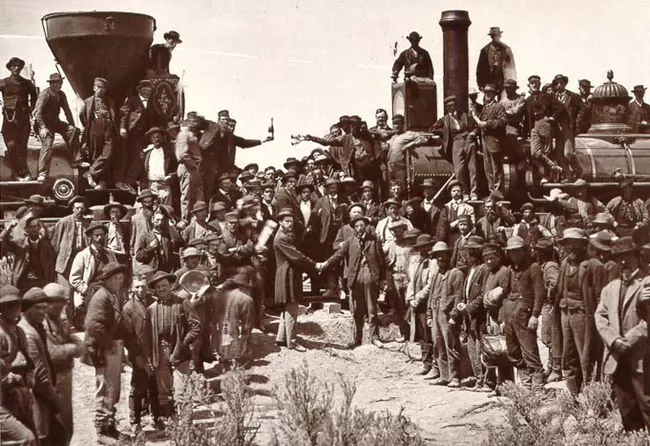
Andrew J. Russell’s “East and West Shaking Hands at Laying of Last Rail.”
On May 10, 1869, the final rails were joined.
The Golden Spike did not merge the Central Pacific and Union Pacific into one company. They remained distinct organizations, with distinct identities and interests.
But their rails had connected.
Together they created something larger than either railroad alone: a transcontinental network.
Two Movements, Same Divide
Something remarkably similar has been happening in Christian business.
For roughly a generation, two movements have been laying track toward one another.
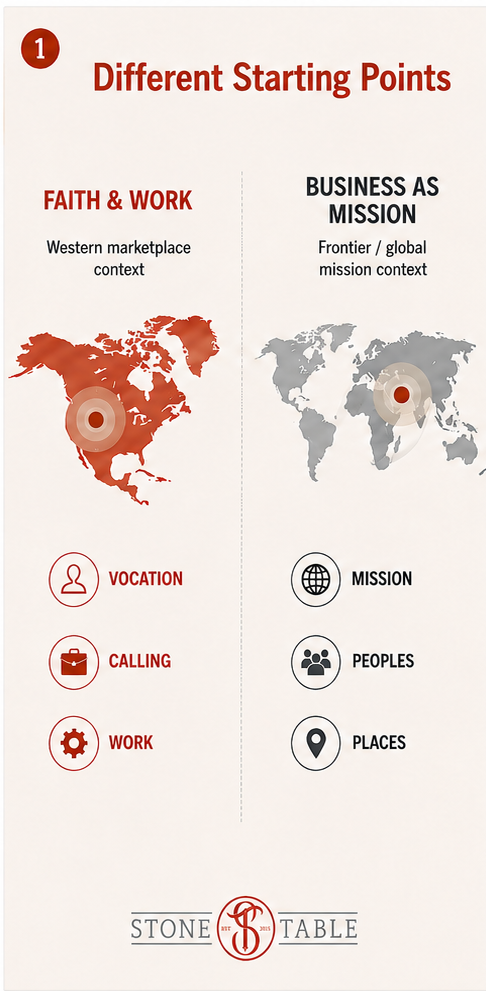
On one side, the frontier missions world gave birth to the modern Business as Mission movement. Missionaries and mission leaders began asking how real business could create sustainable presence, make disciples, plant churches, create dignified work, and contribute to transformation where Christ was least known.
On the other side, another movement was gathering momentum.
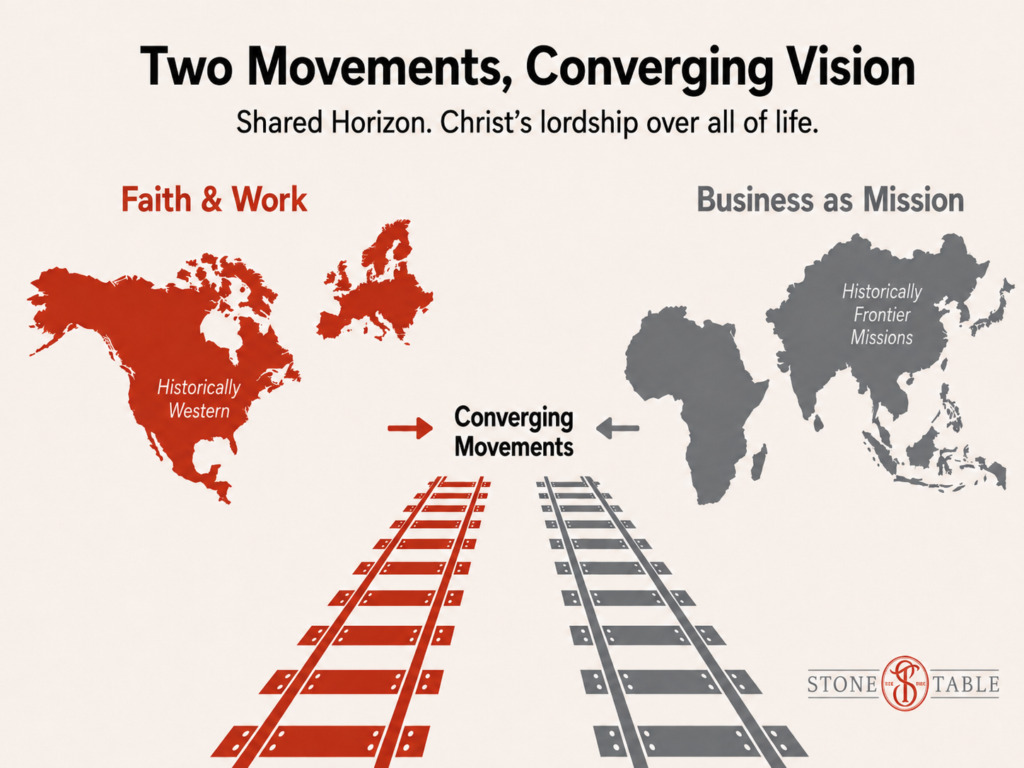
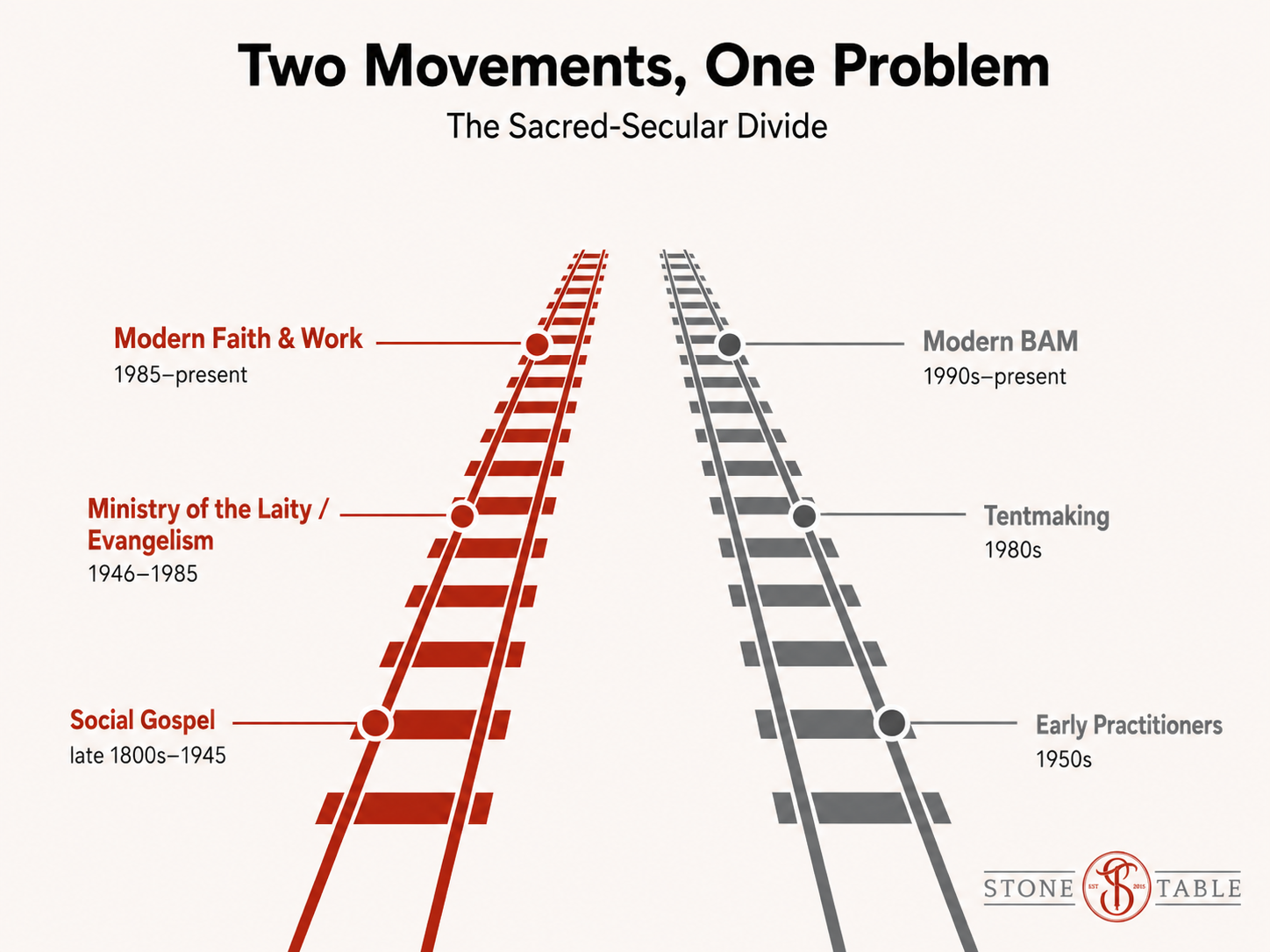
Its roots reached much further back. Historian David W. Miller traces the modern Faith at Work movement through three waves. The Social Gospel era of the late nineteenth and early twentieth centuries asked how Christian faith should shape society and economic life. After World War II, a “Ministry of the Laity” movement recovered the conviction that ordinary Christians were not merely supporters of ministry but ministers themselves, called to serve God in the factories, offices, professions, and institutions where they spent their lives.
But by the mid-1980s, something changed.
Miller identifies roughly 1985 as the beginning of a distinct Faith at Work era. Increasingly, the energy was coming not from churches or seminaries but from Christians in the marketplace themselves. Executives, entrepreneurs, professionals, and workers began forming networks, workplace fellowships, conferences, ministries, and publications devoted to closing the gap between Sunday faith and Monday work. The question was becoming larger than, “How can a layperson minister at work?” It was becoming, “What does it mean for the work itself to come under the lordship of Christ?”
Through the 1990s and 2000s, that conversation expanded from workplace evangelism and ethics into calling, leadership, organizational culture, entrepreneurship, investing, human flourishing, and the purpose of business itself. Churches and universities increasingly entered the conversation, but much of the movement continued to develop through networks and institutions created by marketplace practitioners.
At almost exactly the same moment in history, another conversation was emerging far beyond traditional American headlines.
By the late 1990s, missionaries, tentmakers, mission agencies, and entrepreneurs were wrestling with a parallel question: How can business, under the lordship of Christ, actually become a vehicle for ministry?
The emerging Business as Mission (BAM) movement began intentionally joining two words Christians had often worked hard to keep apart. By the 2004 Lausanne BAM consultation, more than seventy participants from business, church, missions, education, theology, law, and research were working toward a shared framework for the movement.
BAM began with mission and discovered the importance of business.
Faith and work began with vocation and discipleship and increasingly discovered the missional significance of business.
They had different origins, different vocabulary, and different institutions, but both were laying track across the same theological landscape: the sacred-secular divide.
The Convergence of Vision
Both movements started with different horizons in view, but they were headed toward the same goal. If Christ is Lord over all of life (Colossians 1:20), then business cannot be spiritually neutral.
Business is no longer a necessary evil or simply a vehicle for donations or access. It is itself a means for ministry when submitted to the lordship of Christ. It is no longer a day job that I compartmentalize my secular life to, all the while doing my “real” ministry on Sunday at church. Products, employees, customers, capital, culture, profit, geography, and ambition all come under his lordship.
And if mission belongs first to God rather than to a missionary or an agency or my pastor or priest, then the everyday work of God’s people must somehow participate in what God is doing in the world.
That is where these movements increasingly meet.
And the convergence is already visible. Networks such as Faith Driven, Praxis, and City to City have increasingly pushed their constituencies to think globally, while BAM leaders are borrowing more freely from the language of vocation, redemptive entrepreneurship, and culture making. Faith Driven has taken 20,000 entrepreneurs through their programs in over 140 countries. Praxis has accelerated ventures in 113 countries, and Tim Keller’s City to City Network has expanded to over 26 countries around the globe. Increasingly, their networks are moving from a primarily Western constituency to a global audience.
As Western believers are transformed by faith and work thinking, increasingly they are franchising their companies into unreached areas, investing in emerging faith driven entrepreneurs, coaching, offshoring, mentoring, and expanding into multinational offices to impact the nations.
On the other hand, BAM practitioners are being transformed by redemptive and faith driven language. They are beginning to think more about engaging with the whole person, moving beyond evangelism and church planting only and into the questions of poverty, joblessness, human trafficking, discipleship, and the witness that is born out of positive environmental impact.
BAM has matured beyond the idea that business is merely a visa platform or a clever vehicle for “real ministry.” The business itself matters. Is the product good? Are employees flourishing? Are customers genuinely served? Is the company economically sound? Would it still be worth building if it did not solve an access problem?
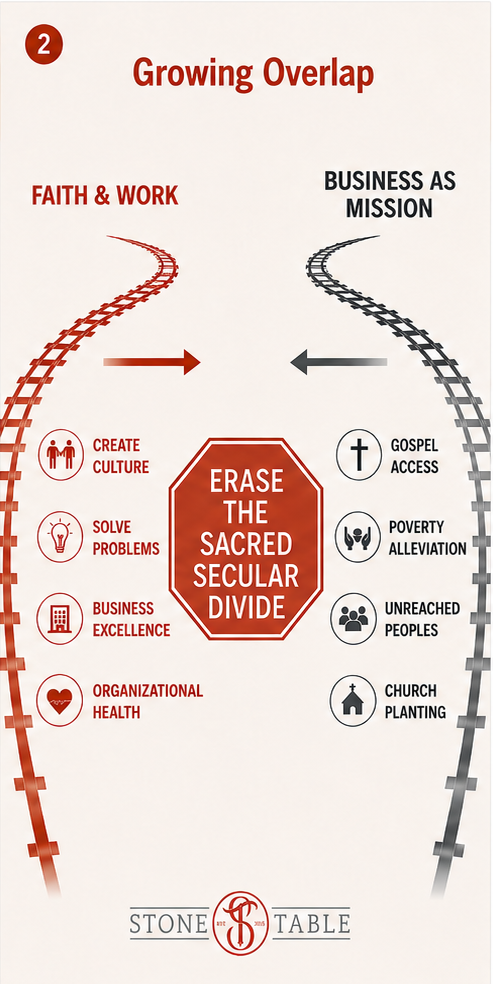
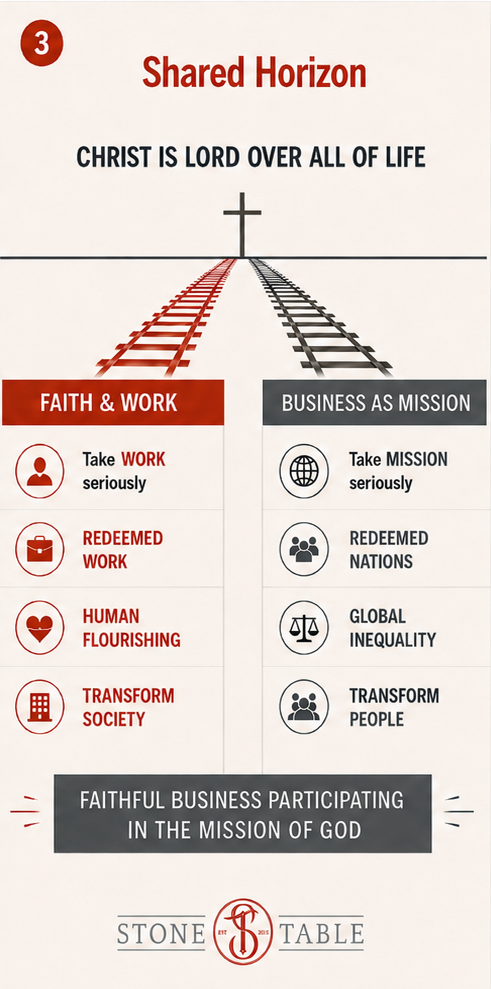
Faith and work reminds BAM to take business itself seriously. A company is not merely transportation to some more spiritual destination. Creating something genuinely good, serving customers, building healthy organizations, stewarding capital, and cultivating human flourishing are themselves part of faithful Christian work.
BAM reminds the faith and work world to look outward. Faithful work cannot terminate in personal fulfillment, ethical management, or a healthier corporate culture. The mission of God has a geography. There are still peoples and places where Christ is barely known.
One movement keeps asking us to take the mission of God seriously.
The other keeps asking us to take the work God has given us seriously.
We need both.
Toward a Shared Horizon
That brings us back to Utah.
As the Central Pacific and Union Pacific approached one another, they became so focused on extending their own railroad that they literally built past each other.
Movements can do the same thing.
We build institutions around the vocabulary we know. We attend our own conferences, publish our own books, create our own networks, and sometimes discover that another group of Christians has been crossing the same territory with different language.
The answer is not to flatten the distinctions.
At Promontory, the two railroad companies did not become one. Nobody had to surrender its history, identity, or expertise.
They simply connected the rails.
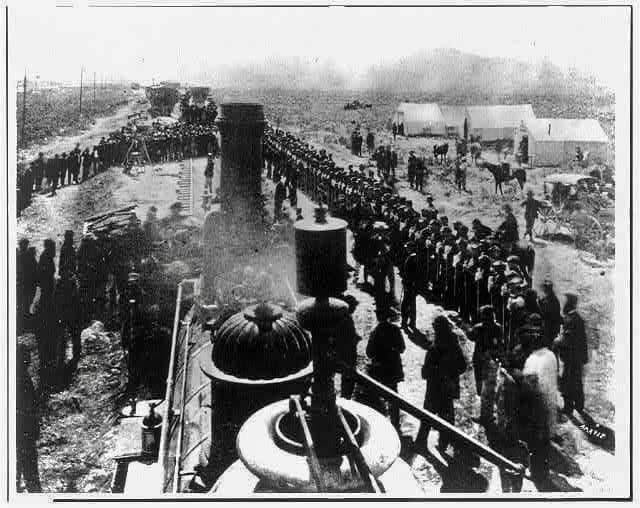
Ceremony at “wedding of the rails,” May 10, 1869 at Promontory Point, Utah. Library of Congress.

Jon B
Jon has spent his career as a serial entrepreneur and business consultant both in the US and abroad in missions contexts. From a young age he has worked to marry a calling to missions and gifting for business. He is currently the Director of Transformational Business Development at The Stone Table and Coach Coordinator for OPEN USA.