

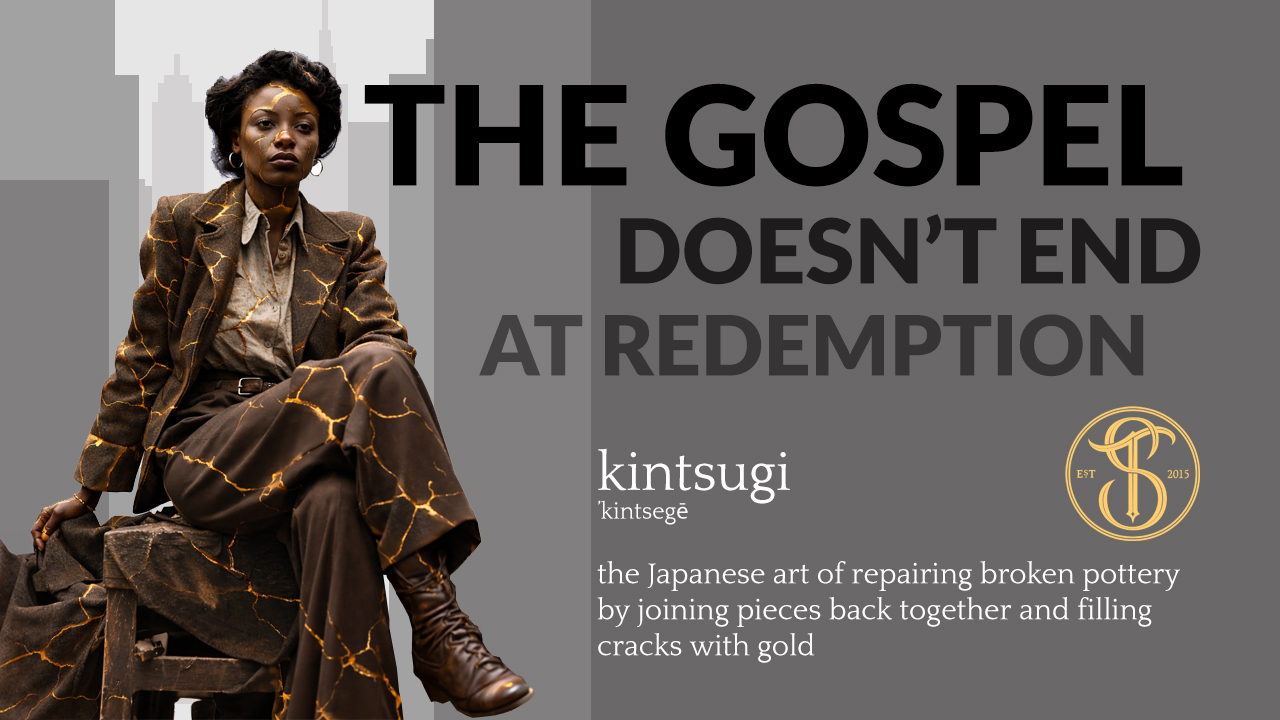
The Gospel Doesn’t End at Redemption
This is a continuation from The Scopes Trial and the Birth of a Divide
The Scopes Trial Revisited
In 1925, a courtroom in a small Tennessee town drew the attention of the entire country.
John Scopes had been accused of violating state law by teaching evolution. What could have remained a local legal matter quickly expanded into something much larger. Reporters flooded in. Prominent voices joined the case. The proceedings were followed far beyond the town itself.
Newspapers, radio, and public opinion framed the spectacle as a battle between two distinct worlds. Enlightened science versus dogmatic faith. Urban progress versus rural religion. What happened in that courtroom didn’t just resolve a legal question. It created a narrative that would shape how Americans understood the relationship between faith and the world for generations.
And that narrative stuck.
Over time, the categories began to independently fossilize. Faith was increasingly treated as something private and internal. Personal belief. Church activity. Moral formation. Meanwhile, education, business, science, and culture were treated as operating under a different set of rules.
Two domains.
Sacred and secular.
The trial didn’t invent that divide. But it gave it language. Visibility. Momentum.
And for the last hundred years, much of American Christianity has unfortunately been living inside of that framework.
The Real Problem: We Don’t Understand the Full Story
The deeper issue isn’t what happened in Dayton.
It’s how we understand the story we have been given.
Because the sacred-secular divide doesn’t ultimately come from culture. It grows out of a thin understanding of the biblical narrative. Not that we reject it. Not that we ignore it. But that we often carry an incomplete version of it into how we live.
We tend to tell the story like this. 1) God creates. 2) Humanity falls. 3) Jesus saves. And now we wait.
Wait for heaven.
Wait for rescue.
Wait for the end.
So we begin to organize our lives around what feels most spiritual. Church attendance. Devotional rhythms. Evangelism moments. And everything else becomes…secondary. Necessary, but definitely not sacred.
That framework shapes how we live.
Even when we do not realize it.
Because what we believe about the story determines how we interpret our place in it. And if the story ends at redemption, then most of life will feel disconnected from what God is doing.
We do not forget the story. We misunderstand where we are in it.
The Great Story
Scripture tells a bigger story than three acts.
Four acts: creation, fall, redemption, and restoration.
In the beginning, God creates a world that is fully integrated. There is no divide between sacred and secular because God is present in all of it. Humanity is given work before sin ever enters the picture. To cultivate. To build. To steward. Genesis 1:31 tells us that God saw everything He had made, and it was very good. And in Genesis 2:15, humanity is placed in the garden to work it and take care of it. Work is not a result of the fall. It is part of the design.
All of life was whole.
Then sin enters, and everything fractures. Genesis 3 does not just describe a spiritual separation from God. It shows the unraveling of everything. Work becomes painful. Relationships become strained. Even the ground is described as cursed. What was once integrated becomes disordered. But the world is not discarded. It is broken.
Fractured, not forsaken.
Redemption enters through Jesus. In Luke 4:18–19, Jesus announces His mission to proclaim good news to the poor, freedom for the captives, and recovery of sight for the blind. In Colossians 1:13–14, we are told that we have been rescued from the dominion of darkness and brought into the kingdom of the Son. Through His life, death, and resurrection, reconciliation with God becomes possible.
But redemption is not the end of the story.
It is the turning point.
The story has always been moving toward restoration. Acts 3:21 speaks of a future restoration of all things. Romans 8:19–21 describes creation itself waiting to be liberated from its bondage to decay. And in Revelation 21:5, God declares that He is making all things new.
Not escape.
Not replacement.
Restoration.
The Theology of Restoration
This is where many of us stop short. We have a clear theology of salvation, but a limited understanding of what comes after. We know how someone is reconciled to God, but we are less certain about what God intends to do with the world itself. Scripture, however, does not leave that ambiguous. It consistently points forward.
In Acts 3, Peter speaks of the restoration of all things. In Romans 8, Paul describes creation groaning, waiting to be set free from its bondage to decay. In Colossians 1, Christ is reconciling all things to Himself. And in Revelation 21, God declares that He is making all things new.
Not all new things.
All things new.
That distinction matters. Because it means God is not abandoning His creation. He is renewing it. Not discarding what is broken, but restoring it. The future is not an escape from the world, but the redemption of it.
Restoration is the destination.
Why This Breaks the Divide
If God is restoring all things, then all things fall within His concern. That includes the parts of life we have been tempted to label as secular. Work. Business. Education. Culture. Systems. Institutions. These are not neutral spaces operating outside of God’s purposes. They are arenas where the effects of the fall are present, and therefore where restoration is needed.
Nothing sits outside the story.
The sacred-secular divide only works if there are areas of life that fall beyond God’s redemptive plan. But scripture consistently refuses to give us that category. When Moses encounters God in Exodus 3, he is not in a temple. He is in the wilderness, tending sheep. And God tells him to take off his sandals because the ground beneath him is holy.
Ordinary ground becomes holy.
Because God is present.
(Pause and reread that)
Living in the Restoration Stage
This changes how we understand our role. We are not simply recipients of salvation waiting for a future reality. We are participants in what God is doing now. Paul writes in 2 Corinthians 5:11-21 that we have been given the ministry of reconciliation. That God is making His appeal through us. This is not a narrow assignment reserved for vocational ministry. It is a comprehensive calling that touches every follower and every part of life.
You are not on the sidelines.
You are in the story…and that should change perspective on everything.
It means your work is not just about productivity or provision. It is a place where broken things can be made whole. Your relationships are not random interactions. They are opportunities for reconciliation. Every single solitary environment – school, work, home gas station, bank, Target – you step into each day is not spiritually neutral. They are spaces where the presence and purposes of God can be made visible.
You carry restoration with you.
A Personal Realization
It is easy to default back into a divided life. At least it is for me. The three act approach to the Gospel was a big part of my early spiritual formation. To think that ministry happens when we open our Bible or engage in something explicitly spiritual, and that the rest of our day operates on a different plane. That way of thinking is subtle for me, but it is deeply formative. It shapes how I prioritize, how I measure impact, and how I understand purpose.
The tension is real.
What began to shift for me was not my environment, but my awareness of act 4 – restoration. The realization that I was not stepping into and out of God’s work throughout the day. I was either paying attention to it or I was not.
The story did not change.
My understanding of it did.
The Divide Was Never the Point
The Scopes Trial exposed a divide that many of us have inherited, but it was never meant to define how we see the world. Scripture gives us a different framework. A story where God creates, where sin fractures, where Christ redeems, and where all things are being restored. That story does not leave room for a permanent separation between sacred and secular.
We are not living between two worlds.
We are living in one story.
And that story is moving somewhere. Toward renewal. Toward reconciliation. Toward restoration. The question is no longer whether God is involved in the world around us. The question is whether we recognize how comprehensive His work actually is.
The divide ends when the full Gospel is embraced.

Bill Tibbetts
Bill Tibbetts is the Vice President of Education and Multiplication at The Stone Table, bringing over two decades of experience in higher education to his role. As the former Dean of the College of Business and Technology at North Central University, he developed a deep passion for mentoring, missions, and business consulting. Bill's extensive expertise uniquely positions him to lead initiatives that encourage marketplace believers and college students to actively engage with the Great Commission. He also serves on the board of the Community Reinvestment Foundation and is based in Minneapolis, MN, supporting The Stone Table's expansion into new regions.