

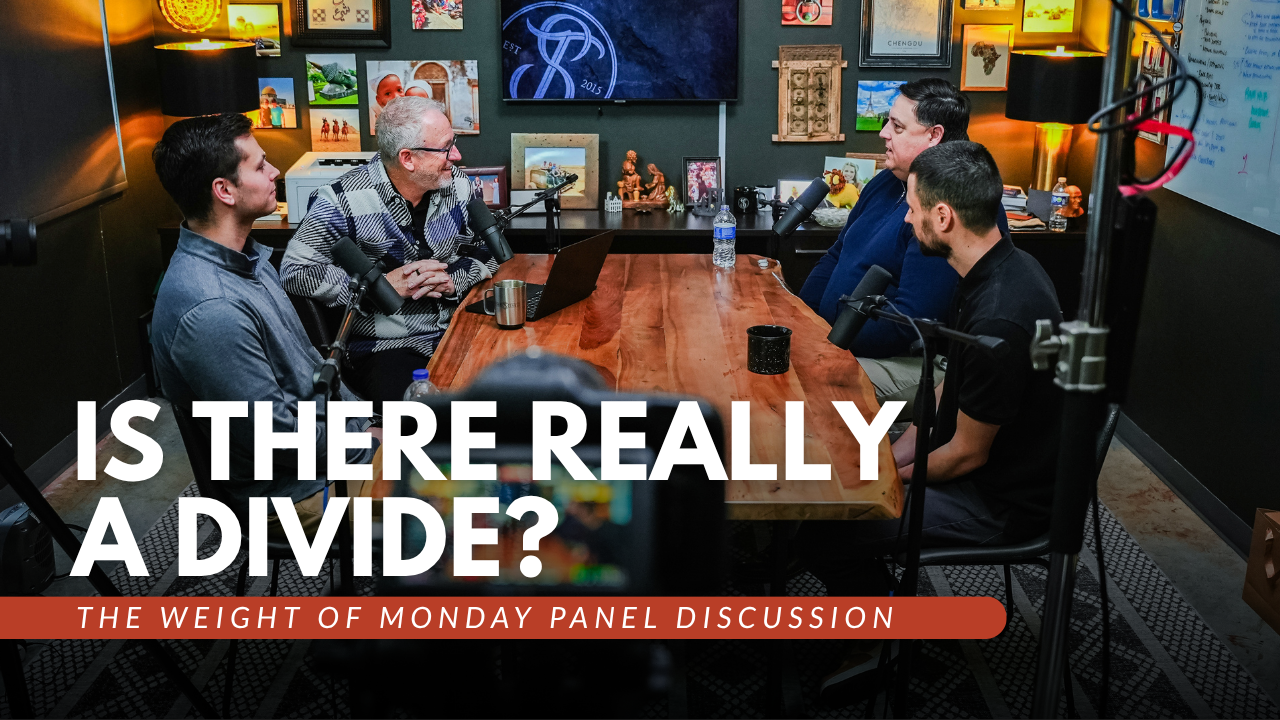
The Weight of Monday | Panel Discussion
The Lie Most Christians Believe About Their Work
Here is a quiet assumption that has shaped an entire generation of Christians: that God is present in the sanctuary and mostly absent in the office.
Nobody says it out loud. Nobody preaches it. But somewhere between Sunday morning and Monday morning, millions of believers walk into their workplaces feeling like they have left sacred ground and entered secular territory.
That assumption is wrong, and it may be costing you more than you realize.
At a recent Christian Business Breakfast hosted by The Stone Table, three marketplace believers sat down to unpack what the Bible actually teaches about work, calling, and the so-called sacred-secular divide. What they said is worth hearing.
Where the Divide Comes From
Steve Allison, a business owner and business pastor, traced the origin of the divide to something most people would not expect: the separation of church and state.
“I think that turned into the separation of life outside the church versus life inside the church,” Steve said. “And that naturally created a divide.”
Josh Chitwood, filmmaker and co-owner of Chitwood Media, put it another way: the sacred-secular divide functions as fuel for a culture-war mentality. It limits where we allow ourselves to see God’s fingerprints.
“We only see him moving in explicitly Christian, church-adjacent spaces,” Trent said. “But in reality, the Great Commission cannot be fulfilled unless it is truly in all spaces of life.”
Neither of them was taught this divide explicitly. They absorbed it. Erik Cooper, founder of The Stone Table, has a phrase for that: assumed theology. It was never declared. It was just… expected.
The Real Cost of the Assumed Theology
When work feels disconnected from God, something breaks down.
Trent Urhammer, a CPA at one of the Big Four accounting firms, says it happens mid-spreadsheet. “You’re working on something, you’ve spent so many hours on it, and you start to feel frustrated. You forget that this task has a purpose, not only to the marketplace itself, but how completing it with excellence actually has a relational impact.”
For Steve, it happens when things are going well. “I have this tendency to rely on God until I get to a certain point, and then I’m like, okay, I’ve got it from here. Things get rolling, ego gets a little puffed, and you think you know what you’re doing.”
The divide does not just affect how we feel about work. It affects how we work. When we believe our daily tasks are spiritually irrelevant, we lose the very motivation that makes us effective, excellent, and truly human.
What the Bible Actually Teaches About Work
Josh never wrestled with this question the same way. For him, the connection has always been instinctive.
“The very first thing we learn about God is that he was creative,” Josh said. “Being image bearers, created in his image, we were created to create.”
This is the Imago Dei applied to your Monday morning. Being made in the image of a working, creating, sustaining God means that your work, whatever it is, participates in something sacred.
The Hebrew word for this is avodah, which the Old Testament uses interchangeably for worship, work, and service. The ancient writers did not draw a line between the three. The divide we inherited is not a biblical concept. It is a cultural one.
Martin Luther understood this. His famous quote captures it plainly: “God is milking the cows through the vocation of the milkmaid.” God is present and active in the ordinary work of ordinary people. Not just in the pulpit. Not just on the mission field.
In yours.
You Are the Mobile Unit of God’s Presence
Trent offered one of the most memorable images of the conversation: the shift from a wall phone to a cell phone.
“Before the resurrection, the presence of God was fixed to the temple. It was stuck to the wall,” Erik Cooper reflected. “But the resurrection of Jesus and the coming of the Spirit changed everything. Now the temple resides in us. We are the mobile units of God’s presence.”
This is not a metaphor. This is theology with a Monday morning application.
When you walk into your office, onto your job site, or into a client meeting, you carry the presence of God with you. That changes the stakes. It changes what “showing up to work” actually means. The temple does not stay home when you go to the office. It goes with you.
Steve put it simply: “God doesn’t care about your job. He cares about you. He cares about everybody you come in contact with, regardless of what it is you’re doing.”
Calling Is Not What You Think It Is
One of the most damaging ideas circulating in the church is that “calling” belongs to pastors and missionaries.
At church camp, the altar calls were for people being called into vocational ministry. The rest of the students sat in their seats and quietly wondered if God had anything for them at all.
He does.
Here is a word worth knowing: vocation. It is the word we use to describe what we do for a living. Its root is the Latin vocare, which means calling. The church did not invent a separate category for sacred workers and then call it vocation. The word itself carries a theological claim: all legitimate work is a calling.
“All of us as believers have the same calling,” Erik said. “If you are in Christ, you are called. We all have different assignments within that one calling, but you are called.”
The farmer. The filmmaker. The auditor. The entrepreneur. You are not funding the ministry while someone else does the real kingdom work. You are the ministry.
How to Start Living This Out
Josh offered a practical starting point for anyone who struggles to see God in their work: look for his fingerprints.
“The more I’ve trained myself to be sensitive to the Holy Spirit and to see where God’s fingerprints already are, that’s where I’ve found purpose in my work,” Josh said. “Look for God’s fingerprints.”
That practice changes everything. Not because your job title changes, but because your eyes do.
You are not a CPA who also happens to be a Christian. You are the mobile unit of God’s presence, temporarily housed in a Big Four accounting firm, touching families who are becoming first-time homeowners, businesses that are employing people, a coworker who is going to show up at a church basketball game because you invited him.
That is kingdom work. And it is happening through your ordinary job.
Start Here
If you are wrestling with how your faith connects to your everyday work, we created something to help. Head to thestonetable.org/start for a free five-day devotional designed to help you make that connection practically and biblically.
Your work matters to God. Not just your Sunday. All of it.
Full Transcript
Erik: We just finished our Christian Business Breakfast, our first quarter CBB on the Sacred-Secular Divide. We’ve got three friends here and we’re going to unpack it through the lens of your own lives. First, I want each of you to introduce yourself and tell us what you do every day in the marketplace. We’ll start right here.
Trent: My name is Trent Urhammer. I’m a public accountant, a CPA at one of the Big Four accounting firms. My actual title is Auditor. So we’re talking spreadsheets today. That is my bread and butter.
Erik: You just ended busy season. Like last week was it. So you’re finally able to breathe a little bit. We do believe that Jesus can redeem and resurrect auditing.
Josh: My name is Josh Chitwood. I’m a filmmaker. My wife and I own Chitwood Media, a freelance videography company we’ve been running since 2014. Our heart is just to show people the beauty of God and the beauty of people.
Erik: So we’ve got you on the other side of the camera today. You’re usually the one shooting these videos.
Steve: My name is Steve Allison. I’m a business owner and entrepreneur, but also the business pastor at my church.
Erik: Steve and I have known each other for a long time. I’ve watched your journey unfold and I know you have a lot of good things to share today. So let’s have a conversation. In your own words, how do you define the sacred-secular divide?
Josh: Rather than defining it, I see the sacred-secular divide as fuel for the culture wars. What I mean is that we almost limit where we see God’s fingerprints. We only see him moving in explicitly Christian, church-adjacent spaces. But in reality, the Great Commission cannot be fulfilled unless it is truly in all spaces of life. That’s what I would say the divide creates: a culture-war mentality where certain things are kingdom-minded and certain things are not.
Erik: That’s a really interesting perspective. Steve, what do you think?
Steve: Years ago we had the separation of church and state in our country, and I think that turned into the separation of life outside the church versus life inside the church. And that naturally created a divide.
Erik: That’s a lens I’d never run it through before. There’s just this assumption that certain spheres are secular and certain spheres are sacred. Trent, how do you see it?
Trent: Simply enough: God is with us in some areas that feel spiritual, and that’s where God should be. In other areas of life, he’s not quite present. That idea that he’s not present with us, or not capable in those spaces.
Erik: Right. So let’s talk about your everyday work. Where have you felt like your work really matters to God? Or do you struggle to connect those dots?
Trent: Something I’ve gotten to experience recently is inviting a coworker into a joyful experience with Christian community. I have a bunch of young guys I work with. Everyone likes playing sports, everyone likes hanging out. Through our church, we play basketball every other week. And when guys from work show up, they get to be loved on by people they don’t know yet. They get just another touch point from God and God’s presence. That’s really how it’s been standing out to me.
Erik: So your work really is a platform that puts you in connection with people who need access to Jesus.
Trent: Certainly.
Erik: I always liked the joke, because my early career was similar to yours. I used to joke that Jesus can redeem every profession but not accounting. I’ve been a recovering accountant for 25 years. But do you ever feel in the work itself, not just the relational access, a connection with your faith?
Trent: I think I struggle with it. When you’re working on something, you’ve spent so many hours on it and you start to feel frustrated, and you don’t feel like it has any relational tie to anyone else. I need to get this task done and I have a deadline. That’s when it starts to slip. I forget that this task has a purpose, not only to the marketplace itself, but how completing it with excellence and communicating things well actually does have a relational impact. But it’s easy to see it slip pretty quickly.
Erik: You’ve got a big client, right? Commercial real estate, properties across the US. Sometimes we can get so bogged down in the minutiae that we forget. Small businesses are being housed in those commercial properties, employing people, adding value to people’s lives. And you are an extension of that. But when you’re just trying to get the debits and credits to balance, you can feel distant from the human value-add side.
Trent: Exactly.
Erik: Steve, you’ve spent a lot of years as an entrepreneur. When did you feel most connected to your faith through your job?
Steve: A shame to say, but it usually happens when there’s problems. It’s like God’s reminder that maybe you do need him a little bit. Years ago we walked through an exercise with our employees, about nine people at the time, around the principle of the butterfly effect. We really sat down and talked through what impact they were actually having day to day, because you get bogged down in the minutia of customer service calls, deadlines, frustrations, and you forget how much impact you really have. At the time we were doing anywhere from six to eight hundred closings a month nationwide for title companies. My team was scheduling everything, getting documents to where they needed to go, being the go-between from client to contractor. And we walked through all the different lives we were touching: the home buyer becoming a first-time homeowner, the loan officer, the realtors, the title company. Every transaction touched no less than ten families. You only see the little ripple you make in the lake, but you never see all that really goes out from it.
Erik: There’s an old quote from Martin Luther, the father of the Protestant Reformation: “God is milking the cows through the vocation of the milkmaid.” I always loved that quote. People sometimes have a hard time connecting with it because we don’t have milkmaids today, but the principle stands. God was housing people through the work that you guys were doing. He was doing that through his image bearers, through you and your team. I think we have an easier time connecting the dots when we see our work gives us access to people who need Jesus, which is true. Or that our work provides money to give to people in need. And that’s also true. But even the work itself is sacred and holy before the Lord. Josh, talk to us.
Josh: That kind of lands on what I was thinking about, being an image bearer with my work as a filmmaker. I identify more as an artist than a business person. And the very first thing we learn about God is that he was creative. Being image bearers, created in his image, we were created to create. By default, my type of work makes it not hard for me to see the spiritual side, because I see myself as creating alongside God. And people think “I’m not an artist because I can’t paint,” but there’s creative thinking, organizing, envisioning the world. God has given us so many different creative ways of engaging with reality. The original question of when did I feel like my work mattered to God, it’s never been a question in my mind. The process of creating things, seeing his fingerprints within that, and then seeing someone’s response to what was made, whether it creates laughter, tears, or brings someone back to a sentimental moment. What’s really cool about the filmmaking and art sphere is that there isn’t the sacred-secular divide within the creative community. Most artists, whether Christian, non-Christian, or even atheist, still see a divine spiritual component to the creative process. I see openness to me sharing my faith, talking about the image of God, talking about being an image bearer. People are hungry and they’ve actually experienced the divine.
Erik: That’s common grace, isn’t it? Even if they’re not aware of God, his stamp is still on them. I love this idea of the Imago Dei, that we were created to create with God’s creation. He gave us all of these raw materials and pieces intentionally to be creative. In Josh’s line of work it’s a little easier to see, but it’s in all of ours as well. There’s a creative aspect to everything we do, and an aspect of purpose and usefulness and adding value to people’s lives. That’s what we were created for.
Erik: Let’s talk generationally. Steve and I are the older guys in the room. I’ll just speak for myself. I never heard anyone talk about a theology of the marketplace until I was almost 40 years old. Did you guys grow up hearing this message? Trent?
Trent: I never heard any of that growing up. I grew up in church, a big church in Fort Wayne, really great teaching, a lot of people who poured into me. But I never heard anything about it. I went to college, business school, surrounded by business-minded students and believers through the ministry I was a part of. No one was talking about this. The idea of calling was present but it was always through the lens of what internship or accounting job am I getting from the business school. It wasn’t whether God has something else for my life, or what does that look like once I get the job. So it never came up. As I got closer to graduation, I started processing what my career actually looks like. That’s when I felt a tension come up. I’m pursuing a relationship with Jesus, really getting to know him, understanding scripture, seeing my life grow in that area. But once I graduate, I have to go work. My time isn’t 100% in ministry and community anymore. That’s when the tension started to really build. I had to think, what does God do in this space? Is it just, I go to class, I go to work, and I don’t consider God at all? And that tension became very tangible as I got close to graduation. Then that’s when we actually met. And that whole shift in my mindset, what does God have in store for the marketplace, where is God actually moving, really started to explode.
Erik: It’s interesting with college ministries. They’re amazing. A lot of people either find faith there or really deepen their faith. It’s three or four years of intense discipleship and community, and it’s the focus of your life. And then you launch out into the world and it can feel like, well, that was awesome. Now what? The more we can do to help connect those dots, the better. Josh, generationally, you grew up a pastor’s kid.
Josh: Similar to you, I never heard a sermon explicitly for people going into the marketplace. But growing up we would go to this Christian conference that talked about kingdom workers. They would show really beautiful documentaries about people expanding God’s kingdom. They were doing things close to vocational ministry, but maybe in a different country with a business mindset. It still felt like they’re preaching, teaching, doing Bible studies. And there was always this call: are you feeling called to be a kingdom worker? For me, in terms of what they showed, I didn’t feel called to what they were doing, because most of them were preaching or teaching. But when I saw the documentary-style films, I thought, that’s what I want to do, and I want to do it for God’s kingdom. At the end of the week, they would have a call for anyone wanting to be a kingdom worker. And I didn’t feel like I could raise my hand and go up because it was very clear that a kingdom worker meant preaching, teaching, doing Bible studies. It wasn’t until college that I actually heard a sermon directed at people going into the marketplace. And ironically, when I heard that sermon, I had just unintentionally started our business. Someone asked if I did videos, I said sure, and it just kind of stumbled into Chitwood Media. I had just printed our business cards when I heard this sermon. There was worship at the end, and I went to the very front of the altar and just put my business cards down. I was praying and crying until everyone was gone. It was one of those moments where I felt like, God, I know this is where you’re positioning me. This is truly yours. Not to build wealth, not to expand my kingdom, but I really want to expand yours. That sermon was so impactful because it was the first time I felt like a pastor was affirming the call that I felt in my life.
Erik: Wow. That’s powerful. And I’ll throw myself under the bus here. I was in full-time ministry for twelve years. I never even digested this. To me, I wasn’t in the marketplace anymore. I was doing sacred work. And then in 2012, after twelve years of preaching, teaching, leading worship, I found myself renting apartments. I was almost 40, having to wrestle with this in my own life, realizing no one had ever talked to me about it and I had never talked to anyone else about it. How does renting apartments have anything to do with God’s work in the world? There are a lot of people out there wrestling with this. Steve, did you ever hear about this growing up?
Steve: No, not at all. You go to church camp and there’s always a very specific night with a call for those called to ministry to come forward and be prayed over. There’s something powerful in that. I don’t dismiss that. But when you’re not one of those kids, you feel lesser than. And I think that’s unintentional. No one means to do that. For me, it was like, I never heard these words explicitly, but what I assumed from my surroundings was that it’s either you do the ministry or you fund the ministry. One or the other. I went to Evangel and started to learn from President Spence, who always talked about the integration of faith and learning. I got a biblical studies degree and a business management degree, spent some time as a youth pastor, and then God very clearly called me into the business world where I’ve spent the last 30 years. But it’s been interesting watching your progress, being your pastor for a season, watching you wrestle with knowing you’re called to something higher than business, for lack of better words, than making a dollar. And watching how The Stone Table was birthed out of that tension in your own life.
Erik: That’s really good. And I’ll say, for the season I was your pastor, I’m sorry I didn’t preach on this. I didn’t know. I didn’t know what I didn’t know.
(Pause for resource mention)
Erik: If you’re new to The Stone Table, head to thestonetable.org/start. We have a free five-day devotional to help you practically think about how to connect your faith to your everyday work. It gives you access to a ton of free resources to encourage you as a believer in the marketplace. Who you are and what you do matters to God. Now, let’s get back to the conversation.
Erik: There is something unique about the ecclesiastical call to pastoral ministry and we want to honor that. Scripture talks about double honor. Our intent is not to bring down the sacredness of pastoral ministry. Some of my best friends are pastors. And people who move cross-culturally as missionaries, taking their families to the hardest places in the world, that is a unique and special assignment. What we’re trying to do is raise the water level. You said it, Steve: we just assumed all you do is fund the ministry. You drag those secular assets back and give them to the people doing the real sacred work. And you used the word assumed. No one ever said that to me. I assumed it. That’s what I call an assumed theology. It wasn’t overtly taught. A pastor friend of mine did a sermon series on this and introduced me to his congregation by saying, “I need to apologize to you, because I’ve been your pastor for over two decades and it never even occurred to me to talk about where you spend half of your waking hours.” There’s a disconnect. We’ve all bought into this Gnostic sacred-secular divide idea. Our hope in breaking it down is that everyone can see the people God puts them in contact with at work, the money God gives us through work, and the work itself, as part of God’s forming, filling, subduing, of honoring God and loving our neighbor. Maybe we can move the Great Commission forward in the world. Steve, that’s what this is all about.
Erik: Let’s zoom in a little. When work is going well or going poorly, what does it do to your faith? I’ll throw something out: we’ve had stress on the housing side of our business, programs we depended on that didn’t come through. I don’t always like what comes out of me in those moments. I hang up the phone with our attorney or our CPAs and I’m like, I just disconnected my faith from this moment. Josh?
Josh: When things are going poorly or there’s difficulty, I’ve learned it creates a deeper dependence on God because I see my flesh, my natural instinct, come out. This past year we scaled back on weddings and focused more on documentary work. Weddings are actually great documentary bootcamp because you have no control. You can’t tell them to walk down the aisle again. Most of our wedding films generate one to three notes from the bride. But this year, the first two weddings we did, both brides had like 20 changes each. My initial reaction was not good. I had to ask God for grace to listen and to hear them out while also advocating for the shots I believed in. That’s where I have to depend on God to show grace and put the interests of others above my own. As an artist I have a certain amount of creative control, but when a client wants changes I don’t agree with, that’s where it gets hard. Putting the client’s interests above my own is genuinely hard for me.
Erik: So there’s this tension between your vision as an artist and their vision as the client.
Josh: Exactly.
Steve: For me, it’s usually when things are going bad that I’m more aware of my faith, my need, my dependence on God. For whatever reason, I tend to rely on God until I get to a certain point and then I think, okay, I’ve got it from here. And I forget that what got you here was reliance on God. Things get rolling, you start making money, ego gets a little puffed, and you think you kind of know what you’re doing. And then God uses circumstances to reel you back in and remind you that you need to rely on him.
Erik: Anything that makes us more dependent on Jesus is our friend, even if it stinks to high heaven while we’re going through it. And when we are dependent, when we are abiding in Jesus, I think that’s when we’re actually fully human. When we’re trying to do it on our own, we actually become less than what we were created to be.
Trent: I feel very similarly. In hardship and difficulty, my level of asking goes way up. “God, I have this problem, I’m stressed, I need help, come alongside me.” But I’ve also found that in those times, my abiding goes down. Just sitting humbly before the Lord, being in his presence, taking a slow moment with him, those moments shrink. And then as things go well, I easily forget those moments where God was present and helped and answered. So when things are going well, God gives me a little humility check: look at what I’ve done in your life so far, look how present I’ve been. Those moments draw me back to abiding in the good times and inviting God into the celebration as well. It’s a difficult but joyful circle of difficulties and overcoming and letting God partner in both seasons.
Erik: All right, think of a time you handled your faith at work well. When did you feel like you really embodied that lack of a sacred-secular divide? Trent?
Trent: I have a client contact I regularly deal with who tests me every interaction. I never know where it’s going to go. I might walk away with nothing but backlash. But I depend on his work to get my work done. There was a moment over the last few months where I needed something urgently and the conversation did not go well. Later that day I felt the Holy Spirit nudge me to go back and just check in. See how things are going. And it wasn’t an overt moment of “this is my faith in Jesus.” It was just: “Thank you for dealing with all these questions. Thank you for working with us and being patient.” Acknowledging the work he did rather than just coming to him to ask for things. That felt like making sure he actually felt seen, thought of, and valued, even though we were both a little frustrated.
Erik: I have a moment in my own life where I just blew it with a guy. I’m embarrassed to even think about it today. But it’s the moments we can step back into those situations and make them right. Sometimes that almost brings more of the kingdom than getting it right the first time. The Lord can redeem anything. Sometimes he redeems my stupidity. Thank God for Jesus. Steve?
Steve: For me it’s usually relational. When you set the task aside and engage in conversation. When your work ethic is strong and your integrity is strong, you earn the right to speak into people. You attract people who need counsel or help or just a listening ear. I’ve been sitting in a title company doing closings for the day, just minding my own business. Title company employees are low man on the totem pole, they get yelled at about everything. I can identify with that. I empathize. And I’ve had several opportunities where people come to me because they see me living out my faith in how I talk, how I engage. They confide things about their marriages, their health. They need a listening ear or prayer. Those have been opportunities where I think God has been able to use me in a way that wasn’t on my radar. It’s not in the business mission statement. It’s not on the task list for the day. It’s just opportunity presenting itself.
Erik: That is the temple of the Holy Spirit, the overlap of heaven and earth. The opportunities we have because now the temple is in us, to be that in other people’s lives. I have so much more of that now than when I was in full-time ministry. Beautiful. Josh?
Josh: About 75% of my work is me alone editing. That’s where I see the relationship between me and God. The other quarter is human interaction, loving my neighbor. We do a lot of interviews and I want to help the person feel comfortable enough to share and get to the heart of what we’re talking about. When I first started the company, I was so stressed about the technical stuff, making sure the camera was running, the audio was good. Now that I’ve gotten that under control, I’m able to actually be present with the person. Truly listening and allowing the conversation to go deeper has led to off-camera moments that go even deeper. A few months ago we were interviewing a young man who is currently homeless. My wife noticed he had talked about his brother, and there was a really difficult situation going on. Afterwards we just asked him, how is your brother doing? He broke down crying. His brother is now in prison, and he is partly the reason why. We asked, can we pray for you? And my wife and I just ended up praying for him. He was shaking and crying. There are moments like that where we’re explicitly praying for someone. There are other moments where we’re just finding commonality, just saying, hey, I really related with that. People know where we stand. We share our faith. We’re open books. But it doesn’t always have to be the forefront of the conversation when we’re just finding common ground with other people.
Erik: All right, just a handful more questions. If you were going to talk to somebody who says “my job doesn’t matter to God,” what would you say? Josh?
Josh: I would tell them: be curious and look for God’s fingerprints wherever you are. There were certain aspects of the filmmaking process, even just owning a business, where I didn’t see the sacred. The more I’ve trained myself to be sensitive to the Holy Spirit and to see where God’s fingerprints already are and where he’s moving, that’s where I’ve found purpose in my work. Look for God’s fingerprints.
Erik: Trent?
Trent: We’ve talked about temple language and the Holy Spirit. What I would tell someone is that they are the mobile unit of God’s presence. Before I started working, someone told me that. When you step into the office, when you go to the site, wherever you go, God’s presence is with you. And if God’s presence is there, he cares about it. As you grab coffee, talk to someone, sit down at your task, have a meeting, God’s presence is there with you. Even when I may not feel it or have direct revelation of it, God is still present with me and able to work through those times.
Erik: The mobile unit of God’s presence. Someone once told me: what happened when Jesus died and was resurrected? It moved us from a wall phone to a cell phone. Used to be the temple’s presence was stuck to the wall. But with the resurrection of Jesus and the coming of the Spirit, the temple now resides in us. We are the mobile phones. We are the mobile units of God’s presence. The temple goes with us wherever we go. Steve?
Steve: I think I’d say: you’re right. God doesn’t care about your job. He cares about you. He cares about everybody you come in contact with, regardless of what you’re doing. Life is really simple when it comes down to it. We’re just called to love God and love others. It’s not easy, but it’s not complex. Whatever we do, we do it unto the glory of God. Especially in America, we feel this pressure to find our calling, that one specific thing God has called us to do. But the calling is to love him and love others. Life gives you different paths along the way. A teacher inspires you, you change majors, you meet someone. It’s not some predestined, you-were-put-on-this-planet-to-put-widgets-together plan. We’re put on this planet to love God and love others. Whatever it is you do, do that. And God is going to bless it.
Erik: Such a good reminder. We talk here a lot about the difference between calling and assignment. The terminology we use can end up creating separations it was never intended to create. All of us as believers have the same calling. If you are in Christ, you are called. And the word we use for “what do you do for a living,” your vocation, its root is the Latin word vocare, which means calling. Whether we’re making widgets or preaching sermons, we are all called to the glory of Jesus and the love of our neighbor. We all have different assignments within that one calling. But you are called. You are called. You are called.
Erik: All right, we’re going to wrap up with the lightning round. Fast and fun.
Erik: One word for how you feel about your work right now. Steve?
Steve: Stewardship.
Josh: Inshallah. Which is Arabic for “God willing.”
Trent: Finished. This is a CPA who just finished busy season right there.
Erik: What’s one thing you’re currently learning the hard way? Trent?
Trent: Patience. I’m leading a team right now with quite a few people under me. Patience is the hard way.
Josh: Time is not always money. I’ve been a filmmaker in the marketplace but now I’m volunteering in the church much more. I’m not getting paid for it and I’m happy. I feel like a tentmaker in that sense. I’m learning that I don’t need to get paid for everything God’s called me to do.
Steve: Stewardship again. Being the business pastor at the church has forced me to focus on it more. I’m learning that stewardship is not just financial. God has entrusted you with time, with abilities, with family. All those things need to be stewarded well.
Erik: One thing you’re grateful for in this season. Trent?
Trent: Honestly, a comfortable bed where I can get good sleep. I actually heard a theologian talk about the spiritual discipline of sleep. In our Western culture there’s a self-righteousness to “I was up early, I’m grinding.” There’s actually a discipline in rest.
Josh: Deepening roots. This is the first time in my life where I’m not looking elsewhere or wanting to move somewhere else. I feel like I’m where I’m supposed to be. My wife and I are growing roots. It’s very freeing to not feel like the grass is greener somewhere else. Even when the grass dies, you’re trusting that God is going to water it.
Steve: Grace. I was in a camp group a couple weeks ago and the question was, if you could ask Jesus one question face to face, what would it be? My question was: how could you love me so much? When you live long enough, you realize there’s nothing about you that’s special. You’ve messed up too many times to deserve any of what you have, let alone his grace and mercy.
Erik: The gospel becomes real when you’ve lived long enough to realize how incapable you are of fixing what’s wrong with you. You spend a lot of time trying to fill that hole in your own soul. And then you realize, only Jesus. Only Jesus.
Erik: One misconception people have about your generation. Steve and I are Gen X. Go ahead, Steve.
Steve: They think we’re boomers. We don’t understand the slang anymore.
Josh: I’m technically a millennial but I don’t relate to millennials. I got married at 20, my wife was 19. We started Chitwood Media, had kids, bought a house. Studies show a lot of millennials experience a delayed adolescence: waiting to get married, waiting to have kids, now waiting too long to buy a house. We did all of it really early so I’ve always related more with the generation above me.
Trent: For my generation, other generations think we’re willing to take shortcuts to get to outcomes or just be lazy. But behind that, I think my generation takes a very different approach to things. And that approach gets seen as bad when it’s really just different.
Erik: We do want to learn from you. Truly. Last lightning round question. What’s one phrase you’re tired of hearing at work or at church?
Josh: “Just use AI.” I think there are things that I use AI for that are practical and helpful. But I think there are things we’re letting AI do that we were made to do. We’re going to lose certain aspects of what it means to be human and what it means to work. There’s an aspect of our image-bearing quality that simply cannot be replicated by a machine.
Trent: In the marketplace: “Let’s get aligned.” Let’s connect and get aligned on this. It’s too much.
Steve: “That’s the way we’ve always done it.”
Erik: As Gen Xers, we hated when our boomer parents said that. It happens. Well, guys, this has been incredibly rich. Thank you. We want to wrestle with these things together, with the understanding that work is sacred. There was never intended to be a sacred-secular divide. Whether we’re putting our hands to closing loans, making films, or accounting, it all matters to God. It is all part of his forming, filling, and subduing. It can all be redeemed by the finished work of Jesus because it was always intended to be part of God’s work in the world. Thank you for talking with us today.

The Stone Table
The Stone Table is a global missions organization rooted in the marketplace. We leverage the profits from our marketplace businesses to fund strategic global missions projects around the world. We also equip and encourage marketplace Christians to make Jesus known at work and around the world.