That Folding Chair Is Not a Stepladder
That Folding Chair Is Not a Stepladder
Your Work Is Beautiful When It Functions as It was Designed
You step confidently into the garage.
In the far corner, on the top shelf beneath your old baseball mitt, the “It’s Fall Y’all” doormat awaiting its October debut, and the boogie board you bought on spring break twelve years ago because you just knew you’d use it again someday, sits a plastic tub holding the perfect candleholders your wife has been saving for tonight’s dinner party.
The stepladder is trapped behind the riding lawnmower.
“Who’s the idiot that put it way back there?” you mutter.
(It was you).
You need to get this done quickly. Halftime is almost over, and you don’t want the dog to discover the sandwich you left on the end table. So you scan the garage, looking for something that can get the job done in a timely manner. A cobweb-covered folding chair leans against the wall within easy reach.
“Good enough.”
You grab your new makeshift step stool, unfold it, and start your climb.
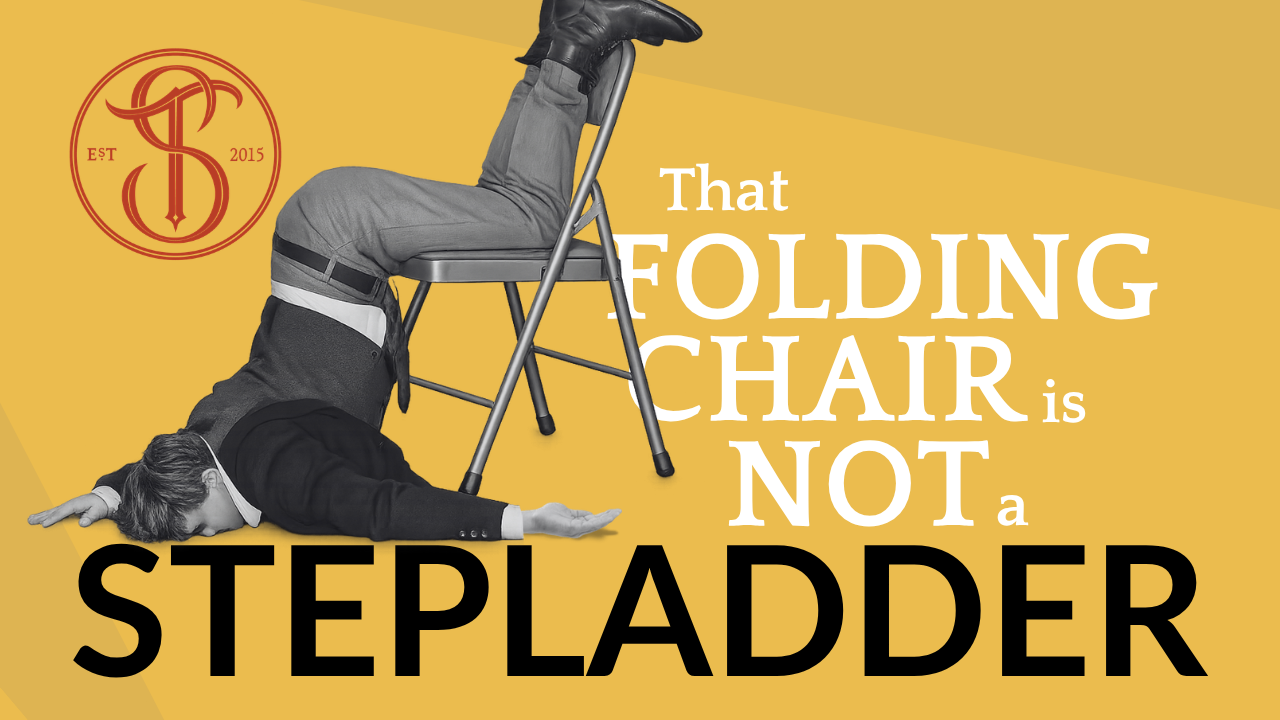
It all seems to be going remarkably well until you reach eye level with the top shelf and notice the carcass of a large wood spider lying next to an old garden hose. You scream like your 6-year-old niece and instinctively take one small step backward on your folding-chair-step-stool.
The chair does exactly what folding chairs do. It folds.
You manically grab onto anything within arm’s reach in a desperate attempt to prevent the inevitable, but a split second later your body crashes onto the garage floor with your baseball mitt and the old garden hose tumbling down on top of you. Then, in true Home Alone fashion, the dead wood spider lands squarely on your face.
What in the world just happened?
Well, the chair did exactly what it was designed to do. It simply wasn’t designed to carry your weight that way.
When Good Things Become Ultimate Things
We put weight on all kinds of things that were never designed to carry it. Sometimes with physical objects like the folding chairs from our garage. And sometimes with bigger things—like our relationships, our favorite sports team, or…our jobs.
We quietly shift weight onto these things—even good things, things with clear design and purpose in our lives—and ask them to become our identity, to provide our security, to give us peace and purpose.
You could even say to “save us.”
And because none of those things were designed for that purpose, they ultimately collapse underneath the weight like a mis-used folding chair.
We Make Idols
I’ve talked at length here over the years about how perplexed I get reading the book of Exodus. The Israelites live in such an undeniable reality of God’s supernatural presence and power. They seem Him tangibly at work in ways many of us would dream of:
- Supernatural plagues that force Pharoah to release them from Egyptian slavery.
- The Red Sea splitting down the middle so they could walk on dry ground.
- A pillar of God’s presence in cloud and fire at the center of their wilderness camp.
- Their physical food on the ground outside their tents each morning.
No one since the Garden of Eden could say God’s presence was more tangible to their everyday existence than the Exodus-era people of Israel. And yet at their first opportunity, they turn away from God, make a cow-idol out of their gold jewelry, and bow down to worship it.
These people asked a bovine statue they made with their own hands to replace the God of the universe that was tangibly in their midst.
Speaking of the Garden of Eden, scripture tells us that Adam and Eve literally walked with God in the cool of the day! But the temptation for self-salvation was so strong, they asked a piece of fruit to replace fellowship with their Maker.
In both cases, God’s people chose something they could see, touch, and control over Someone they had to trust.
It’s easy to stand out the outside thousands of years later and condescendingly wonder how people so physically close to God could try and replace Him with a design of their own making? They had God Himself! Why did they feel the need for something else?
That’s when the Holy Spirit knocks on the door of my heart: “Hey Erik, you do the same thing every day.”
We all make idols.
(Not cow-statues, I’m guessing. But idols nonetheless).
An idol is nothing more than a God-replacement.
Oftentimes, the idols we make in our lives are not even bad things. They’re good things we ask to be the ultimate thing. They feel right in the moment because we make them, we see them, and we (think we) control them. But they ultimately fail to carry the weight we place on them. Not because they’re immoral, but because they weren’t designed to carry our identity, our peace, or our salvation.
Idols are the folding chair we pull out of the corner of the garage and ask to be a stepladder.
The Idol of Work
Our work, our jobs, our careers can easily become one of these idols. Work is good! As we discuss here ad nauseum, God created human work! Partnering with Him to cultivate and care for His creation through our everyday work is part of His sacred design for mankind.
But sometimes we take this good, God-made thing and try to turn it into the ultimate thing.
We put our trust in our paycheck.
We find our identity in the social status of our work.
We ask our jobs to give us that ultimate sense of peace and purpose.
Our work has a God-made design, but it isn’t to carry any of these things. When we ask our job to be our functional savior, we will crush it under the weight of this expectation it was never designed to carry. The folding chair will…fold up.
When Our Work Plays Its Role
When Jesus died on the cross, he cried out “It is finished!” Jesus is the only One designed to carry the weight of our identity, our hopes, our peace, and our salvation. When we surrender to the finished work of Christ, our everyday work no longer has to carry the weight of these things it was never designed to carry.
Our work can return to what it was always designed and fashioned to be: a daily opportunity to fulfill the Great Commandment.
When they asked Jesus what the greatest of all the commandments was, he replied love God and love your neighbor. Our day-jobs are the perfect place for this commandment to come to life.
In their book, The Gospel and Work: Gospel for Life, Russell Moore and Andrew Walker say it this way:
“The main purpose of work is to be productive—what the Bible calls ‘fruitful.’ Our work should create value for others. That means work is fundamentally about love. Because we will spend more waking hours engaged in work than any other activity, work is the main way we carry out the Great Commandment to love God and neighbor.”
When we stop asking work to be our savior, our work can finally begin to function as it was designed. We can sit comfortably in the folding chair sipping a glass of lemonade after mowing the lawn instead of trying to use it as a ladder to reach the top shelf.
That’s what good design looks like. The chair is still useful, but only when it’s playing the role it was created to play. The same is true of our work.
- Your job was never designed to tell you who you are. Jesus already settled that.
- It was never designed to secure your future. Jesus already secured that.
- It was never designed to give your life ultimate meaning. Jesus already gives that.
- It was never designed to save you. Jesus already finished that.
When we stop asking our work to do what only Christ can do, we discover something surprising: our work actually becomes more meaningful, not less. We’re finally free to create, build, serve, solve problems, provide for our families, and love our neighbors—not because we’re trying to earn an identity for ourselves, but because we’ve already received one in Jesus.
Maybe that’s the question worth asking today: Are you asking your work to be something it was never designed to be?
Don’t get frustrated with the folding chair. Stop asking it to be a stepladder.

Erik Cooper
Erik began his career in the business world before spending twelve years in full-time ministry, serving on staff at a large suburban church and later as a church planter in downtown Indianapolis. Today, he serves as the President of a family of business-oriented nonprofit organizations that work together to mobilize the marketplace to make Jesus known in the world. He leads The Stone Table, which equips marketplace believers and invests in global mission initiatives, and Community Reinvestment Foundation, a nonprofit real estate company providing high-quality affordable housing in Indiana and directing its profits to missions through The Stone Table.