
HISTORY OF BAM: EARLY FIGURES & BIBLICAL CONTEXT
PART 2 – HISTORY OF BAM: EARLY FIGURES & BIBLICAL CONTEXT
This is part 2 of 2 in a “History of BAM” series. Click here for Part 1.
When you read the headline “early figures” of BAM, you might think 20 years ago, maybe even 50 years ago. BAM is not so old.
But that’s only true in terminology. The reality is that BAM is much, much older – perhaps even with Old Testament roots.
KEY HISTORICAL FIGURES
Though we have written on the subject as it emerged with modern terminology, it is hard to distinguish the pioneering work of those who had language for tentmaking or BAM from those who had done without.
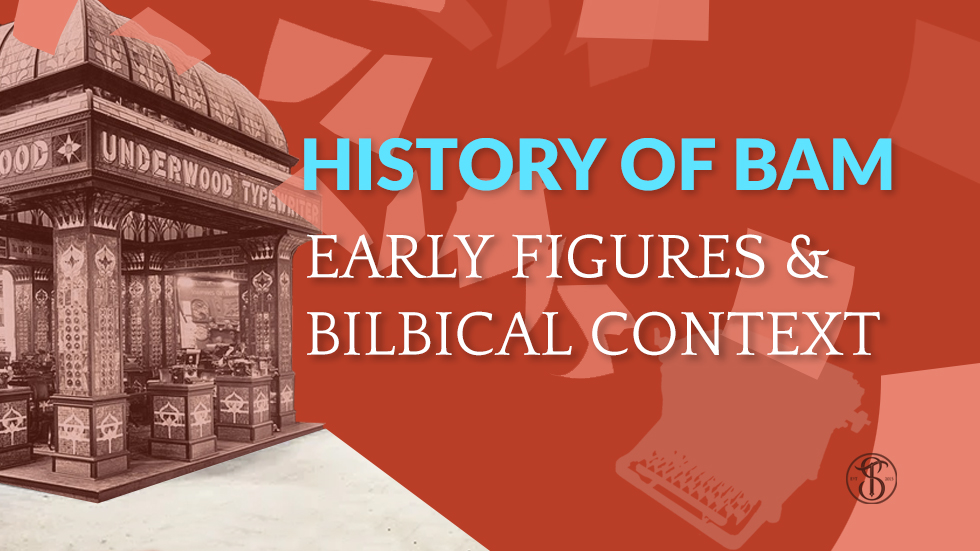
John Underwood: Through the success of the Underwood Typewriter Company, John Underwood financed four generations of missionaries in Korea, demonstrating how commercial innovation can sustain long-term mission efforts across generations. (Platt, 2019)
William Carey: As a bi-vocational missionary in India, Carey leveraged roles as a factory manager, cobbler, educator, and journalist to gain access, provide for his family, and advance gospel impact—modeling early tentmaking in restrictive contexts. (Lai, 2006)
The Quakers: Quakers blurred the sacred-secular divide by treating business as an extension of Christian discipleship, creating an ecosystem of accountability where commerce and faith flourished together for the good of society. (BAM Global, Incubation, 2015)
Hans Nielsen Hauge: A spiritual entrepreneur, Hauge catalyzed economic and spiritual revival in Norway by founding or inspiring over 30 businesses in just four years, empowering laypeople to pursue both gospel witness and productive enterprise. (BAM Global, Incubation, 2015)
Count Zinzendorf: The Moravians of the 18th century used business ecosystems to propel 226 missionaries around the globe in just one generation. (Jackson, 2023 & Benge, 2006)
BIBLICAL CONTEXT FOR BAM
The idea of Business as Mission (BAM) is deeply rooted in Scripture, especially in the examples of Paul and Abraham, though I’ll touch on Isaiah 61 as another great example.
Paul: The primary biblical figure for the basis of the modern Business as Mission movement.
It should be noted that what we mean BAM today is not necessarily synonymous with what Paul did in the Bible. Paul was a tentmaker, and we also use that term in BAM circles, but it’s not quite the same.
The general consensus in the BAM community is that “tentmaker” means “self-funded.” After all, that is the primary reasoning that Luke and Paul use for Paul’s work as a tentmaker. However, it is not necessarily self-funded missions.
It should also be noted that, today, tentmaking is often used to refer to digital nomads, job takers, and entrepreneurs. BAM, however, is often used more exclusively to refer to business owners.
Paul was a self-funded solopreneur. He was a tentmaker, and he was also a BAM practitioner in what you might call the purest or most original sense of the word.
Paul is a helpful model for us in missions precisely because he shows so much flexibility. He:
- Worked. (Acts 18:3)
- Chose not to work. (Acts 18:5)
- Received support. (Phil. 4:14-18)
- Chose not to receive support. (1 Thess. 2:9, 2 Thess 3:7–10, 1 Cor. 9, Acts 20:33–35)
Just how flexible was he?
“I have become all things to all people so that by all possible means I might save some.” (1 Cor. 9:22b)
In other words, if BAM is required, then BAM it is. If traditional missions is required, than traditional missions it is. If working as a digital nomad is what it takes then praise be to God who has made a way.
May it be said of us and the work that the Lord has called us to.
Now let’s look at another example – one from the Old Testament…
Abraham: Believe it or not, even the father of nations carried out the very activities of Business as Mission. God called him to leave his homeland and promised that through him all the families of the earth would be blessed (Genesis 12:1–3). This itself is a very missional act.
Abraham became a successful businessman, managing large herds, resources, and a trained workforce (Genesis 13:2; 14:14–24).
He used his influence to bless others and consistently built altars, establishing worship in every place he settled (Genesis 12:6–8; 13:18; 21:33).
His life demonstrates that business and mission can work hand in hand to fulfill God’s purposes.
Isaiah 61:1–6: Isaiah, a BAM passage? Yes! Isaiah paints a powerful picture of the redeemed bringing good news to the poor, restoring what is broken, and creating lasting impact. It describes businesspeople as priests of God working among foreigners. Let’s take a closer look:
- Verse 1-2. We, the redeemed of God, are called to bring good news to the poor among many other acts of freedom and healing. We are called to restore people and systems.
- Verse 3. The redeemed are called “oaks of righteousness, the planting of the LORD.” BAM is more than just a vehicle for access. It is a vehicle for job creation and sustainable financial impact for the burgeoning church.
- Verse 4-5. The redeemed will rebuild the ruined cities and employ strangers and foreigners in their enterprises (shepherding, farming, and cultivating vineyards).
- Verse 6. These redeemed who are engaged in business activities in a foreign land are finally called “priests of the Lord” who are feeding on the wealth of nations.
Of course, in all these examples, it should not be assumed that the authors had BAM as a missional strategy in their minds or that they believe that everyone is called to business. That would go too far. But I do want to make the distinction that creativity, commerce, and the Lord’s commissioning are regularly intertwined in the threads of scripture.
For more about the Biblical foundations for BAM, see the BAM Global report on the subject: Biblical Foundations for Business as Mission.
SACRED VS SECULAR IN BIBLICAL BAM
Whenever Business as Mission is discussed, I think it is helpful name the toxin in the theological bloodstream.
In part 1 of this series, I pointed to the sacred-secular divide as the crux of the problem in the modern BAM movement. But it could be said that the dichotomy has quietly muddled theology of work since the beginning of time.
In the Bible, Micah believes he needs a religious specialist, and he hires out connection with God rather than abiding in daily devotion to the Lord (Judges 17–18).
“Now I know the Lord will prosper me, since this Levite has become my priest.” (Judges 17:13)
Yet, existing as a theology in the bible does not make it correct theology.
Even with an established vocational priesthood, God had said,
“you will be for me a kingdom of priests and a holy nation” (Exodus 19:6)
The Lord himself envisioned a people who neither delegated their relationship with God nor saw their physical labor or business activities as secular work. This fulfillment is demonstrated in a lineage of priestly kings such as Melchizedek, David, and Isaiah’s words in chapter 61 (v 4-6) that businesspeople, farmers, shepherds, and construction workers would be called the priests of God.
The New Testament echoes this divine vision of the people of God in 1 Peter 2:9. This passage, among others, later becomes the basis for Martin Luther’s conviction that there should be no clergy-laity divide, a hierarchical separation of believers, largely drawing from a heretical sacred versus secular duality.
GOD’S IDEA
From the beginning, humanity was commissioned not merely to worship in sacred spaces, but to cultivate, build, steward, and multiply within creation itself (Genesis 1:28; 2:15).
From the beginning, we were commissioned, not just to create, but to carry the missional presence of God.
It has been said that business was God’s idea first.
And it has been said that God is a missionary God.
Both are true.
And as faithful followers of Christ, we have been invited to carry out our giftings – business, music, teaching – whatever they are, with sacred, missional intent.
Business as Mission is not a modern innovation. It is not a clever funding mechanism. It is not a workaround for closed countries. It is not a niche strategy for entrepreneurial Christians.
It is the recovery of God’s original design for business.
——————————————————————————————————————
If you haven’t already, read part 1 of this series.
Further reading:

Jon B
Jon has spent his career as a serial entrepreneur and business consultant both in the US and abroad in missions contexts. From a young age he has worked to marry a calling to missions and gifting for business. He is currently the Director of Transformational Business Development at The Stone Table and Coach Coordinator for OPEN USA.