

From Sanctuary to Cubicle with Dr.Allen Tennison
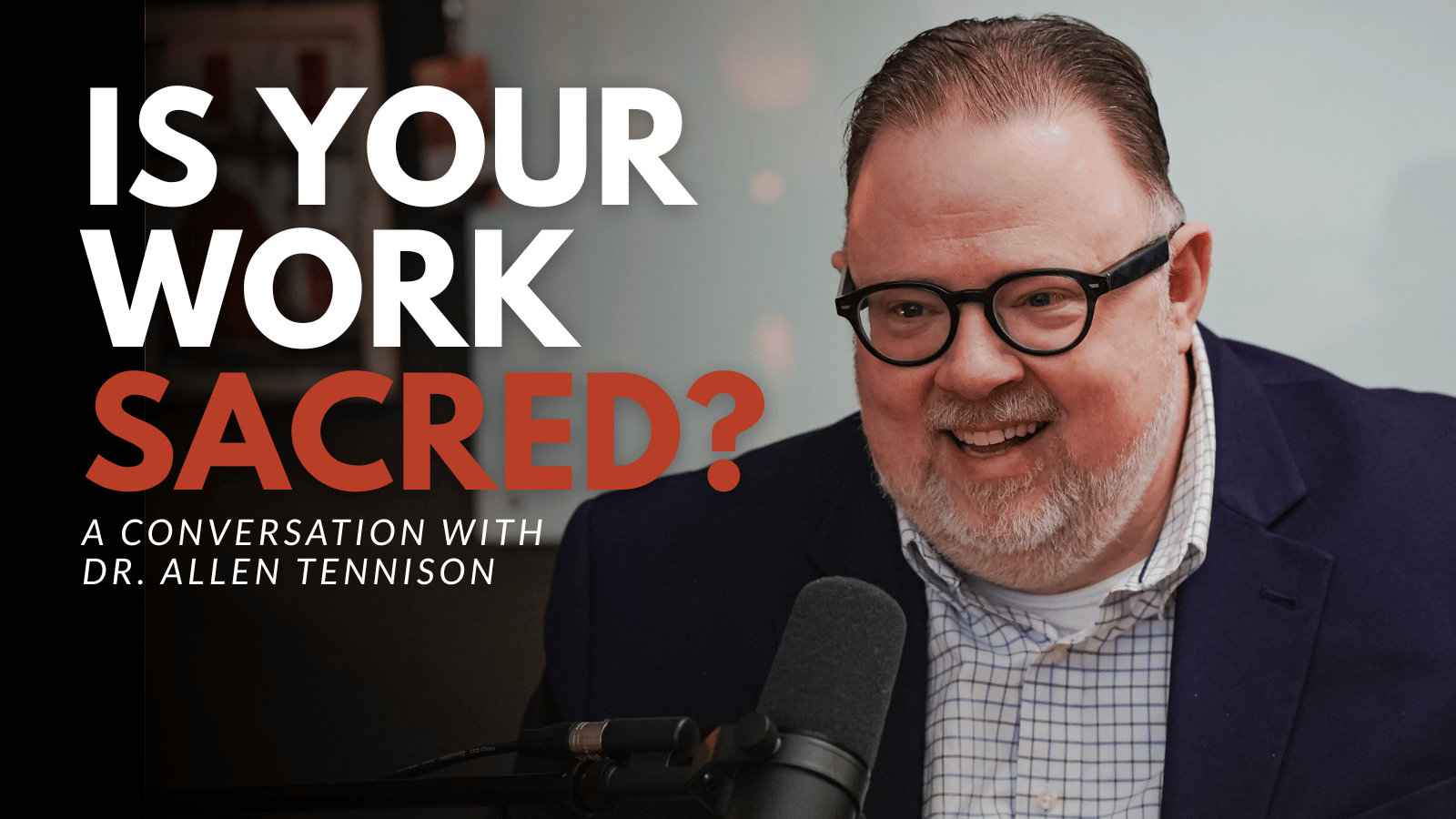
The Question Most Pastors Are Afraid to Ask
Where does your church go on Monday morning?
For most congregations, Sunday is the only moment pastors can account for. The rest of the week, their people scatter into offices, hospitals, construction sites, courtrooms, labs, and classrooms. And in those spaces, something is always doing the forming. The question is whether it’s the gospel or the job.
Dr. Allen Tennison, theologian and former pastor in Los Angeles, puts it plainly: people can be discipled by their jobs more than they are discipled by the church.
That’s not a warning about bad jobs. That’s a warning about the default state of a church that has never learned to engage the workplace.
The Gap Nobody Talks About
There’s a discipleship gap running through most congregations, and it’s not in the youth ministry budget. It’s in the assumption that Sunday is enough.
Most churchgoers sit in the pews carrying an unspoken belief: what they do at work doesn’t really count before God. The sacred stuff happens at church. The rest is just life.
This isn’t a new problem. It goes back to a deeply embedded sacred-secular split that most Christians have absorbed without realizing it. The result is a congregation full of people who are spiritually motivated on Sunday but spiritually invisible to themselves from Monday through Saturday.
Dr. Tennison’s prescription starts with the pulpit. “Preach on the sacredness of work itself,” he says. “That will be liberating for a lot of people to realize it matters to God.”
That one shift, preaching work as sacred, can begin to close the gap.
Three Things Pastors Can Do Right Now
- Find out what your people actually do for a living.
It sounds simple, but most pastors don’t have a working knowledge of the professional landscape in their own congregation. Tennison suggests going further than a survey. If a particular profession is well represented, visit people at work. Take someone to lunch. Learn the language.
When he was pastoring in LA, Tennison had a significant number of people in the entertainment industry. His response was to take a screenwriting class. Not to become a screenwriter, but to gain enough fluency in their world to be a pastor in it.
“It was the easiest way for me to get some of the language and lingo of their jobs,” he says, “and to have some insight into what they’re facing.”
- Get people in the same profession in the same room.
Tennison ran a small group in LA made up entirely of scientists from his congregation. They included a cancer researcher, a nanotechnology specialist, and a biochemist. He facilitated the group not as a scientific expert, but as a pastor who cared enough to find resources from Christians who had already wrestled with those same questions.
“I’m not a scientist. I don’t have a lab coat. But there are scientists who have talked about this.”
This model can work in any church with any dominant profession. A group of educators. A group of nurses. A group of attorneys. The content isn’t as important as the conversation.
- Recognize that discipleship must extend to the workplace.
Every job has a culture, a set of unspoken rules, and a worldview embedded in it. If the church is not actively helping people bring a Christian lens into their profession, the profession will bring its own lens to bear on the person.
Tennison has watched it happen firsthand. Congregation members entering high-pressure industries and coming out the other side with a changed personality, a changed set of values, a changed disposition. The job did the discipling because the church never entered the space.
The Sacred-Sinful Distinction That Changes Everything
One of the most clarifying things Tennison offers is a reframe of the standard sacred-secular vocabulary.
“The real distinction is not between sacred and secular,” he says. “The real distinction is between sacred and sinful.”
Most work is not sinful. Most jobs are genuinely good, and the people doing them can do them in ways that reflect the glory of God, serve the common good, and extend the kingdom. The role of pastoral care is not to pull people out of the marketplace but to equip them to inhabit it faithfully.
But sometimes the how of a job, the methods, the means, the culture, can become incompatible with a life surrendered to Christ. And occasionally, the job itself is incompatible.
Tennison tells the story of a man in his congregation who worked as a sales rep for a defense contractor. His method for closing government contracts involved strip clubs and buying access through compromise. He was known in his circles as “Mr. Goodtime.” Then he became a Christian.
He couldn’t do his job the same way anymore. He tried to build relationships through steak dinners and honest conversation. Eventually, he lost his job. He couldn’t deliver the contracts without the old methods.
When Tennison asked him how he felt about losing his career after coming to faith, the man’s answer was immediate: “It was the best thing that ever happened to me. It freed me.”
That story illustrates the full range of pastoral care in the workplace. Sometimes it’s helping someone do their job better, with more integrity and more grace. Sometimes it’s helping someone recognize it’s time to leave.
What Redeemed Work Looks Like
Tennison describes a vision for marketplace discipleship that is both theological and practical. The goal is not to make work feel spiritual by adding a Bible verse to the email signature. The goal is to see work itself as a place where God is active, where the gospel has something to say, and where the people of the church are deployed as agents of the kingdom.
“If the gospel redeems and resurrects all things,” he says, “what would it look like for your vocation to be redeemed and resurrected by the gospel?”
That’s the question pastors can ask. That’s the discipleship conversation that most marketplace believers have never had with their church.
Start Where You Are
You don’t have to overhaul your discipleship program overnight. Start with the question: where does my church go on Monday?
Find out what your people do. Visit them in it. Preach the sacredness of work. Get people in similar professions talking to each other. Help them see that the way they do their work has to be treated as fit for the presence of God.
That’s not a program. That’s pastoral care extended to the places where your people actually live their lives.
The Stone Table exists to equip marketplace believers to connect their faith to their everyday work. Start with our free five-day devotional at thestonetable.org/start.
Full Transcript
Erik: Dr. Tennison, one of the things I hear a lot from my pastor friends is, “I don’t really know how to engage my marketplace people. I don’t know how to talk to them about their work.” How would you encourage them to incorporate this conversation?
Dr. Tennison: I would do at least three things.
Number one, I would start preaching on the sacredness of work itself. There are people in the congregation who still don’t know that what they do when they’re not at church matters to God. They think the only thing that counts before God is whatever they’re doing inside the church. So they need to know that first.
Then I would actually find out what professions are represented in my church, and I would try to talk about how the church can encourage people in those professions, maybe even get people in the same field together. I did this once when I was pastoring in LA. I realized I had a number of people in my church who were in the sciences. I would talk to them, and some of them had no idea how to integrate what they were doing in a laboratory with what they were doing for the Lord.
So I put them together in a small group to read from scientists who were also Christians, just to have that discussion. I’m not a scientist. I don’t have a lab coat. But there are scientists who have written about this, so let’s come together and talk about it. One person was doing cancer research. One person was working in nanotechnology. Another was a biochemist. Let’s all sit in a room and talk through what this looks like.
And then, if you can, go visit people in the workplace. Ask if you can meet them for lunch. Just ask how their day is going. If there is a dominant profession in your church, you can actually learn more about that profession as a pastor. If you’re a pastor in a rural community and most of your congregation is in farming, there is no reason why you can’t learn a little more about farming and just be with people in their work.
When I was pastoring in LA, I had a lot of people in the entertainment industry. One thing I did as a pastor was take a screenwriting class. Not because I had any intention of becoming a screenwriter, but because it was the easiest way to pick up the language and lingo of their world, and to gain some genuine insight into what they were actually facing in that industry.
So the three things: preach on the sacredness of work, because it will be genuinely liberating for people to realize their work matters to God. Find what professions are in your church and find ways to coordinate. You might actually discover there are solutions to problems in your city that your church could be part of, if you just knew how to utilize these professions well. And understand that work as best you can, showing up for people in their workplace the same way you would show up in a hospital.
Let them talk to you about their job. You might not understand everything about what they do, but you can still recognize where the discipleship boundaries are. Because here’s what we have to be careful of: people can be discipled by their jobs more than they are discipled by the church. Every job has its own culture. Every job has its own set of rules. Every job has a worldview embedded in it. And if we are not intentionally discipling people toward the workplace, we may be handing over our discipleship to the workplace and letting that job do the forming.
I’ve had members of my church go into difficult professions and watched their personalities change because of the impact, and sometimes not in the right direction. As a pastor, I’ve had to step in and say, “We need to talk about your attitude.” Because the job was giving them a view of the world that may be useful inside that workplace, but it wasn’t actually true.
We want to interrupt for just a moment. If you’re new to The Stone Table, we have something for you. Head to thestonetable.org/start for a free five-day devotional to help you practically connect your faith to your everyday work. It will give you access to all kinds of free resources to encourage you as a believer in the marketplace — because who you are and what you do matters to God. Now, back to the conversation.
Our role and job is to help people see their work through the redeemed lens of the gospel. I heard someone say once: if the gospel redeems and resurrects all things, what would it look like for your vocation to be redeemed and resurrected by the gospel? I think that is exactly what pastors can help everyday marketplace Christians work out. That would be a huge discipleship moment.
And I’ll add one more thing. There may be times as a pastor when you have to help someone move on from a job, because you realize it is not spiritually healthy for them. And I want to offer this distinction: the difference is not between sacred and secular. The real distinction is between sacred and sinful. What is it we do that can be the work of God through us, and what is it we do that is actually resisting the work of God in the world?
In the book of Acts, when the church was working out how to incorporate Gentiles, they gave three restrictions: avoid eating food sacrificed to idols, avoid the blood of strangled animals, and avoid sexual immorality. In a sense, those were three boundary markers: have nothing to do with idolatry, nothing to do with immorality, and nothing to do with what is simply inhumane.
I would argue those are probably three great boundaries for work as well. If you’re going to be a Christian, you probably cannot be a pagan priest. You have to say, “I’ve got to leave that profession because I’ve given my heart to the Lord.” If you’re going to be a Christian, you cannot be involved in the sex industry. That is simply not a part of your life anymore. And if you’re a follower of Christ, you cannot be engaged in what is simply inhumane.
Sometimes people give their heart to the Lord and we have to help support them financially because they may need to leave their place of work. Other times, the job itself is not bad, but the person is doing it badly.
I’ll give you an example. I had a guy in my congregation who worked for a major defense contractor. His job was to sell classified projects to the Pentagon. And the way he did it was by taking clients out to strip clubs, paying a little extra to make sure they got special attention. He became known as “Mr. Goodtime.” When he showed up, everyone was happy to see him, because he delivered a certain kind of experience.
Then he gave his heart to the Lord.
Suddenly, the way he had been doing his job, he couldn’t do anymore. Now he was taking these officers out to a great steakhouse, giving them a fine meal, and then they were done. And they’d ask, “What are we going to do now?” And he’d say, “This was it.”
I asked him how that affected his job. He said, absolutely it did. He was known as Mr. Goodtime, and once that stopped, eventually he lost his job because he could no longer bring in the contracts the way he once had.
I said to him, “So you gave your heart to the Lord and you lost your career because of it. How did you feel about that?”
And I loved his answer. He said, “It was the best thing that ever happened to me. It freed me.”
Now, I’m not saying you couldn’t work for a defense contractor as a Christian. But there are certain ways of doing a job that do not work toward the glory of God, the common good, and the kingdom of God. As pastors, we have to help people see that.
I want you to see your work as sacred, meaning the way you do your work has to be treated as if it is fit for the presence of God. Part of our discipleship, no matter the profession, is helping people understand not only is their work sacred, but here is what they are ultimately working toward.
And if I can’t speak directly into a specific profession, I can bring other lawyers, other doctors, other engineers together who are also believers. I might even find someone who has already learned how to integrate their faith with their work and have them serve as a mentor.
The goal is to understand where my church actually is Monday through Saturday. On Sunday, I know you’re here. But where does my church go the rest of the week, and how can I utilize that to help serve the city or state we’re in?
Erik: That is so powerful and so practical. Thank you.

The Stone Table
The Stone Table is a global missions organization rooted in the marketplace. We leverage the profits from our marketplace businesses to fund strategic global missions projects around the world. We also equip and encourage marketplace Christians to make Jesus known at work and around the world.