

Business is Not the Bad Guy
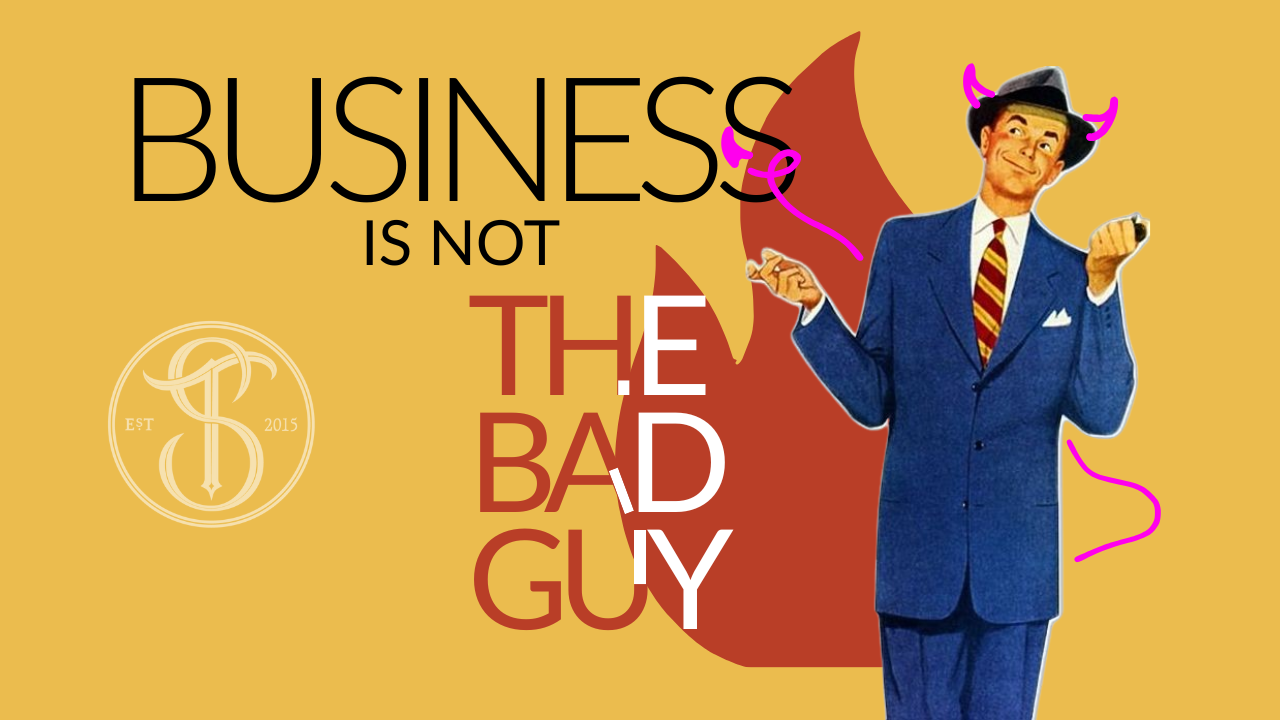
BUSINESS IS NOT THE BAD GUY
I just got new glasses—and they’re driving me crazy.
My most recent trip to the eye doctor showed little change in my prescription—just a tweak—so I splurged and ordered two pairs of stylish new frames (approved by my daughter). I was so excited when I got word they were ready, we raced to the store to pick them up.
When I first threw them on, my eyes strained to adjust. I have a lot of things going on with my glasses—astigmatism, prism, and (ehem) progressive bifocals—so the initial disorientation didn’t shock me. It usually takes a few days to fully adjust. But these glasses were so close to my last prescription, I was surprised I felt it so much.
A few days went by, and I was still feeling woozy. Maybe the frames just needed adjusted? One pair felt better than the other, but something definitely wasn’t right. After a month of trying to convince my brain, I gave up and took them in. It turns out the second pair was ever so slightly off center. And with all I had going on, that 3 millimeters was completely distorting my vision.
Even the slightest difference in the lenses we look through can completely change what we see. It’s amazing what a few millimeters can do.
How Do You See Business?
I grew up with an entrepreneurial father. He left his stable job when I was in elementary school, buying a number of nursing homes that he ran for a decade with two other business partners.
I remember visiting those facilities regularly, mostly in low-income areas, and seeing how my dad’s efforts were impacting the lives of real people. I remember my mom telling me how he was occasionally up all night, pacing the floors, worried about how he was going to make payroll some weeks because of delayed healthcare payments or unexpected expenses.
My dad made money through business by helping people. He carried the responsibility for his residents and his staff, bearing the burden of other peoples’ lives. That sacred responsibility carried into every business he owned, including the nonprofit affordable housing company he eventually co-founded, that served low-income residents for over three decades and funds the missions work of The Stone Table to this day. This is the lens through which I see the business world.
So when I watch movies and TV shows today that always seem to cast the businessman as the greedy villain, it’s frustrating to me. It’s just not the lens I see the business world through. But I know others have a different lens.
All you have to do is google “corporate greed,” or ask ChatGPT to “show examples of how business has been used as a force for evil in this world,” and you will see valid reasons for the cynicism and vitriol that many carry for the marketplace.
There are real slumlords in the world. There are actual Ebeneezer Scrooges, Gordon Geckos, and Mr. Potters leveraging business to control and take advantage of others. If you have experienced that side of the equation, the lens you see the business world through creates a completely different image.
Is Business Really the Villain?
Without downplaying your personal experiences, good or bad, I want to shift the praise or condemnation from business itself to where I believe it truly belongs. Business is not godly or sinful in and of itself, it’s a neutral platform or a tool that manifests what is in our hearts.
If your lens shows you businesspeople as evil, power-hungry villains, business isn’t the problem. Greed is the problem.
Greed is not a business problem—it’s actually a worship problem.
Yep, you read that right. Colossians and Ephesians both tell us that “a greedy person is an idolater, worshiping the things of this world.” (Ephesians 5:5). Business doesn’t make us greedy. Worshipping something other than God makes us greedy.
But if your lens shows you businesspeople as beautiful, servant-leader heroes, business isn’t the reason either. Kindness and goodness are the reason. And kindness and goodness are not a business creation, they’re a “fruit-of-God’s-grace” creation.
Our experience creates our perspective, and our perspective is the lens we see the business world through. But beyond our experience alone, there are some other “under the surface” desires at work in us that also form our lens—and not all of them are warm and fuzzy. It’s easy to condemn greed, but fewer of us recognize its evil counterpart.
The Other Ignored Lens
I travel a lot for work, and full confession, something ugly happens in me when walk through first class to the coach section of the airplane, desperately hunting for luggage bin space.
Why didn’t I get an upgrade? Why do I have to put my bag under my seat so the lady traveling with her emotional support poodle can have the overhead for Pookie’s carrier?
Envy is sneaky. And it distorts how I see reality.
It’s easy to see how greed and lust for power have distorted the way many people see business and the marketplace. But what if the lens distorting our vision of the business world isn’t always the greed of others, but our own desires for what some else has created or been given to steward?
What stories do I tell myself about people who have more influence, margin, or money than I do? When their success bothers me, is it because it’s unjust, or because it reminds me of what I wanted and didn’t receive? Greed and envy are both vision distorters.
Jesus himself said, “For from within, out of a person’s heart, come evil thoughts, sexual immorality, theft, murder, adultery, greed, wickedness, deceit, lustful desires, envy, slander, pride, and foolishness.” (Mark 7:22). Romans 1:29 names envy right alongside greed in a long list of “wickedness” that fills our hearts.
Envy is greed’s equally ugly cousin. But we often find it easy to baptize envy as discernment or prophetic critique. But in my experience, envy is often self-righteousness pretending to be humility. It tries to sound noble—maybe something like this:
“I’m sure glad I’m not like them. At least I’m not chasing status the way they are.”
“I don’t care about influence like they do. I’m just trying to be faithful.”
“If I had that kind of money or power, I’d certainly use it a lot better than they are.”
Greed has certainly distorted the business world, hijacking a platform that was designed to bring life and hope to the world. But envy has done its fair share of warping as well.
If you always see business as the bad guy, perhaps you’re allowing your envy to flatten the business world into a cast of villains just so you don’t have to face your own dark side. Both greed and envy are great at distorting the truth.
Recognize Evil Where It Truly Exists
Nobel Prize winning author, Aleksandr Solzhenitsyn, called us all on the carpet in his famous work, The Gulag Archipelago:
“If only it were all so simple! If only there were evil people somewhere insidiously committing evil deeds, and it were necessary only to separate them from the rest of us and destroy them. But the line dividing good and evil cuts through the heart of every human being. And who is willing to destroy a piece of his own heart?”
Generosity can fuel the heart of a billionaire business owner just like greed can drive the motives of a charitable nonprofit. But it’s easy to drift toward the lazy caricatures instead of doing the hard work and introspection I believe we’re called to as followers of Jesus.
Let’s embrace God’s original design for business and the marketplace and covenant to live into the Gospel-redeemed reality that Jesus made possible through His death and resurrection. Business is not the bad guy. In Christ, business can be a beautiful Kingdom-expanding tool to Make Jesus Known in all the earth.

Erik Cooper
Erik began his career in the business world before spending twelve years in full-time ministry, serving on staff at a large suburban church and later as a church planter in downtown Indianapolis. Today, he serves as the President of a family of business-oriented nonprofit organizations that work together to mobilize the marketplace to make Jesus known in the world. He leads The Stone Table, which equips marketplace believers and invests in global mission initiatives, and Community Reinvestment Foundation, a nonprofit real estate company providing high-quality affordable housing in Indiana and directing its profits to missions through The Stone Table.