
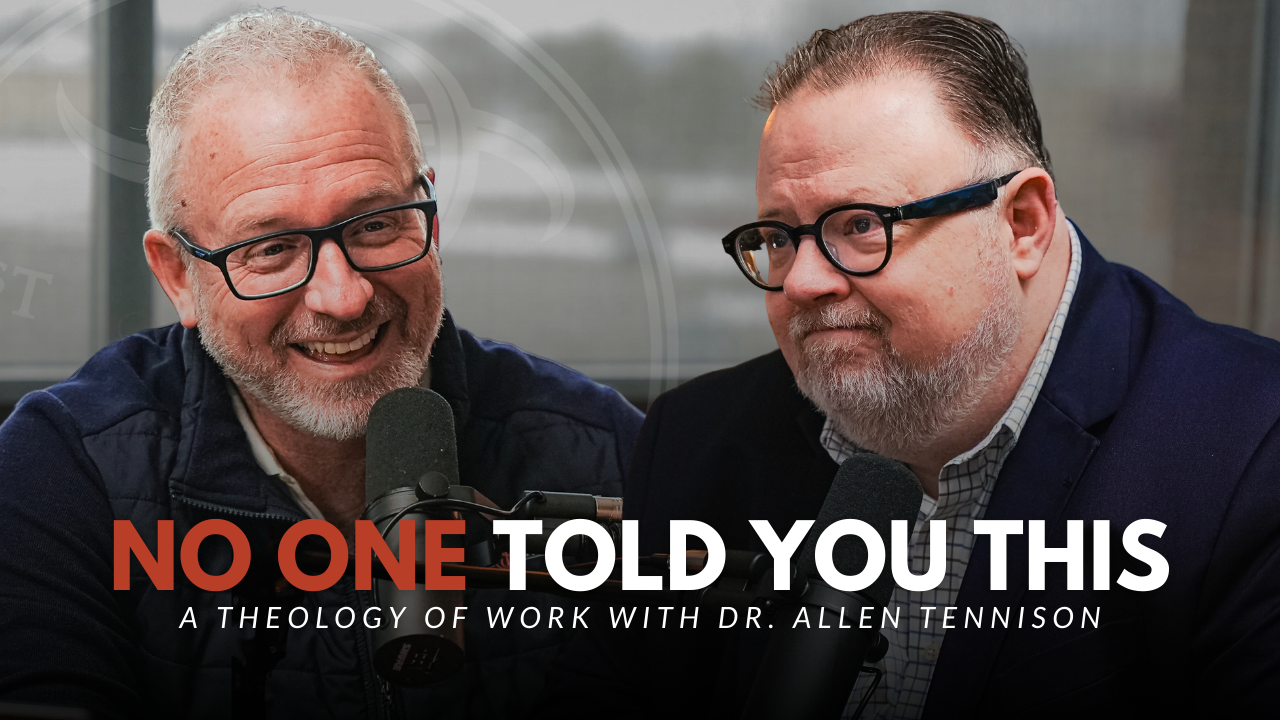
The Four Greats: A Theology of Work with Dr. Allen Tennison
What Is Your Daily Work REALLY Saying About God?
Most marketplace believers have spent years feeling spiritually invisible from 9 to 5. Dr. Allen Tennisen, chief theologian for the Assemblies of God, makes the biblical case that your job isn’t just a way to fund ministry, it IS ministry.
A retired police detective in Kansas City spent 30 years protecting people, solving crimes, and serving his community. At the end of a theology-of-work talk, he walked up with tears in his eyes and said something that stopped the room: “This is the first time anyone told me that mattered to God.”
Thirty years. And nobody had ever connected his work to God’s work.
That’s not just one man’s story. It’s the story of millions of marketplace believers sitting in our churches every Sunday, spending half their waking hours in a world they’ve been trained, however unintentionally, to see as spiritually second-rate.
It starts with a single false idea. And it’s time to dismantle it.
The Divide That Scripture Never Created
The sacred-secular divide is the unspoken belief that pastors and missionaries do God’s real work while everyone else funds it. It shapes how we talk about calling. It colors how we think about Sunday versus Monday. And it leaves most believers sitting in the most consequential mission field on earth feeling like they’re not really on the team.
But the divide isn’t in the Bible.
Dr. Allen Tennisen, chief theologian for the Assemblies of God, argues that it collapses the moment you entirely understand what Scripture actually says about creation. Genesis 1 isn’t merely a creation account Old Testament scholars widely recognize it as a temple dedication. The progression from day one through day six to Sabbath is the story of all creation being consecrated as the dwelling place of God. Everything is sacred. Everything belongs to Him.
Genesis 3 fractures that. But the entire arc of Scripture from that point forward is God working to restore it. Jesus, as Tennisen puts it, comes as the new Joshua reclaiming the land for God, making everything clean again, everything fit for the presence of God. And in Revelation 21-22, the New Jerusalem has no temple at all, because God Himself fills everything. The whole of creation is sacred once more.
In between those bookends? Your work is part of that story.
The Garden Was a Vocation, Not a Vacation
One of the most overlooked facts in Genesis: work existed before the fall.
Genesis 2 places humanity in the garden to work it and keep it. The fall doesn’t happen until Genesis 3. Work is not a consequence of sin. It is part of God’s original, good, pre-fall design.
“The Garden of Eden wasn’t a vacation, it was a vocation,” says Tennisen.
The two Hebrew verbs in Genesis 2, to tend the garden and to protect it, are the same verbs used elsewhere in Scripture for the priests who care for the temple. Adam and Eve weren’t relaxing in paradise. They were functioning as priests. They were caretakers and partners in God’s ongoing work of creation.
Genesis 3 distorted work. The thorns and thistles came in, and with them the toil, the competition, the grind. But the distortion didn’t change what work is. It only changed what work feels like in a broken world. And the whole trajectory of redemption is moving toward its restoration.
You Are in a Joint Venture with the Creator
God made the raw materials. He didn’t make the cities, the economies, the businesses, the institutions, the supply chains, or the hospitals. That was the human vocation to form, fill, subdue, and cultivate. As Tennisen explains, the creation narrative doesn’t end with “this is the way it’s always going to be.” God brought everything to the point where it could take over from there and handed it to us.
Martin Luther captured this centuries ago: “God is milking the cows through the vocation of the milkmaid.”
That word vocation comes from the Latin vocare, to call. Your job, whatever it is, is part of a calling to partner with God in the ongoing work of creating, caring for, and restoring the world He made.
An Amazon delivery driver rushing diapers and formula to a foster family at midnight is, in that moment, a messenger from God. A salesman who sells medical equipment that saves lives is doing exactly what God designed work to do. A police detective who protected and served for 30 years was participating in the work of God the restorer, every single day.
The work itself matters, not just the evangelism you squeeze around the edges of it.
The Ancient Hebrew Word That Changes Everything
At the center of this conversation is a single Old Testament word: avodah.
It appears 145 times in the Hebrew Bible. Depending on context, it’s translated as labor, worship, or service, the same word, carrying all three meanings. Because in the Hebrew worldview, they were never meant to be separate categories.
Work offered to God on behalf of others is worship. The priest serving in the temple and the farmer tending the land were both doing avodah. One inside the walls, one outside, but both in service to the same God, both with the same sacred weight.
“When I do my work as if it’s God doing His work through me,” says Tennisen, “that in itself is showing the difference. I’m not working just for a paycheck. I’m working for an eternal purpose.”
The Idol Your Ambition Is Hiding
Before we can fully embrace this, we have to deal with something harder: the idol hiding inside our work.
The Israelites watched the Red Sea part. They ate manna off the ground every morning. They had the visible presence of God in the pillar of cloud and fire. And the moment Moses went up the mountain, they melted down their gold and worshipped a cow. Read it, and you think: what is wrong with these people? And then quietly, the Lord reminds you that you do the exact same thing.
Tim Keller identified it well. There is a work under our work. It’s the striving, the earning, the relentless attempt to build our identity on what we accomplish or accumulate. And most of us carry it every day without naming it.
When work becomes the place we go to find meaning, justify our existence, or fill the emptiness inside, it becomes an idol. And as Tennisen says, “whenever we make something an idol, we put on it the weight that it cannot bear. Only God can bear the weight of our worship.”
Your career cannot carry that weight. Your success cannot. Your reputation cannot. Everything you’ve placed on those things will eventually give way.
But tetelestai, it is finished. The work under your work is done. Jesus accomplished what every striving heart is ultimately looking for. And that sets you free.
Free to Work, Finally
Eugene Peterson tells a story about a family that adopted a girl from a country that had suffered famine. On her first night in their home, the table was full of food. The teenage sons started eating the way teenage sons eat. The girl tried to keep up, couldn’t, and grew quietly furious. The mother realized what was happening: this little girl assumed it was all the food they had. These brothers were going to eat everything in one meal.
So the mother stopped the table, took the girl by the hand, and brought her to the refrigerator. Opened it wide. Brought her to the pantry. Opened that too. She wanted the girl to see: the brothers are not your competitors. There is more than enough. You can eat freely. There will always be enough for you.
That is the “it is finished” of Jesus applied to work. We live in a world of grace, not scarcity. The thing we are desperately working to earn has already been given. And when we finally believe that, something fundamental shifts: we stop working to fill ourselves and start working to serve others. Work becomes worship. Work becomes a mission. Work becomes what it was always designed to be.
Why This Matters for the 42%
Roughly 42% of the global population has little to no access to the gospel. And the most strategic missionaries to reach those people may not be in seminaries or on fundraising campaigns. They are in offices, neighborhoods, supply chains, and industries where no missionary has a natural foothold.
This isn’t a modern strategy. Justo González’s History of Christianity documents that a significant portion of the early church spread not through official missionaries from Antioch, but through merchants, traders, and soldiers, ordinary people doing their work who simply couldn’t stop carrying the gospel wherever they went. They weren’t sent. They were scattered. And the gospel went with them.
Ananias in Acts 9 wasn’t Peter, Paul, or Apollos. He was just an ordinary Christian in Damascus who knew how to hear from God. That’s the goal. Not a platform or a pulpit. Just someone so shaped by the life of God that it spills naturally into whatever work they’re already doing.
If you belong to Jesus, the Great Commission belongs to you. You cannot outsource it. You are already placed exactly where God needs an agent.
Three Shifts That Change Your Monday
If this framework lands, here’s how it translates into practice.
First, change the question. Stop asking, “How can I do ministry through my job?” Start asking, “How is my actual job contributing to the glory of God, the common good, and the kingdom of God?” The work itself matters.
Second, ask your pastor where the church is in the marketplace. Not how many attenders have marketplace jobs, but where is the church actually deployed? Ephesians 4 calls leaders to equip the saints for works of service. Most of those works happen outside the building.
Third, own your piece of the Great Commission, not as guilt, but as identity. You are Ananias. You are already placed. The only question is whether you’ll listen to what God wants to do through the work you’re already doing.
Start with the free five-day devotional at thestonetable.org/start — built to help you connect your faith to your everyday work.
Full Transcript
Erik: If you are someone who has ever wrestled with your faith and your work — how those two things go together — then we have an incredible conversation for you today. We’ve got Dr. Alan Tennyson, the chief theologian for the Assemblies of God. We had a deep dive conversation on the role of the marketplace in God’s kingdom work in the world. You are not going to want to miss this. This rocked my world. It was an incredibly rich and meaningful conversation, and I hope you stick with us as we dive in right here.
Marketplace skills are missionary skills. What an honor to be here with you today, Dr. Tennisen. We’re going to talk through the four pillars of the mission of marketplace framework — what we call the four greats. The Great Separation, which is the sacred-secular divide. The Great Story, which is work in the metanarrative of Scripture. Work as a way to fulfill the Great Commandment. And work as a way to engage the Great Commission. I want to start with the Great Separation. We think this issue of the sacred-secular divide is foundational to the whole conversation. There’s this instinct in us that being in full-time vocational ministry — being a pastor, being a missionary — that’s sacred. But if I just get a job in the marketplace, that’s secular. So we’ve got all these people spending half their waking hours with no connection between their work and God’s work in the world. Do you agree with that framing? And what would you say to marketplace people who are wrestling with this divide?
Dr. Tennisen: I would say, first of all, the Great Separation falls away when we understand the Great Story. Let’s start with the word sacred. For something to be sacred means it has been consecrated — set apart for the presence of God. When you go to the very first chapter of the Bible, Genesis 1, and you get that story of creation, a lot of Old Testament scholars will tell you that what’s actually happening is that creation is being painted as a temple. The way we go from day one to day two to day three, all the way to the story of Sabbath, is pointing to all of creation being meant as the temple of God — the place where God dwells. This whole thing is sacred.
By the time you get to the end of Scripture and find that beautiful picture of the New Jerusalem, we’re told there’s no temple there. Because God Himself is there. His presence fills the place. The whole of creation is again pictured as a place that is sacred. There’s nothing in creation that doesn’t belong to God or isn’t meant to be consecrated to God. And in between the creation and the re-creation, you have the story of a fall — a story of the world creating a hostility towards the presence of God, and God working through that to make it sacred again.
He has a people, Israel, who as a people are set apart, called to be sacred, His presence dwelling in their midst. And there’s not a distinction between roles as if this is God’s work and this isn’t. If you’re a priest, it’s God’s work. If you’re a prophet, it’s God’s work. If you’re a farmer, God’s presence still fills that land and it’s God’s work. If you are a king — how many kings are critiqued in the Old Testament because they forgot it was God’s work and that they were simply expressing His kingship?
By the time we get to the story of Jesus, I want to take this from a New Testament scholar by the name of Colin Brown. His argument is that when you get to the Gospel of Mark, it seems to take place in one year — it only features one festival. It starts in Galilee and it’s like a travelogue where Jesus goes all the way to Jerusalem. And his argument is: what is He doing? Jesus as the new Joshua — because that’s what the word Jesus means — reclaiming the land for God and making everything sacred again. Everything that is unclean, meaning not fit for the presence of God, He makes clean. In the Old Testament, what’s unclean makes something else unclean. But with Jesus, He makes everything clean. His whole narrative is making it sacred again. The church in the New Testament has always understood that we live in a space that’s consecrated for God, and the work that we do is consecrated for God, no matter what that work is.
Just to summarize: if you understand the Great Story, you understand what’s wrong with the separation.
Erik: When I talk about this at churches or to business groups, it’s not abnormal for me to have people come down to the front with tears in their eyes — people who have worked 20, 30, 40 years in the marketplace and never felt like what they did was important to God. What would you say to people like that who are wrestling with this? How can accounting and spreadsheets and retail and property management matter? How would you encourage them to tear down this divide?
Dr. Tennisen: What I would argue is that when we come to Scripture, we see that God is at work. God is always at work throughout Scripture. There are three great metaphors of God as a worker in the Bible. There’s God as creator — God as a potter, God as a builder, God as a gardener. There are metaphors of God as a caregiver — God is a shepherd, God is a parent. And there are metaphors of God as a restorer — God is a king, God is a judge. God is working in creation, working in caring and providing, working in restoration. Whatever God is doing in the world typically fits one of those three categories.
So now the question is: how is my work actually reflecting what God is doing in creation? What am I doing that’s contributing to the glory of God? To the common good? To the kingdom of God? Those are the three great ends to work: the glory of God, the common good, and the kingdom of God. It’s not just work for what I can do around it — the actual work itself matters to God.
I’ve given talks on the theology of work and I always have people come up to me at the end. I had one man come up and say, “I’m a salesman, and I don’t know how that pleases God.” I said, “What do you think you can do for God as a salesman?” He said, “Well, I can evangelize my coworkers.” I said, “That’s awesome. But that’s not enough. What else?” He said, “Well, I give money to the church.” I said, “That’s great. But again, not enough.” And he said, “I don’t get it.” I said, “Look, we’ve been talking for five minutes and you, as a salesman, have yet to tell me what you sell. That’s a terrible salesman. What’s your actual product?”
He said, “I sell medical equipment that saves people’s lives.” And then he said it out loud, looked at me, and said, “God is pleased with that, isn’t He?” I said, “God is absolutely pleased. What you’re actually doing makes a difference. And it’s God doing it through you.”
I had another man come up, a senior citizen. He was crying. He said, “I was a police detective in Kansas City for 30 years. This is the first time anyone told me that mattered to God.”
I had another man come up almost as a challenge. He said, “I’m an Amazon delivery driver. What are you going to do with that?” I said — and I want to be clear, this is not saying anything to justify Amazon’s labor practices — “My wife and I are foster parents. We do respite care for children. There are times we’ve had babies dropped off to us and we immediately had to order diapers and formula. Within two hours, there’s an Amazon delivery truck at our house, and in that moment, that driver is like a messenger from God.”
You have to understand, it is the work itself. When you work towards the ends of His glory, you’re caring for what God has created. When you work towards the common good, you’re caring for people. When you work towards the kingdom of God — that restoration — it’s not just that God is pleased with it. It’s actually the work of God Himself through you. And here’s the thing: you don’t even have to be a believer for that to be true. I love this idea from one author of what he called “accidental healers” — people who are actually making a difference in the world and don’t know why, but it’s still God who is at work.
Erik: There is something in all of us — even those who haven’t come to faith in Christ — that image-bearing capacity. We were all created with purpose, and we’re not fulfilled until we feel purposeful.
Dr. Tennisen: That’s right. There’s been this experiment in social psychology where people are asked: if you could be hooked up to a machine that would recreate a world for you — like the Matrix — in which you are completely happy every single day, but the price is that you’re completely disconnected from the world and completely useless, would you do it? And 99.9% of people say absolutely not. The evidence has been that it’s not that people want to be happy. It’s that they want purpose. They want to be useful. There’s something within all of us that says, I want what I do to matter.
Erik: That’s why this conversation is so important. There are a lot of Christians in the marketplace who feel like their work is second-rate. Let’s unpack some of this. You’ve already started to move toward the Great Story conversation, so let’s go there. How does work fit into the metanarrative of Scripture? I want to pull out three core theology-of-work concepts here.
The first is that work was God’s idea — that work existed before the fall. This was a revelation for me when I first started studying this. Genesis 2 shows God placing man in the garden to work it and keep it. The fall, the tree, the serpent — that doesn’t happen until Genesis 3. So before the fall, work was part of God’s original design. Genesis 3 distorted work — we call this the thorns-and-thistles reality. But work is not a necessary evil. It’s part of God’s good and intentional creation. Can you respond to that?
Dr. Tennisen: I always like to say the Garden of Eden wasn’t vacation, it was vocation. Humanity was placed there because it’s God’s garden — not theirs, and not Club Med. They’re being asked to actually care for it. It’s work without struggle, but still work with purpose. The old flannel graphs made it look like Adam and Eve were just laying around naming animals, like a permanent vacation. Which makes no sense when you get to the creation of Eve, because what’s the point? She’s created as a coworker. When we get that word help, it’s a word related to work. She’s brought in not as a servant but as a coworker, because Adam is doing this alone. God always intended for humanity to work together for the care of His creation.
Those two verbs you mentioned — to tend the garden and to protect it — in Hebrew, they’re the same verbs used for the priests who care for the temple. The idea that what a priest is doing in the temple, to care for it, manage it, maintain it — that’s what humanity is called to do for God’s creation. We’re created in the image of God as a reflection of His authority, which is also a reflection of His responsibility toward everything He has created. Authority is just the flip side of responsibility: what I’m in charge of, I have to take care of. And if we’re created in the image of God to reflect His authority, then we have a responsibility to care for what God has created. All of our work fits within that.
And it’s in Scripture at the end as well. When we find the New Jerusalem, what are we told? The gates are never closed. What are the nations doing? Bringing their honor and their glory into the city. Again, this is not vacation. This is us living the way God has always called us to live, as a reflection of His image to the rest of creation.
Erik: That temple metaphor is so powerful. All of creation was intended to be the temple. Genesis 3 broke that connection, and the whole story from that point has been God restoring and reconnecting — letting us see the sacredness He always intended creation as a whole to be. We, as the firstfruits of this, are the already in the not yet.
Dr. Tennisen: And we’re called to reflect that. What’s always bothered me is when we talk about people being gifted by the Spirit and we limit it to whatever happens when we gather to worship, without recognizing that as a church, we’re called to see the work we do outside of that gathering as also belonging to God.
We need to shift our thinking. Instead of saying, “I have three teachers in the public school system attending my church,” we start saying, “Our church has three slots in the public school system.” Instead of saying, “I have five police officers attending our service,” it’s “Our church has five people serving in the police force.” This is an extension of where our church is in the world because the work that they’re doing belongs to God. Our job in discipling them is helping them understand how to do that work as a disciple of Christ — how to be the best I can be on the police force, in the classroom, in the hospital, in a fast food place. As Colossians says, whatever you do, you’re doing it as unto the Lord.
It’s understandable that the organized church needs volunteers — people to work in the nursery, to sing on the worship team. But when we think about equipping the saints for the work of the ministry, we sometimes only think about filling slots in the church. What is the role of church leadership according to Ephesians 4? It’s to equip the saints for works of service. Those works of service don’t only happen within the boundaries of church walls. Everywhere you are is meant to be service to the Lord.
Sometimes I’ve asked pastors: “Tell me what professions are in your church. Where is your church in the marketplace?” Because wherever those people are, that’s where the church is. And it’s amazing how many times I’ve had pastors say, “I’ve never thought to ask.” I say, “Well, then how do you connect what you’re doing with what they’re doing?”
Erik: I always tell my pastor friends this isn’t an either-or. We’re not saying that because you serve in the marketplace, you don’t need to serve in your local church. This is to understand that we’re called to the church gathered and we’re called to be the church scattered. In all of these places, we are engaging the kingdom of God, the glory of God, and we are an extension of the church body wherever we go.
On that same trajectory, one of the other things we love to say is that human work was meant to be a partnership with God. In Genesis 1:27-28, we see that we were made in God’s image and commanded to form, fill, subdue, and have dominion over creation. But when I look at creation, it seems to me that God only made the raw materials. Why didn’t God make the houses and streets and cities and economies and businesses? Because that was our job — to form, fill, and subdue, to make culture and cultivate God’s world. We love to tell marketplace people: you are in a joint venture with the creator of the universe. There’s this great old quote from Martin Luther — God is milking the cows through the vocation of the milkmaid. This idea of vocation, from the Latin vocare, to call, includes partnering with God in ordinary economic and social labor. Do you agree?
Dr. Tennisen: Absolutely. In Genesis 1, when God creates and calls things good, it’s at the point where they’re able to self-perpetuate. Animals can produce other animals. Human beings are called to be fruitful and multiply, fill the earth and subdue it — which is a way of saying: you are to make something of what I’ve created. The creation story doesn’t end with “this is the way it’s always going to be.” God has brought everything to the point that it can take over from here.
And when we get to the end of the Bible in Revelation 21 and 22, the nations are bringing their honor and glory in. What is that honor and glory? It’s what they’ve been able to create. I like to say the culture of heaven is the honor and glory of every other culture — what we have been able to do and create that we bring in as worship of God.
Erik: Let’s stay on Revelation a bit, because one of the last things I want to bring up in this pillar is that we believe work will actually be part of our heavenly future as well. Billy Graham once answered a question in his My Answer column from a man who said a friend told him there will be work in heaven and now he’s not sure he wants to go there. When we combine that with what I call “Looney Tunes eschatology” — the idea that heaven is just laying on clouds and playing harps all day — people start to think work is just something we’re stuck with here. But we always tell people: no, work will be part of our heavenly future, continued as God intended it. The distortion will be gone — the sin and brokenness, the greed, the toil, the thorns and thistles. But work will exist the way God always designed it. What would you add?
Dr. Tennisen: If you’re uncomfortable with the word work in heaven, don’t think of it as work — think of it as purpose. You still have a purpose. You still have usefulness. And I’m going to say something that might sound controversial, though I’m not denying any theology of hell. When we think of the lake of fire in Revelation 20, it’s the place where God puts everything that’s not meant to be part of the new creation — sin, suffering, evil, death. In one sense, what you have in the lake of fire is complete isolation from the new creation, which is also complete isolation from usefulness. I would argue that one of the torments of hell is an existence that is completely useless while the rest of creation goes on without you.
So if someone said to me, “I want to spend eternity being useless,” I would say: you’ve just described hell. You don’t want an eternity without purpose. You want an eternity where we have purpose, but that purpose will come from seeing fully, firsthand, that God is at the center of everything. With God at the center, unmediated, we can understand our purpose in light of that. And that purpose will bring us fulfillment for eternity.
Erik: Eternity is going to be the restoration of God’s original design and intent for us. And back to the partnership idea — from the C-suite to the janitor’s cart, all of it can be part of that purpose. If we can begin to see that we still live in this already-not-yet reality and bring a little of that into our work today, we could get a first taste of it right now.
Dr. Tennisen: There’s that old story of the man watching a cathedral being built in the Middle Ages. He asks a craftsman, “What are you doing?” The craftsman says, “I’m creating the stones that are going to be on the outside structure.” He goes to a carpenter and says, “What are you doing?” The carpenter says, “I’m building the pews that will fit in here.” He sees a woman sweeping the floors and asks what she’s doing. She says, “I’m building a cathedral to the glory of God. Whatever part I’m doing actually fits within the whole.”
That’s what we’re doing. We’re actually creating the world with God the way that God intends. Through our everyday work, we can bring a little bit of that temple reality into the world we live in today. Just by doing our work well, as if it’s God working through us, we’re already bearing witness to the world that is to come. It’s not just that I can use my work to evangelize coworkers because I’m in the same space as them. It’s that when I do my work so well because I think it’s God doing His work through me, that in itself shows the difference. I’m not working just for a paycheck. I’m working for an eternal purpose. And that completely transforms not just the way I do it — it impacts my reason for getting up in the morning. People will notice the difference.
Erik: We want to take a quick break. If you’re new to The Stone Table, go to thestonetable.org/start — we have a free five-day devotional to help you practically think about how to connect your faith to your everyday work. It’ll give you access to all kinds of free resources to encourage you as a believer in the marketplace — that who you are and what you do matters to God. Alright, let’s get back to the conversation.
The next pillar is work in the Great Commandment. I always go back to this idea of idolatry. I love reading the book of Exodus — the Israelites leaving Egypt, all of the miraculous stuff happening, the plagues, the parting of the Red Sea, manna appearing on the ground every morning, the pillar of cloud and fire as the tangible presence of God in their midst. And then as soon as Moses goes up the mountain to get the Ten Commandments, they pull off all their jewelry, melt it down, make a cow, and fall down and worship it. And you read that and go, “What is wrong with these people?” And then the Lord kind of whispers, “You do the exact same thing.”
When we talk about work, we have to talk about idolatry. Work can become an idol. We can put our trust in our paycheck. We can find our identity in the status of our work. But when Jesus said “it is finished,” Tim Keller used to say that at that point, the work under our work — that striving, that earning, that attempt to make a name for ourselves, to earn value or favor with God — that work is finished. And that means I don’t have to go to work to try to fill something in me or make something of me. My work at that point is free to turn outward. And this is where we start thinking about the Great Commandment. Love the Lord your God with all your heart, soul, and strength. Love your neighbor as yourself. When we don’t need our work to fill something in us because it’s been filled by the “it is finished” of Jesus, then our work can turn outward and become worship to God and love and service to our fellow man. Can you expound on that?
Dr. Tennisen: The Great Commandment — love the Lord your God with all your heart, soul, strength, and mind, and love your neighbor as yourself — I like to say the first is worship, the second is ethics. And that commandment puts them together. How we worship God, giving Him everything, comes from Deuteronomy 6: “Hear, O Israel, the Lord our God, the Lord is one.” If our God is undivided, then we can give God our undivided selves. We don’t have to choose this God of the harvest or that God over there. I can just give God everything. But then, in light of that, I’m called to love my neighbor as myself. And in Leviticus, where we also find this, it’s love the stranger who lives in your midst as yourself too. Your vocation is totally shaped by those commandments.
Vocation comes from the Latin word for calling. I like to think of vocation in terms of five spheres. There is calling as a disciple of Jesus — calling isn’t primarily about a paycheck, it’s about being called to follow Jesus, becoming more Christ-like. But then I’m also called as a human being to care for the world God created. Humanity doesn’t just describe a species — it describes a vocation. We are the people here to represent God’s authority and responsibility for the world He created. Then I’m called to a family. I’m also called to a city, a country — a unit where we recognize each other as fellow citizens or neighbors. And I’m called to a personal vocation, which may be where the paycheck comes from.
But if you understand all of those things belong to calling, then how do you do your job? It can’t be in any way that violates all these other callings. I can’t do the job in such a way that it hurts creation. I can’t do the job in such a way that it hurts my family or goes against my neighbor. And whenever my personal job starts to take the place of all those other vocations, that work is becoming an idol — the difference between my work becoming the object of worship or my work being a means of worship. If I can worship God through my work, it’s because I’m taking responsibility for everything God has called me to do and be.
Erik: Let’s unpack that a little more, because one of the other things we love to talk about is the Old Testament Hebrew word avodah. Used 145 times in the Old Testament, it sometimes seems to mean labor, sometimes worship, and sometimes service. The same word carries all three meanings because in the Hebrew worldview, they were never meant to be separated. Can you unpack that word a bit more?
Dr. Tennisen: I’m not a Hebrew scholar, but my understanding is that the word refers to any service on behalf of another — not work I do for myself, but work on behalf of another. So it’s the kind of work you could give to Pharaoh, and that word is used there, but it’s also the kind of work you could give to God. The difference between the two, even though it’s the same verb, is that Pharaoh is the kind of employer who commands bricks to be made without straw. God’s the kind of employer who gives us Sabbath. That work is very different depending on who it’s given to.
But when it’s given to God — where we find that word used for priest, for leader — it’s still a service on behalf of another. Because it’s being done in the temple or tabernacle, you can use the word worship, because that still describes the service. What I’m giving is on behalf of something beyond myself. And certainly when we think of work in light of loving the Lord my God with all my being, it’s an act of worship. But giving that work in love of my neighbor — why am I doing this? Because it’s actually helping my neighbor, serving my neighbor in some way, even if it’s nothing more than giving someone food because I work at a restaurant. That still is a reflection of the great commandment, which again makes it worship.
Erik: And that’s why there’s such an incredible opportunity through the marketplace to preach the gospel. The gospel is what frees me to turn my work outward and make it a benefit and service to others. Otherwise, I need my work to fulfill me, to make a name for me, to show that I matter. And it’s the “it is finished” of Jesus — all the striving, all the earning, everything your heart is trying to gain for itself, that pull toward self — it’s done. Now turn the focus of your life toward God and others. I’ve been set free. And if my work is just for self-fulfillment, I will always find that it disappoints me.
I love the line from Jim Carrey, who said he wished everyone in the world could get exactly what they want and succeed in work — just so they’d realize it’s not enough. You put everything into that, and you’ll spend the rest of your life chasing something that’s not actually achievable. It’s Christ who’s already made that difference. It’s Christ who’s already finished the work.
Eugene Peterson has a wonderful illustration in one of his books. He talks about a family in his church that adopted a girl from a war-torn country that had experienced famine. She was around nine years old when she arrived. On the first night, they celebrated with a table full of food. Her eyes got wide. The teenage sons started eating as quickly as they could, and she initially tried to compete with them, but she couldn’t keep up and eventually stopped eating altogether, growing quietly furious. The mother recognized something was wrong and it hit her: this little girl assumed this was all the food they had for the month. In one meal, these two brothers were going to eat it all.
So the mother stopped the table from eating, took the little girl by the hand, and brought her to the refrigerator. She opened it to show her all the food inside. She brought her to the pantry and opened that too — all to show her that the brothers were not competitors, because there was more than enough to go around. She could eat freely. There will always be enough for you.
And Peterson’s point was that sometimes we live in a world where we think whatever is given to us has to be achieved by our own wits and muscle — that there’s always competition, always limited resources, and my work has to be something I earn for myself. But if we can understand that we live in a world of grace, a world where there is always enough, that what Christ has done on the cross — “it is finished, it’s done, it’s accomplished” — then I can move into a world of grace without seeing everyone else as my competitor. I can let go of the fear that work isn’t going to fulfill me. And now I’m just free to work in love.
Dr. Tennisen: Free to work in love of my neighbor, in love of caring for others, free to work as if it’s an act of worship to God, as if it’s God working through me — without trying to make work something it will never be able to do.
Because here’s the real problem with idolatry. Whenever we make something an idol, we put on it the weight that it cannot bear. Only God can bear the weight of our worship. Only God can fulfill what we’re actually worshiping toward. Whatever else we make into an idol will always fail us because it wasn’t created to bear that weight. The only thing that can is the One who isn’t created.
Erik: And we can turn even good things into idols.
Dr. Tennisen: Typically, that’s exactly what an idol is — it’s not a bad thing. We’ve just elevated it to a place it can’t bear. Our family cannot bear the weight of our worship. Our marriage cannot bear the weight of that worship. I will want my spouse to fulfill me in a way that my spouse absolutely cannot. Our work will not be able to bear that. Our leisure cannot bear that. As Augustine says, our hearts are restless until they find rest in You, O God. Everyone has that God-shaped hole within themselves, and only God can fill it.
Erik: That’s why tetelestai — “it is finished” — the work under our work — is so powerful. It’s done. And that’s why there’s such an incredible opportunity to preach the gospel through the marketplace. Some of us are looking for something from our work that it will never be able to fulfill. When we can turn our lives and our work outward, that’s when we get a taste of what God always intended.
Dr. Tennisen: It sets us free. God has meant to set us free for work — not for work to become a burden that enslaves us.
Erik: That’s so beautiful. Let’s move into the last pillar: work and the Great Commission. The heart of our organization here is the Great Commission. We love to say that we use business to reach the world with the gospel. Our two founders built the Great Commission into our business plan. We’re looking at Jesus’ last words to His disciples before He ascends into heaven: “Go and make disciples of all the nations, of all ethne, of all people groups.” And yet still today, roughly 42% of the global population has little to no access to the gospel. It’s an access issue. And we believe that business and the marketplace were meant to be part of the solution.
We do a lot here with business as mission — mobilizing the marketplace for church planting, mobilizing entrepreneurship for church planting. I love a couple of biblical and historical points here. In Acts 17, we see Paul reasoning in the synagogue with the religious people and in the marketplace with those who happened to be there. We know Paul was a tentmaker who worked in both contexts. And then I found this incredible story from Justo González in his History of Christianity, Volume 1.
Dr. Tennisen: By the way, González is a fabulous historian.
Erik: That makes me feel even better. González points out that while we know Paul, Silas, Barnabas, and Timothy — those who were sent out from Antioch as missionaries — historically, a lot of the early church was developed and spread by merchants, traders, and marketplace people who would go from town to town doing business, carrying the name of Jesus with them. And I want to add soldiers to that as well — as they were shipped out, they carried their faith. You already see this in the book of Acts, when we look at the death of Stephen. As the Hellenistic Jewish believers are being persecuted, it says they scattered and preached the gospel wherever they went. Because as Christians, they could not help themselves. It’s not that they were going with the intention of being a sent missionary. They were scattered — running for the hills because of persecution. But when they went, they went with the gospel.
Dr. Tennisen: Brother Andrew — the great man who used to sneak Bibles behind the Iron Curtain — tells this story of a man in Russia who felt called to become an evangelist in Siberia. No one was going to let him go to Siberia as an evangelist — the USSR didn’t recognize that. So he starts preaching on a street corner. He disturbs the peace. They throw him in jail. He starts preaching in the prison, people get saved. So they kick him out of jail. He goes back to the street corner to preach, gets re-arrested, and is thrown back into the same prison. Everyone claps when he comes in because they said, “You brought us to Jesus, but you didn’t stay long enough to disciple us, and we’ve been praying that God would send you back.” He goes back and disciples them. Now the government is stuck — they can’t leave him on the street, can’t keep him in the prison. So they exile him to Siberia, which is exactly what he felt called to do in the first place, and the government paid for it.
And Brother Andrew’s point was this: wherever you go, you’re going as a believer — whether it’s the street corner, the prison, or being exiled. Whatever you’re doing professionally, you’re still going as someone who carries the gospel. The gospel just has to come out. We can’t help but be who we are. It’s simply authenticity — I cannot help but be honest about who I am and who God has been to me.
Erik: Sometimes we think of evangelism or missions like we’re trying to sell someone something. But it really is just the overflow of this new identity we have in Christ. You hang out with me long enough and you’ll find out at some point that I love Star Wars, that I’m a big fan of Batman. Things that matter to you just come out. And at some point, you’ll find out what Jesus has done for me, because I can’t hide that and I shouldn’t.
And back to the sacred-secular divide: some people think we pay the professionals to do the Great Commission. We love to say: if you belong to Jesus, the Great Commission belongs to you. If we’re going to see that 42% drop to 39%, to 35%, to 32%, until all ethne have access and an opportunity to hear the good news of Jesus, it’s going to take all of us seeing ourselves as part of God’s kingdom mission in the world. Marketplace people, you’re not the B team. God didn’t pass out all His callings and then run out and say, “Sorry, you just go work in the marketplace.” All of us are called to the global glory of Jesus in some way or form. We can’t outsource it.
Dr. Tennisen: I think we have to recognize that as a marketplace person, there are people you will come in contact with who would never intentionally come in contact with the church. When I was serving as a pastor, if someone on a plane asked what I did and I said I was a pastor, the headphones went on immediately. But marketplace people move through the world differently. They will have a chance to meet people in a way that no pastor could.
God intends to have agents everywhere. I love the example of Paul in Damascus in Acts 9. He’s on his way to persecute the church as Saul, and he’s struck down by Jesus, who orders him to go into the city. And there’s a man by the name of Ananias. He’s not a prominent church leader — he only appears in this one story in Acts. But he’s someone who hears from God. And God says to him, “I want you to go to this man, baptize him, pray for him, and I’m going to heal him.”
I love that because Ananias is not a church leader like James or Peter. He’s not a church planter like Paul. He’s not a teacher like Apollos or Priscilla. He’s not a generous giver like Barnabas or Lydia. He’s not a prophet like Agabus or the daughters of Philip. He’s not an evangelist like Philip or Stephen. He’s simply an ordinary Christian in Damascus who knows how to hear from God.
And that should be the goal for all of us. Not that we necessarily have to be in one of these specific ministry roles. But that we are an ordinary, everyday Christian who knows how to hear from God and to do what God wants. That’s how God spreads His Word. It’s not through the person on the stage — it’s through the person on the street. Not because they’re there just to witness, but because they’re doing their life as a service to God. And God lets His word be heard through them.
Erik: It’s so beautiful. Dr. Tennisen, thank you for walking through this framework with us. One of the big things for me is making sure we’re not preaching heresy out there. It’s good to have this dialogue with someone like you. Thank you for your time today.
Dr. Tennisen: My pleasure.

Darren Cooper
After spending years on the creative staffs at multiple churches and even starting a business of his own, Darren joined The Stone Table team to help in all things creative. He is also a producer and composer and loves to speak through the medium of music. Find out more at darrencoopermusic.com.