The Scopes Trial and the Birth of a Divide
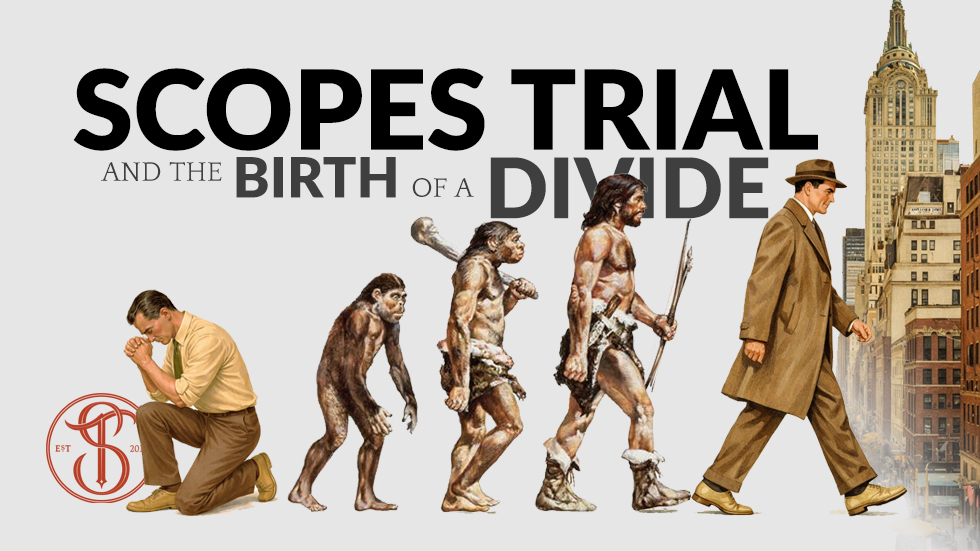
In the summer of 1925, a small courtroom in Dayton, Tennessee became the stage for one of the most consequential legal and cultural confrontations in American history. A high school biology teacher, John T. Scopes, was charged with violating Tennessee’s Butler Act by teaching evolutionary theory in a public school classroom. On one side stood the famed attorney Clarence Darrow. On the other stood three-time presidential candidate and public Christian spokesman William Jennings Bryan.
Legally, the case was narrow. Culturally, it was explosive.
Newspapers and radio framed the trial as a showdown between enlightened science and backward faith. Rural Christians were caricatured as anti-intellectual. Urban modernity was presented as the inevitable future. Though Scopes was found guilty and later cleared on a technicality, the deeper verdict had already been rendered in the national imagination.
Christian faith had been pushed into a defensive corner of public life.
From that moment forward, many believers began to feel that the engines of modern America, especially education, science, and industry, were not simply neutral spaces but spiritually suspect ones.
A divide took root. Church was sacred. The rest of life felt increasingly secular.
Education, Industry, and the Great Withdrawal
In the decades following Dayton, large segments of American Christianity responded not by rethinking their theology of culture but by retreating from it. Universities, research institutions, and industrial cities were often treated as hostile territory. Higher education was encouraged mainly for pastors and missionaries studying in seminaries. And urban life felt morally dangerous compared to the perceived safety of rural or insulated Christian communities.
This instinct was understandable. Public mockery had stung.
Many Christians feared losing their children to an aggressive secularism. But their escapism response had unintended consequences.
By stepping back from classrooms, laboratories, and city centers, the church ceded influence over the very places where culture was being formed. Education and industry were quietly handed over to narratives that assumed God was irrelevant to them.
This retreat narrowed the practical meaning of discipleship. Serving God became associated primarily with church-based roles, while everyday vocations were treated as spiritually secondary.
Yet the biblical story does not permit that split.
From the opening chapter of Genesis, humanity is commanded to cultivate and steward the earth. The mandate to “fill the earth and subdue it” includes developing knowledge, building cities, organizing economies, and pursuing discovery. Culture making is not a distraction from obedience to God. It is part of it.
New Testament scholar N. T. Wright has argued that the Christian hope is not about leaving the world behind but about God putting the world right. If creation is destined for renewal, then engagement with creation in the present matters. Work done in faith is not wasted effort in a disposable world. It is a foretaste of restoration.
Pentecostal theologian Amos Yong pushes this even further by emphasizing the activity of the Spirit beyond church walls. He contends that the Spirit’s redemptive work is not confined to explicitly religious spaces but moves throughout human cultures and institutions. That means classrooms and companies are not outside God’s mission. They are among its arenas.
The early church seemed to understand this instinctively. As Craig Keener’s historical work on the New Testament world shows, the gospel spread through ordinary social, commercial, and educational networks of the Roman Empire. Christians did not abandon those networks. They inhabited them with a new allegiance to Jesus as Lord.
The post Scopes withdrawal, by contrast, created a practical theology in which Sunday belonged to Christ but Monday largely belonged to someone else.
A Divide That Still Shapes Us
Nearly a century later, the effects remain. Many believers still feel an unspoken hierarchy of callings. Full time ministry feels sacred. Marketplace work feels merely practical.
This instinct runs against the grain of the gospel itself. Reflecting on Paul’s letter to the Galatians, Tim Keller often emphasized that grace is not only the doorway into the Christian life but the operating system of the whole life. If justification by grace alone defines our standing before God, then no profession earns more spiritual credit than another. All faithful work becomes response, not self-salvation.
Paul’s instruction in Colossians 3:23 makes this explicit. Whatever you do, do it as for the Lord. The command does not carve out exceptions for science, commerce, or public life.
Daniel D. Isgrigg’s eschatological work highlights that the church lives from the future that God has promised. Because God intends to renew creation rather than discard it, Christian life in the present anticipates that future renewal. Engagement with the structures of society is not compromise. It is participation in what God will one day complete.
When the church treats education and industry as spiritually neutral or hostile by default, it ends up affirming the very secular story it wishes to resist. It implies that large portions of human life fall outside Christ’s present concern.
Scripture tells a different story. The incarnation declares that God entered the material and cultural world. The resurrection declares that this world has a future in God’s purposes. Together they collapse the wall between sacred and secular.
Living as if Christ Is Lord of Monday
If the Scopes era widened the divide, the church today has an opportunity to close it.
This begins with recovering a theology of vocation. Teaching biology, designing software, managing investments, and running factories are not lesser kingdom assignments. When done in love, truth, and justice, they are ways of serving God and neighbor.
It continues with reentering the spaces once abandoned. Universities and cities are not enemy territory. They are places where faithful presence matters precisely because formative ideas and systems are forged there.
And it requires discipleship that reaches past Sunday. Pastors and churches must equip believers not only to pray and worship but to think, create, lead, and build in ways that reflect the character of Christ.
The courtroom in Dayton convinced many Christians that the modern world was slipping beyond God’s reach. The gospel insists the opposite. “The earth is the Lord’s and the fullness thereof” in Psalm 24:1 includes lecture halls, laboratories, and loading docks.
To live beyond the sacred secular divide is to take that claim seriously in ordinary work, ordinary study, and ordinary civic life. Not as a compromise with modernity, but as confidence that the Spirit of God is already at work there, inviting his people not to retreat from the world but to faithfully tend it.

Bill Tibbetts
Bill Tibbetts is the Vice President of Education and Multiplication at The Stone Table, bringing over two decades of experience in higher education to his role. As the former Dean of the College of Business and Technology at North Central University, he developed a deep passion for mentoring, missions, and business consulting. Bill's extensive expertise uniquely positions him to lead initiatives that encourage marketplace believers and college students to actively engage with the Great Commission. He also serves on the board of the Community Reinvestment Foundation and is based in Minneapolis, MN, supporting The Stone Table's expansion into new regions.