
Why Your Calling Never Changes But Your Assignment Does
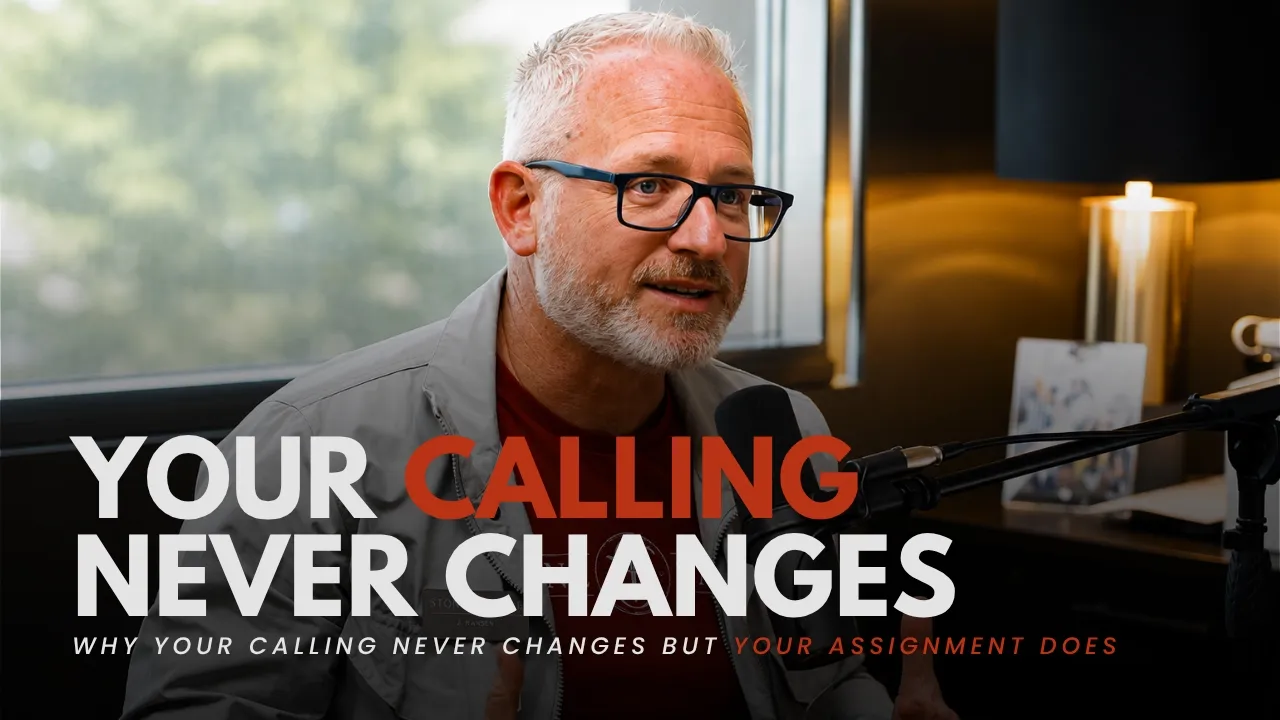
Calling Versus Assignment and Why You Never Actually Missed the Call
There is a specific kind of disappointment that a lot of Christians carry quietly for years. It usually starts young, often at a summer camp, during the service where everyone is invited to answer the call to ministry. Erik Cooper remembers those nights. Everyone praying. The same question running on a loop. Am I called? Am I called? Am I called? And then walking out with a private verdict. No. I guess I’m not called.
Nobody set out to wound anyone. The goal was to stir up passion for ministry and missions. But the language did something it was never meant to do. It split the room into two groups: the called, and everyone else. The fix is a single distinction, and once you have it, the whole disappointment falls apart.
Three Layers, Not One
Dick Brogden, who leads the Live Dead missions movement, says the trouble begins when we make our calling too specific. He breaks it into three layers.
Calling is what every follower of Jesus shares. It is Jesus and His glory amongst all peoples. It does not vary from person to person, and it does not change over a lifetime.
Assignment is the specific arena you serve in. Pastor. Missionary. Accountant. Contractor. Assignments shift occasionally.
Role is the most granular layer. It changes constantly.
In Brogden’s words, “Roles change a lot. Assignments change occasionally. Calling never changes. It transcends geography, it transcends personality, it transcends age.”
Most of our confusion comes from collapsing all three into one word and then treating the whole stack as fragile.
Why This Rescues People in Crisis
The framework is not just tidy. It is pastorally load-bearing.
Picture a missionary who believes they are called to Libya. Then comes a civil war, or a visa problem, or a health emergency, and they are forced out. Under the collapsed definition, their calling just died with the assignment. They are left asking what happened to the thing they built their life on.
Under the three-layer definition, nothing happened to the calling at all. The assignment moved. As Brogden puts it, you are called to Jesus and His glory in all the earth, so go do it in Morocco.
The same logic runs in every direction. Move from pastoral ministry to the marketplace, or from the marketplace into missions, and the calling never flickers. Only the seat changes.
The Seat Changes, the Calling Doesn’t
Cooper lived this in 2012. After twelve years in full-time vocational ministry, he found himself renting apartments. The first weeks were disorienting. His passion for Jesus was still the defining fact of his life, and yet his Monday looked nothing like his old Sunday.
The way he describes it is memorable. He went from preaching on Sundays to renting apartments on Mondays, and the honest question was how the two things could possibly belong to the same life.
The answer he landed on is the whole point. Your calling’s the same. You just sit in a different seat now.
Rob Ketterling applies the same correction inside his own church. When a staff member says they are called to be a youth pastor, he stops them. You are called for the global glory of Jesus. Youth ministry is the assignment, and assignments move. So does your role, and someday even your location. All of it is movable except the one thing underneath.
How Assignment Actually Gets Discovered
If calling is settled and assignment is discovered, how do you find the assignment? The two stories in this conversation suggest it is less a lightning bolt and more a slow convergence of what you love.
Ketterling felt something undeniable at fifteen on a missions trip in the Amazon basin. He wept during devotions, certain God was calling him into ministry, though he could not have explained it. He assumed he would be a doctor and even enrolled in pre-med. A month before classes started, the assignment clarified: pastor. Not missionary, as he first suspected, but a pastor who sends and fuels missionaries. Thirty years into one church, that assignment has held while his roles shifted from worship to youth to lead.
Brogden settled his calling at sixteen, looking at the stars and reading Psalm 19. If the heavens declare God’s glory, he reasoned, how much more the peoples of the earth. The assignment came later and gradually, worked out through the specific loves God had planted: a heart for Africa, a burden for Muslims, an appetite to pioneer where no church existed. As those loves converged, the assignment revealed itself.
Notice the pattern. Neither man went looking for an assignment in the abstract. The assignment emerged from settled calling plus God-given desire over time.
The Word Marketplace Believers Need to Retire
Cooper’s plea is that we stop letting people say, I didn’t get the call, I’m just going into the marketplace.
That sentence contains a lie the framework exposes. The global glory of Jesus belongs to every believer equally. We simply sit in different seats on the same bus, or as Brogden likes to say, at different points on the same apostolic spear. The engineer, the accountant, the apartment manager, and the missionary all own the identical calling.
You did not miss it at camp. You were never going to miss it. The calling was never the thing on offer that night. Only the assignments differ, and yours is as sacred as anyone’s.
Start here: thestonetable.org/start
Full Transcript
Erik: We talk a lot about this idea of calling. Dick, in our breakfast this morning, you brought up this idea of calling and assignment, which I thought was really interesting. Before I press you guys on your own personal journeys, can you unpack that for us a little bit?
Dick: I think where we get in trouble is when we have too specified a calling. Calling is general, and what I believe theologically is that every single follower of Jesus is called to Jesus and His glory amongst all peoples. That’s a calling we share together.
Under that calling, we have different assignments. So Rob’s a pastor, I’m a missionary. Under those assignments, we have different roles. I’ve done different things as a missionary in different places. Rob’s done different things as a pastor. The most fluctuation is at that tertiary level. Roles change a lot. Assignments change occasionally. Calling never changes. It transcends geography, it transcends personality, it transcends age. We are always called to Jesus and His glory amongst all peoples. The assignments will have some fluctuation over time.
Where that’s helpful is, let’s say there’s a missionary called to Libya. If they think that’s where they’re called to, then a government issue, a civil war, a health issue, and they’re kicked out or they can’t stay. They think, what happened to my calling? Nothing. You’re called to Jesus and His glory in all the earth. Go do it in Morocco. Or if the Lord leads you to go pastor, if the Lord leads you into the marketplace. So when you go from marketplace to missions, or from pastoral to marketplace, your calling hasn’t changed. Your calling is steady. You’re always called to Jesus and His glory amongst all peoples.
Erik: I love that, Dick, because I had that experience in 2012. I had spent twelve years in full-time vocational ministry and then all of a sudden found myself here renting apartments. I remember those first few weeks. My passion for Jesus is still the driving identifier of my life. So I went from preaching on Sundays to renting apartments on Mondays. How do these two things go together?
And the Lord spoke to me so clearly: your calling’s the same, you just sit in a different seat now. But the global glory of Jesus is our calling. So we always try to encourage marketplace people with that, because they say, I’m not called into ministry. That calling versus assignment vocabulary is just really helpful.
Rob: I love it. And I’ve done that with staff, because they’ll say, I’m called to be a youth pastor. And I’m like, no. You’re called for the global glory of Jesus. You’re in ministry, so you’re one of the fivefold, okay, we get that. But your role is going to change. Your assignment is going to change. And someday your location may have to change. All those are movable. The first one isn’t.
Erik: So if we’re going to use that terminology of calling and assignment, when did the Lord reveal your direction? Maybe tell us a little bit of your personal story about how you ended up in the assignment of pastor, and in the assignment of missionary.
Rob: I was fifteen years old on my first missions trip. I was in the Amazon jungle basin in Brazil, and I remember doing devotions and I just wept. I felt like God said, you’re going to do this for me. You’re going to be called into ministry. I couldn’t explain it. I was fifteen. I just knew it was a moving moment.
I came back and shared it with my parents, and they were like, okay. And I really wanted to be a doctor. The desire in my heart was to be a doctor. I even enrolled at ORU for pre-med. I was going to be a doctor. It wasn’t until a month before school started that I felt God saying, no, I have called you to be a pastor. I thought it was pastor or missionary. I didn’t know. Actually for a while there I thought it clearly was missionary, and then it turned out to be pastor that is sending missionaries and fueling missions.
But I’ve got to tell you, even to this day, I’ll still say to my wife, okay, we’re still called, but should we move? Like, we should start a church in Bangkok. Everywhere I go I fall in love and I see the need and I’m like, we should go. And she’s like, we have our ministry. And until God calls both of us…
Erik: Be careful saying that sitting next to Dick Brogden.
Rob: Trust me, I know. But she knows. So that’s how it happened. Once I laid it down and said, I’m not going to be a doctor, I’m going to be a pastor or missionary or whatever you want me to be. I’ve done youth pastor, lead pastor, I was a worship pastor for a while, and I’ve been able to move around in those positions. I love where I am now. And I prayed this prayer: God, could I pastor one church my entire life? I’m thirty years in on one church.
Erik: That’s awesome. Love hearing a little bit of that. So Dick, what about you? When did you know your assignment was going to be the global mission field?
Dick: Backing up one step, I knew calling when I was sixteen, looking at the stars in the heavens. Psalm 19, the heavens declare the glory of God. There is no language or speech where their voice is not heard. That’s where I settled that whatever I did assignment-wise, I wanted to live for the glory of Jesus amongst the nations. I thought, if stars can glorify Him, how much more the crown of His creation, which is all the peoples of the earth.
So calling was settled at sixteen. Then I went to North Central Bible College, and I loved Africa, and God gave me a heart for Muslims in prayer. And I liked a fight, so I wanted to pioneer. I didn’t want to go where there was a church or Christians. I wanted to go where there was nothing. So the assignment was actually worked out through some of the loves that the Lord had put in my heart. As those loves coalesced, it showed me what my assignment was.
Erik: That is really cool. I wrestled with that a lot as a kid. We’d go to summer camp and there was always a called-into-ministry night, and we would all pray and go, am I called, am I called, am I called? And I always left those services going, no, I guess I’m not called.
I understand what we were doing in those moments. We were trying to spark a passion for people to go into full-time ministry or missions. But I do think, if we’re not careful with that language, we can end up creating a bifurcation that we don’t intend to create. I remember telling people, no, I didn’t get the call. I’m just going into the marketplace.
So I love hearing these stories of you personally, but I also love framing it for marketplace people to say the global glory of Jesus belongs to all of us. We all sit in different seats on that bus, or as you like to say, Dick, on the apostolic spear. But we all own that calling.

Darren Cooper
After spending years on the creative staffs at multiple churches and even starting a business of his own, Darren joined The Stone Table team to help in all things creative. He is also a producer and composer and loves to speak through the medium of music. Find out more at darrencoopermusic.com.