
Rooted in Scripture & Unapologetically Practical
Career Focus
Personal Finance Focus
Church Focus
Relationships Focus
WELCOME
LAUNCH is not a typical devotional.
It’s rooted in Scripture and unapologetically practical. The goal is not inspiration alone, but formation that actually shows up in real life.
Beta Test
This is a beta. We’re testing the content, structure, and impact. The final version will have a lot more bells and whistles, including an opportunity for a mentor to partner with you on the journey.
Near the end of the semester, you’ll be invited to complete a short evaluation. Those who participate will be eligible for a financial prize. Your feedback matters.
How Each Week Works
Four Categories | 12 Weeks: Career, Finance, Church, Relationships
The Weekly Devotional
A focused Scripture passage, short teaching, reflection questions, and optional Scriptures for the week. No pressure, but you’ll get out of it what you put in.
Practical Application
This is where faith meets real decisions. Career planning, managing money, building community, and developing healthy rhythms during and after college.
This is theology presented for real life. Skimming won’t help. Wrestling will.
About The Guy Who Wrote This
Hey, I’m Bill.
(most people call me by my last name…Tibbetts)
For over 20 years, I’ve had a front-row seat to the lives of people in their 20s. College students, young professionals, and leaders trying to follow Jesus while figuring out work, money, relationships, and what they’re supposed to do with their lives.
I love this season. It’s honest. It’s fun. It’s awkward. It’s full of big questions and half-formed answers. And it matters.
People who know me describe me as intentional in my relationships, fluent in Scripture and spreadsheets, and known for a laugh you can hear from the other side of the restaurant. All of that shows up here.

This devotional didn’t come from a quiet cabin and a leather journal. It came from thousands of conversations. Coffee shops, late-night texts, career freak-outs, faith questions, hard decisions, and a lot of Scripture opened in real life.
Mentoring young adults is one of the great privileges of my life. I don’t take that lightly.
One last thing. And I mean this.
I don’t want this to be a one-way experience. I genuinely want to hear from you. If something clicks, confuses you, challenges you, or you just want to talk, reach out. I’m in.
Email: bill@thestonetable.org
Text: 952.836.7178
Instagram: bill_tibbetts
LinkedIn: Bill Tibbetts
(Please don’t be a psycho and sell my information. If that happens, I expect a business plan and revenue projections.)
If you’re willing to engage, I’m willing to walk with you.
WEEK 1 | Career Focus
The Great Divide: When School And Work Feel Spiritually Empty
(20-25 mins)
The Tension We Carry Into Monday
Faith tells me my school and work matter to God.
Most days, it doesn’t feel like it does.
Scripture For Day 1
How I Ended Up Here
I was twelve years old when I picked up All the President’s Men.
Two reporters.
A break-in at the Watergate Hotel.
A secret source.
And the President of the United States slowly unraveling at the end of the trail.
I was hooked.
Maybe it was all the Scooby-Doo reruns. Maybe I just liked the idea of pulling masks off powerful people. Either way, something clicked. I was going to be an investigative reporter.
I studied journalism.
I wrote constantly.
I joined student politics.
I had a plan.
And then I met Jesus.
Suddenly my world tilted. Church became oxygen. Worship nights. Pizza with my new Christian friends. Reading Scripture until I fell asleep on the couch. Life felt smaller and brighter at the same time.
Somewhere in that early formation, I picked up an idea without realizing it. “Real ministry” happened at church. My future job out in the so-called secular world existed for two reasons. Make money to support ministry. Convert my coworkers before lunch.
No one ever said that out loud.
But I lived like it was true.
So I stuck with the plan. Graduated. Got hired at the Cincinnati Enquirer.
That first day felt cinematic. The old building looked like Superman should leap off the roof at any moment. I got my badge photo taken. Rode the elevator. Walked into cubicle land.
Back then, cubicles meant you had arrived
Today they mean you probably need therapy.
The guy next to me was Jim. I swear he stood eight feet tall. The first thing he said to me was, “How the (bleep) you doing, Bill? Welcome to the (bleeping) team!”
(my poor baby Christian ears)
On the other side sat Janell. Brilliant. Friendly. And surrounded by artwork that made me suddenly very aware of my eye contact. Mid-handshake she casually told me she was an exotic dancer on the weekends.
I froze.
I sat at my desk completely spun out. How did this fit into God’s plan? How did chasing deadlines and sitting between Big Jim and Janell have anything to do with Jesus?
I missed the early days of faith. The clarity. The sense that everything mattered.
Instead, all I felt was the gap.
Church on one side.
School and work on the other.
And nothing connecting the them.
Truth That Closes The Divide
What I was experiencing that day has a name.
The sacred-secular divide.
Here’s how it works. We divide life into categories. Church. Bible. Prayer. That’s sacred. Work. School. Emails. Dishes. That’s secular.
Once you split life that way, one side always feels more important.
Church feels eternal.
School and work feel like filler.
Say it out loud and it sounds ridiculous. Would Jesus really look at your Monday and say, “Yeah, this part doesn’t count”? Of course not.
And yet, if we are honest, that is exactly how many of us live.
Paul confronted this thinking head-on in a letter to a small church in Colossae. They were being pressured by voices telling them Jesus was good, but not quite enough. They needed extra rules. Extra spirituality. Extra experiences.
Paul didn’t start with behavior.
He started with Jesus.
“The Son is the image of the invisible God… For in him all things were created… all things have been created through him and for him. He is before all things, and in him all things hold together.”
All things.
Not just church things.
Not just quiet times.
Not just moments that feel spiritual.
Then Paul pushes it even further.
“For God was pleased to have all his fullness dwell in him, and through him to reconcile to himself all things… by making peace through his blood, shed on the cross.”
If Jesus is reconciling all things, then there is no corner of your life labeled irrelevant.
Author and super influential guy Tim Keller once said, “Any work done well, for the glory of God, is Christian work.”
Your school and work are not neutral.
They are formative.
They shape your patience.
Your integrity.
Your humility.
Your love for people who cannot help you.
They may not feel meaningful. But meaning is not found in the task. It is found in who you are becoming while you do it.
Storyteller Lisa Sharon Harper once said, “Holiness is not separation from the world; it’s participation in God’s healing of it.”
(oooh, read that again)
God is not waiting for you to leave class or clock out so He can be involved.
He is already there.
The sacred-secular divide collapses when you realize this. Your whole life is one story under Christ. No compartments. No pretending. Just one sacred life, everywhere you go.
Questions To Wrestle With This Week
- Where have I quietly assumed God cares more about my church life than my school or work life?
- What part of my daily school or work most resists being offered to God, and what might that reveal?
- If my school or work is shaping me, who am I becoming because of it?
Simple Prayer To Carry This Week
Jesus, meet me in the work I usually overlook.
Scripture For The Rest Of The Week
Day 2: Genesis 1:26–31
Day 3: Psalm 90:16–17
Day 4: Proverbs 16:3–4
Day 5: Ecclesiastes 3:9–13
Day 6: 1 Corinthians 10:31
Day 7: Revelation 21:1–5
Application For The Week
(10-12 mins)
Choose one ordinary part of your week. Schoolwork. Job tasks. Chores. Errands. Before you start, intentionally offer it to Jesus. No performance. No pressure. Just presence. Share this goal with a friend.
No More Calling FOMO: When Everyone Else Sounds So Sure
(20-25 mins)
The Tension We Feel but Rarely Admit
It feels like everyone else knows their calling.
I’m afraid I’m missing mine.
Scripture For Day 1
How Calling Became a Source of Anxiety
Some of my college friends still qualify as ride-or-die.
And here’s the wild part. We stayed close without social media or texting.
I know.
I sound ancient.
College is a crash course in identity. You walk in one person and walk out another. New ideas. New habits. New beliefs. A haircut you will regret forever.
(looking at you, alpaca cut)
Even if you did not go to college, your twenties work the same way. You are evolving. You can still recognize the old you, but something is clearly different.
I was part of an on-campus ministry at Purdue University, and we were often challenged to “live for God’s purpose.”
For impressionable twenty-somethings, that message hit hard.
And sometimes, we completely missed the point.
I remember the first time someone in our group said, “I know God’s calling for my life.”
My ears perked up.
Then someone else said it.
And someone else.
And someone else.
Apparently, God was handing out crystal-clear blueprints to everyone but me.
Cue the internal panic.
Why was everyone else so sure? Where was my lightning bolt moment? Did I miss it because I was not praying hard enough? Was God testing me? Was I already behind?
I started looking at my future like a landmine field.
One wrong step.
Boom.
Game over.
That fear is real.
And if it’s not fear it’s confusion of what steps to take to figure out the future.
Both quietly paralyze a lot of people.
You stop applying.
You stop exploring.
You stop moving.
And it’s not because you are lazy
Truth That Brings Freedom
Looking back, I realize we had two categories completely mixed up.
Calling and assignment are not the same thing.
Jesus was once asked a question meant to trap Him. A religious expert asked, “Teacher, which is the greatest commandment in the Law?”
There were 613 laws at the time. Rules about food. Rules about clothing. Rules about rest. Rules about worship.
Jesus did not hesitate.
“Love the Lord your God with all your heart and with all your soul and with all your mind.”
“And love your neighbor as yourself.”
That was it.
Two sentences.
Jesus was not being poetic. He was being revolutionary. He stripped faith down to its core.
Love God.
Love people.
That is your calling.
(let’s say this in unison: “my calling is to love God and love people as myself”)
It does not change with your job title.
It does not expire when you feel confused.
It does not disappear if you make a wrong turn.
Gordon T. Smith, theologian, famously said, “Calling is not first about what we do, but about who we are and whose we are.”
Where you live that calling out is your assignment.
Assignments change.
Jobs change.
Cities change.
Seasons change.
Calling stays.
Think of it like Mario Kart.
Everyone is heading toward the same finish line. But the routes look different. Some people find shortcuts. Some hit banana peels. Someone always gets wrecked by a blue shell right before the end.
Still bitter about that.
Different routes. Same destination.
So how do you choose an assignment?
If it gives you space to love God and love people, you are free to pursue it.
(no skywriting required)
Paul reinforced this when he wrote, “You, my brothers and sisters, were called to be free. But do not use your freedom to indulge the flesh; rather, serve one another humbly in love” (Galatians 5:13).
Your calling is not a mystery to solve
It is a posture to live from.
Which means this.
You do not need to wait until you feel sure to move forward.
You move.
God guides.
Questions To Wrestle With This Week
- Where have I been waiting for clarity instead of taking responsibility for movement?
- What fears surface when I think about choosing the wrong path?
- How could my current season become an assignment instead of a placeholder?
Simple Prayer To Carry This Week
Jesus, thank You that my calling is secure even when my future feels uncertain. Give me courage to take steps instead of waiting for perfect clarity. Help me be faithful in the assignment I have today. Amen.
Scripture for the Rest of the Week
Day 2: Galatians 5:13–14
Day 3: 1 Corinthians 7:17
Day 4: Colossians 3:17
Day 5: Micah 6:6–8
Day 6: Ephesians 4:1–6
Day 7: John 15:16–17
Application For The Week
(120-180 mins)
This week, you are going to build a resume.
Not a perfect one. A usable one. Why? So when opportunity shows up, you are ready!
Step 1: Build your resume
There are thousands of online tools and resume builders online. Here are my top three free recommendations:
Pro Tip: Early career resumes need to focus on skills you’ve gained. This helps elevate traditional jobs you may have held as a teenager or young adult. Here’s what I mean:
- Traditional Statement: Worked as cashier, dealing with customers and multiple forms of payments.
- Skill-Focused Statement: Managed fast-paced POS operations while driving customer engagement through Target Circle and RedCard promotion.
Pro Tip: You should adjust your resume for every place you apply. A simple way to stay organized is to save each resume as a PDF using your name and the company name.
Examples:
- Beverly Smith_Sephora USA.pdf
- Beverly Smith_Target Corp.pdf
Step 2: Get it on LinkedIn
Create or update your LinkedIn profile so it aligns with your resume.
When professionals you network with look you up, LinkedIn is usually the first place they go. A polished profile signals credibility, professionalism, and that you take your career seriously.
WEEK 3 | Career Focus
You Don’t Have to Have It All Figured Out
(18-22 mins)
The Tension We Feel Late at Night
I thought I would feel more settled by now.
Instead, I have no idea what I want to do 10 years from now.
Scripture For Day 1
Why Feeling Behind Is Normal, Even If It Feels Like Failure
My daughter loved puzzles as a toddler.
Obsessed, really.
What do you think she did first after dumping the pieces out?
Start with the corners?
Build the border?
Be a lunatic and start in the middle?
(side note: that last one is why my wife and I no longer do puzzles together)
Nope.
She propped up the box cover.
She wanted the picture. The endgame. Every move she made went back to that image.
Wouldn’t it be nice if life worked like that?
Career.
Relationships.
Where to live.
When to buy a car.
Life would still be work, but at least you would know the goal. Instead, we get the pieces without the box.
And that is where the anxiety creeps in.
Because we crave control
But we live in a world that often feels out of control.
Those two things do not play nicely together.
Think about what you and your friends have already lived through.
The 2008–2009 financial collapse stressed your parents and reshaped households. It took nearly a decade for the economy to recover.
Then COVID hit. The entire world shut down. Schools closed. Jobs vanished. Plans evaporated.
Layer on national anti-racism demonstrations. Political unrest. School shootings.
And we wonder why stability feels like oxygen.
Why control feels essential.
Honestly, that reaction makes sense.
Scripture never shames our desire for stability. In fact, Proverbs tells us that planning is human. It is normal. It is wise. “The plans of the diligent lead surely to abundance, but everyone who is hasty comes only to poverty.” (Proverbs 21:5).
The problem is not planning.
The problem is when planning becomes the place we look for peace.
Poet and musician Jackie Hill Perry puts it this way: “Obedience today is better than clarity about tomorrow.”
(dang)
I sometimes wonder how Boomers survived world wars and the Great Depression. I genuinely do not know.
But I do know this. The answer for you is not, “Just toughen up.”
Truth That Creates Direction
One of the biggest stress points in your twenties is career.
Where do I work?
What do I major in?
What is my calling?
We have already talked about this earlier. Your calling is clear.
Love God.
Love people.
Jesus Himself said that everything else hangs on these two commands (Matthew 22:36–40). That is the picture on the puzzle box.
But here’s the tension. It’s a great picture, but it doesn’t tell you your next step.
So let’s zoom out before we zoom in.
Here is the posture that changes everything.
Be a learner.
Be curious.
Be willing to discover.
Step outside your comfort zone.
Try things.
Proverbs 18:15 says, “The heart of the discerning acquires knowledge, for the ears of the wise seek it out.”
That posture alone will reshape how you experience your twenties.
A former coworker of mine named Simon once explained it with an image that stuck with me.
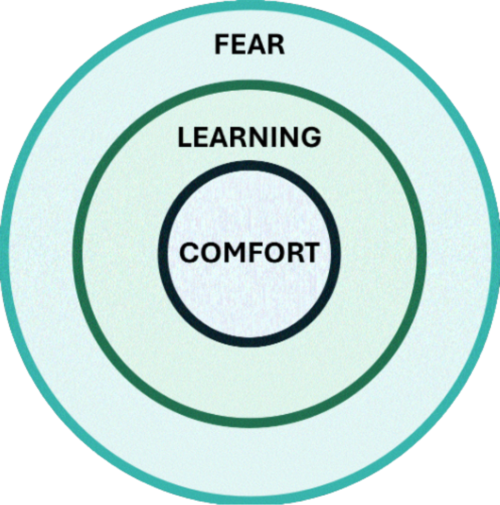
Three rings.
In the center ring is the comfort zone. It is where we all want to live. Easy. Predictable. Safe.
The next ring out is the learning zone.
The outer ring is fear.
Here is what most of us do. When we are nudged out of our comfort zone, we skip learning and run straight to fear. Because at least fear is familiar.
This creates a life where everything feels binary. Good or bad. Safe or unsafe. Win or fail.
But real growth does not happen in comfort or fear.
It happens in the learning zone.
That space between what is familiar and what is terrifying is where new skills form. Where discernment grows. Where God stretches you.
Scripture actually agrees.
“In their hearts humans plan their course, but the Lord establishes their steps” (Proverbs 16:9).
You plan.
You move.
He guides.
You cannot be guided if you never take a step.
“God seems far more interested in our trust than our plans,” said author Brant Hansen.
God does not promise to hand you the full picture. He promises to direct you as you move.
How This Applies To Building Your Career Right Now
Let me hit you with a few practices more people should be talking about.
First, informational interviews matter more than you think.
Reach out to people in fields you like and ask about their journey. One student I worked with did this and landed seventeen calls, three internships, and a career she loved. (instructions below)
Second, see your first job as an investment.
Your first job will not be your last job. Think stairs, not elevator. One woman wanted event planning but started in window sales. Not glamorous. But she built skills that eventually launched her into her dream role.
Third, test the waters.
Explore industries you never considered. Keep a like and dislike list. One student thought she loved people and entered Human Resources. After one summer she said, “I hate people now.” They laughed, let her try other departments, and she discovered marketing. By twenty-five, she was overseeing national food brands.
Fourth, only plan for the next three to five years and eliminate the question, “What do I do for the rest of my life?”
Scripture almost always talks about guidance in terms of steps, not lifetimes. I went from journalism to international finance, then into church ministry, then higher education, and now I’m leading a nonprofit. None of that was part of a lifelong plan. It was a series of faithful next steps. Think less about forever and more about what’s right in front of you.
Questions To Wrestle With This Week
- Where have I been confusing clarity with faithfulness?
- What step have I been postponing because it feels too small to matter?
- Who might God want to use to shape my next step?
Simple Prayer To Carry This Week
God, I don’t need to see the whole path.
Help me trust You with my next step.
Give me courage to move instead of waiting. Amen.
Scripture For The Rest Of The Week (Optional)
Day 2: Psalm 37:23–24
Day 3: James 1:5
Day 4: Isaiah 30:18–21
Day 5: Matthew 6:31–34
Day 6: Hebrews 12:11
Day 7: Lamentations 3:31–33
Application For The Week
(150–180 mins)
This week, your goal is simple. Start conversations by doing Informational Interviews. Not networking in the cringey, transactional sense. Curiosity-driven connection.
Step 1: Identify 14 people
Two per day for seven days. Look on LinkedIn for people in fields you are interested in, even a little bit. Do not overthink this. Curiosity is enough.
Step 2: Send a short, respectful message
You can copy and paste this and personalize it.
Greetings, my name is (your name), and I’m studying (your major) at (your university).
You’re in a field I’m exploring as an option for my future.
Would you be open to meeting for 30 minutes, virtually or over coffee, to talk about your career journey?
Some people will not respond. That is normal. This is not failure.
Step 3: When you meet, ask these four questions
- What was your journey that led to your current position?
- What is the best and worst part of your job or industry?
- Is there anyone else in your network you recommend I talk to?
- Would you be willing to review my resume?
This is not about impressing anyone.
It is about learning.
Listening.
Taking steps.
Movement creates momentum.
WEEK 4 | Personal Finance Focus
Stewardship Starts With Seeing Clearly
(12–15 mins)
The Tension We’d Rather Avoid
I want to be wise with money.
I just don’t want to look too closely at it…it’s easier to ignore.
Scripture For Day 1
Why Facing the Numbers Feels Scarier Than Ignoring Them
I’ve walked thousands of individuals and couples through personal financial management.
(I’ve seen it all)
Young couples getting married with six-figure debt. Students using financial aid refunds to buy seventy-five-inch TVs for their dorm rooms. People working part-time jobs while driving brand-new cars with premium payments.
And I’ve never judged one of them.
Because the truth is, we’ve all made financial mistakes.
But one person stands out. Her name was Pearl.
True story.
Like many people, Pearl had no idea what her full financial picture actually looked like. She did not know her total student loan balance. She did not know what she was spending each month. She did not know where her money was quietly going.
So we started with discovery.
Track every dollar.
Write it down.
Face it.
That step alone took courage.
And that is when we found it.
To her shock and mine, Pearl was spending $460 a month at Starbucks.
(yes…you read that right)
Four. Hundred. And. Sixty. Dollars.
That is not a coffee habit
That is a car payment.
For context, Gen Z today averages around fifty-seven dollars a month on coffee. Pearl was outpacing her entire generation.
And she had no idea.
Because she had never looked.
Scripture names this dynamic honestly. Ecclesiastes says that money often promises satisfaction but quietly fuels restlessness instead. “Whoever loves money never has enough” (Ecclesiastes 5:10). The issue was not Pearl’s latte. It was that her money was shaping her without her knowing it.
Jesus said it this way. “Where your treasure is, there your heart will be also” (Matthew 6:21). Which means money is never just math. It is formative.
Pearl was not reckless
She was unaware.
And avoidance did not protect her
It controlled her.
Once the numbers were clear, something shifted. Not overnight. Not magically. But steadily. Pearl learned stewardship. She tracked her money. She made a plan. She applied biblical wisdom to real life.
And slowly, things changed.
Today, she is debt free.
Not because she found a secret hack
But because she chose to see clearly.
Truth That Reframes Money
Jesus once told a story about building a tower.
“Suppose one of you wants to build a tower. Won’t you first sit down and estimate the cost to see if you have enough money to complete it?” (Luke 14:28).
That is not a budgeting seminar.
That is wisdom.
Jesus is not criticizing ambition. He is not condemning the builder. He is naming a reality we often avoid.
Clarity comes before construction.
Throughout Scripture, stewardship begins with awareness. Proverbs puts it plainly. “Be sure you know the condition of your flocks, give careful attention to your herds” (Proverbs 27:23). In an agrarian society, that was wealth language. Know what you have. Know what you owe. Know where you stand.
Scripture never shames us for wanting stability. It acknowledges seasons, limits, and responsibility. But it consistently warns against drifting blindly. “The prudent see danger and take refuge” (Proverbs 22:3).
Avoidance may feel safer in the moment, but it gives fear the steering wheel.
Stewardship is not about God needing your money.
Moses reminded Israel, “Remember the Lord your God, for it is he who gives you the ability to produce wealth” (Deuteronomy 8:18). David echoed the same truth. “Everything comes from you, and we have given you only what comes from your hand” (1 Chronicles 29:14).
We do not own
We manage.
Money is kind of like water…if it flows, it gives life. If it stagnates, it destroys.
Jesus summarized it this way. “Whoever can be trusted with very little can also be trusted with much” (Luke 16:10).
Before budgets
Before generosity
Before long-term plans.
There is honesty.
And honesty is not condemnation.
It is the first step toward freedom.
Questions To Wrestle With This Week
- What emotions surface when I think about looking at my full financial picture?
- Where have I been avoiding clarity because I fear what I might find?
- How might honesty about my finances actually reduce anxiety instead of increase it?
Simple Prayer To Carry This Week
God, I want to be faithful, not fearful.
Give me courage to see clearly and trust You with what I find.
Meet me with grace as I take this first step. Amen.
Scripture For The Rest Of The Week (Optional)
Day 2: Proverbs 27:23–24
Day 3: Romans 13:8
Day 4: Matthew 6:19–21
Day 5: Proverbs 22:7
Day 6: Ecclesiastes 5:10–12
Day 7: 1 Timothy 6:6–1
Application For The Week
(45–60 mins)
This week is not about fixing anything. It is about finding your total indebtedness.
That means naming every place you owe money, even if the number feels uncomfortable.
Take this step slowly and honestly.
Step 1: Student loans
- Check Federal Student Aid.
Step 2: Private loans and credit cards
- Login to the lender’s website (aka. the people who gave you the money).
- If you’re unsure if you have other debt, pull a free credit report at Annual Credit Report.
Step 3: Friends and family
- Identify any money that you have borrowed from others.
When you are finished, add everything together.
That number is not your identity
It is information.
You do not need a plan yet.
You just need to be honest.
Clarity is the first act of stewardship.
WEEK 5 | Personal Finance Focus
Enough Is A Spiritual Discipline
(12–15 mins)
The Tension We Carry Quietly
I often feel inside like I need a little more at times
to feel secure (emotionally and practically).
Scripture For Day 1
Why More Quietly Started To Feel Necessary
There was a season of my life where I learned how quietly comparison works…and hurts.
At the time, I was working in international finance.
Which sounds far more impressive than it usually felt.
The people around me were sharp. Confident. Well-dressed. And casually driving vehicles that cost more than my first home.
(no joke)
Six-figure cars.
Not collector cars.
Not someday cars.
Daily drivers.
And then there was me.
Pulling into the parking ramp in my Toyota Camry.
A perfectly reliable, sensible vehicle. Which, parked next to Bentleys, somehow looked like a thirty-year-old rusted minivan.
No one ever said anything.
No one needed to.
Now, I realize that to you, a new Toyota Camry might be an incredible upgrade. Reliable. Comfortable. And that’s fair.
But comparison always adjusts to your environment.
(Read that statement again.)
For you, it might not be a car.
It might be where you live.
The clothes you wear.
The laptop you pull out in class.
The apartment that feels a little too small when friends start upgrading.
I told myself I was fine. That I believed God was enough. That my faith anchored me somewhere deeper than status and appearances.
And I meant it.
I was not thinking, I need more money to matter. I was not daydreaming about luxury. I was not rehearsing envy.
It was quieter than that.
It was the feeling of being on the outside.
The subtle awareness of not quite belonging.
The desire to not be overlooked or dismissed.
I did not say those thoughts out loud. I barely even acknowledged them.
But they showed up in my body.
A tightening in my chest during certain conversations.
A hesitation when stepping into rooms.
A temptation to shrink instead of stand tall.
I genuinely believed God was enough.
And yet, part of me still wanted to feel secure, respected, and not on the margins.
That tension matters.
Because following Jesus does not automatically remove the human desire to belong.
It just brings it into the light.
Truth That Reframes Enough
Paul writes something deeply countercultural to Timothy.
“But godliness with contentment is great gain” (1 Timothy 6:6).
That sentence does not land unless you feel the pull of more.
Contentment is not pretending you do not want good things.
It is refusing to let wanting define you.
Paul goes on to warn that the desire for wealth can quietly distort us. Not always through excess, but through fixation. Through the belief that a little more will finally bring peace.
That is why Proverbs frames contentment as a prayer, not a command. “Give me neither poverty nor riches… otherwise, I may have too much and disown you” (Proverbs 30:8–9).
Enough is learned, not achieved.
Pastor Rich Villados stated that contentment is not complacency; it’s learning to live from the tyranny of wanting more.
You do not arrive at contentment by hitting a number. You practice it by trusting God with what you already have and refusing to let comparison write the story.
The writer of Hebrews says it plainly. “Keep your lives free from the love of money and be content with what you have, because God has said, ‘Never will I leave you; never will I forsake you’” (Hebrews 13:5).
Enough is not about settling.
It is about anchoring.
When God defines enough, money loses its power to name your worth.
Questions To Wrestle With This Week
- Where do I feel pressure to prove that I am doing okay?
- What does “a little more” promise to fix for me emotionally?
- How might practicing contentment actually increase my freedom?
Simple Prayer To Carry This Week
God, I believe You are enough.
Help my desires catch up to my beliefs.
Teach me the discipline of contentment and free me from comparison. Amen.
Scripture For The Rest Of The Week (Optional)
Day 2: Proverbs 15:16–17
Day 3: Luke 12:15
Day 4: Philippians 4:11–13
Day 5: Matthew 6:24
Day 6: James 4:1–3
Day 7: Psalm 16:5–6
Application For The Week
(60–90 mins)
This week is about practicing enough in real life.
If your income comes from multiple sources like part-time work, gifts, or support, include all of it. This practice will scale as your income grows and becomes more consistent.
Here are some user-friendly budgets:
- Try a printable Quick Start Budget and use a pencil (things change a lot at first)
Or us an app.
- EveryDollar – great for beginners, user-friendly.
- YNAB (You Need A Budget) – great for planning ahead and breaking paycheck-to-paycheck cycles.
- Rocket Money – tracks budgets and subscriptions.
Pro Tip: This might feel like a lot at first. Totally normal. Set it up once, then just do quick weekly check-ins. If your income changes every week, that’s fine. Plan for monthly expenses and drop in what you actually earn as you go. The more you do this, the less intimidating it gets. Promise
WEEK 6 | Personal Finance Focus
Money Is A Tool, Not A Test of Worth
(12–15 mins)
The Tension That Pulls Us In Two Directions
I want to feel financially secure.
I also don’t want to forget God in the process.
Scripture For Day 1
When Saving And Trusting God Felt Like Opposites
My twenties were a financial tug-of-war.
On one side was wisdom.
Save. Prepare. Be responsible. Build margin so one bad month does not wreck everything.
On the other side was faith.
Give. Trust God. Support the church. Be generous even when it feels uncomfortable.
And I felt stuck in the middle.
I had been taught a simple framework that made sense to me. Pay God. Pay others. Pay yourself.
Clean.
(shout out to Dave Ramsey)
Biblical. Responsible.
The problem was not the framework.
The problem was me.
Because when money felt tight, “pay yourself” quietly started to move up the list.
I never announced it.
Never justified it out loud.
It just happened.
I told myself I was being wise. That I needed a cushion. That I would give more later, when things were more stable.
Which is what everyone says.
I genuinely wanted to honor God. I loved the church. I believed in missions. I wanted my life to count for something bigger than me.
But I also wanted to feel safe.
And safety felt like numbers in a savings account.
So I wrestled.
Was saving a lack of faith?
Was giving irresponsibly spiritual?
Was I supposed to trust God or plan ahead?
Scripture did not give me a simple answer.
It gave me a better one.
(pause)
Listen, if right now you are only making enough to cover your bills, stay focused on being faithful there. Your income will grow in time. Until then, generosity does not have to be financial. You can give your time, your skills, or your presence to a ministry or someone in need.
Truth That Reorders The Conversation
Proverbs says, “The wise store up choice food and olive oil, but fools gulp theirs down” (Proverbs 21:20).
That is not fear.
That is wisdom.
Scripture consistently affirms preparation. Planning. Margin. Joseph stored grain before the famine. The ant prepares in summer. Wisdom looks ahead.
But Scripture also refuses to let preparation become hoarding or self-protection.
Paul writes to the Corinthians, “Each of you should give what you have decided in your heart to give, not reluctantly or under compulsion, for God loves a cheerful giver” (2 Corinthians 9:7).
Giving is not about guilt.
It is about formation.
Jesus said it is more blessed to give than to receive (Acts 20:35). Not because giving earns favor, but because it reshapes the heart.
Here is what took me a long time to learn.
Saving and giving are not enemies.
They are both tools.
Saving says, “I trust God enough to prepare wisely.”
Giving says, “I trust God enough to let go.
Problems arise when either one becomes ultimate.
When saving replaces trust, fear takes over.
When giving ignores wisdom, chaos follows.
The question is not whether you save or give.
It is what you believe money is for.
Money is a tool.
Not a test of worth.
Not a scoreboard for faith.
Your role is not to choose between responsibility and generosity.
It is to practice both, in proportion, with humility.
Questions To Wrestle With This Week
- Where do I feel tension between being prepared and being generous?
- What does saving money give me emotionally that I might be asking God to give instead?
- How might generosity shape my trust, not diminish it?
Simple Prayer To Carry This Week
God, I want to be wise without being fearful
and generous without being careless.
Teach me how to trust You with both preparation and provision. Amen.
Scripture For The Rest Of The Week (Optional)
Day 2: Proverbs 6:6–8
Day 3: 2 Corinthians 9:6–8
Day 4: Malachi 3:8–10
Day 5: Luke 16:11–13
Day 6: Psalm 112:5
Day 7: 1 Timothy 6:17–19
Application For The Week
(30-45 mins)
This week is not about picking between saving or giving. If you already do both, continue as is. If you do one, do the other. If you do neither, start, even if it’s a little.
It is about practicing both, even in small ways.
Step 1: Build an emergency fund
Your goal right now is to start a $500–$1,000 emergency fund, what I like to call a GONF: a God Only Knows Fund.
This is not for vacations.
Not for upgrades.
Not for random spending.
This is for real emergencies. The things you cannot predict.
This approach comes straight out of Dave Ramsey’s wisdom. When you move into a full-time career later, this fund should grow to roughly 10% of your income, but for now, the goal is simply to start.
You can keep this fund in a basic savings account. Many banks allow automatic transfers from direct deposits, or you can move money manually. The method matters far less than the habit.
Step 2: Give something
Give something this week to your local church or to missions.
Some people argue for a strict 10%. Others land somewhere lse. You need to work that out with God. What matters most here is not the percentage. It is the posture.
Jesus was clear that faithfulness is revealed in small things. God cares deeply about what you do with one dollar, just as much as what you do with one that has several zeros after it.
This week, practice both.
Saving forms wisdom.
Giving forms trust.
You need them together.
WEEK 7 | Church Focus
Find Your Place, Find Your People
(12–15 mins)
The Tension We Don’t Realize We’re In
I want community.
I’ve just never had to build it like this before.
Scripture For Day 1
When Community Stops Being Automatic
From the time you were born, community mostly happened for you.
School did it.
Sports teams did it.
Clubs did it.
College definitely does it.
Even the dance troupe my mom signed me up at six did it
(pause…I need a moment…that memory just filed an emotional HR complaint)
Even when people look different, think differently, or study different majors, everyone around you is moving in the same direction. Same schedule. Same season. Same shared goal
Community is baked in.
You don’t have to build it.
You just show up.
But then college starts winding down.
Schedules loosen. Friend groups scatter. Conversations shift toward jobs, cities, and what’s next. You realize that the invisible structure holding everything together is temporary.
And community stops feeling “automatic”.
I distinctly remember this feeling after graduation as I tried finding a new church after moving for my first big boy job.
Same songs.
Same Bible.
Same Jesus.
But it felt different.
Not bad.
Just…not as familiar as being with my fellow believers in college.
People were friendly. Smiling. Polite.
But friendly is not the same as connected.
What I didn’t realize at the time was that I was standing on the edge of a major shift.
For the first time in my life, community was no longer being built for me.
It was something I would have to help create.
Up until now, most of your life has been shaped by people and institutions designed to invest in you. Teachers. Coaches. Professors. Campus ministries. Systems built around your formation.
Church works differently.
For the first time, you’re not just receiving.
You’re being invited to contribute.
This may feel unfamiliar to you or others.
It exposes muscles most of us haven’t had to use before.
Scripture assumes this shift long before we feel it.
Paul tells the Corinthians, “Now you are the body of Christ, and each one of you is a part of it” (1 Corinthians 12:27). Not audience members. Not spectators. Parts.
Bodies don’t function when parts only consume.
They function when parts participate.
Truth That Reframes Belonging
Paul’s words in Romans are deceptively simple.
“For just as each of us has one body with many members, and these members do not all have the same function, so in Christ we, though many, form one body, and each member belongs to all the others” (Romans 12:4–5).
Paul assumes something we often forget.
Belonging comes before comfort.
You don’t belong because you feel at home.
You feel at home because you belong.
The early church was anything but convenient. Different ages. Different backgrounds. Different social status. What held them together was not similarity, but shared commitment to Christ.
Dietrich Bonhoeffer warned against romanticized ideas of Christian community. He wrote that when we cling to an ideal version of community, we often end up destroying the real one God has given us.
Real community forms when expectations give way to faithfulness.
Another way of saying this is that we have to stop moralizing our preferences.
Tim Keller, speaker, often pointed out that the church is not a vendor of spiritual goods and services, but a family of sinners saved by grace, learning to love one another over time.
That takes patience.
Church is not something you attend until it meets your needs.
It’s something you join so others might flourish.
You don’t find your place by waiting to feel settled.
You find it by staying long enough to be shaped.
Questions To Wrestle With This Week
- Where have I expected community to happen without my participation?
- What expectations might I need to release in order to belong more fully?
- What small, faithful step could I take now to help build the kind of church I hope for later?
Simple Prayer To Carry This Week
God, as I move toward what’s next,
teach me how to belong without needing control.
Give me patience to stay and courage to contribute. Amen.
Scripture For The Rest Of The Week (Optional)
Day 2: 1 Corinthians 12:12–14
Day 3: Hebrews 3:12–13
Day 4: Acts 4:32–35
Day 5: Ephesians 4:15–16
Day 6: Philippians 2:1–4
Day 7: John 17:20–23
Application For The Week
(30–45 mins)
This week is about training muscles you’ll need later.
Step 1: Practice church consistency now
Choose a church and show up regularly. If you already attend, resist the urge to slip in and out unnoticed.
Consistency forms roots.
Community doesn’t appear overnight.
It’s built through presence.
Step 2: Invite a friend to join you
You don’t need a big speech or perfect timing. Inviting someone along can turn an awkward step into a shared one and remind you that you’re not meant to do this alone.
WEEK 8 | Church Focus
Choosing a Church When Commitment Matters More Than Comfort
(15-18 mins)
The Tension We Feel but Rarely Name
I want to be part of a good church.
I just don’t know how to figure that out.
Scripture For Day 1
Why We Chose People Over Preferences
For sixteen years, my family and I were part of the same church.
It wasn’t just a place we attended.
It was a place we served.
A place we grew.
A place that helped raise our kids.
We built deep friendships there. We were formed there. Some of the most meaningful seasons of our lives happened in that community.
And then, slowly, something began to shift.
Nothing bad happened.
No conflict.
No drama.
Just clarity.
There were things God was placing on our hearts. Directions He was nudging us toward. And we began to realize that staying would mean saying no to what He was inviting us into next.
(dang…that realization was heavy)
So we talked with our pastor. Honestly. Openly. With a lot of emotion. And with his blessing, we made the hard decision to begin looking.
What followed surprised me.
We spent several months visiting churches around the city. And instead of walking in with a critical eye, we chose a different posture.
Celebration.
We celebrated what God was doing there, even when we knew it wasn’t where we would land. Different styles. Different strengths. Different communities. All of it mattered to someone.
Eventually, we found a church we felt drawn toward. And instead of rushing in, we committed to a six-month assessment.
Not a lifetime commitment.
Not blind loyalty.
A season.
The same things mattered to us that matter to most families. Distance. Children and youth ministry. Authentic worship. Biblical teaching.
But what became the deciding factor was leadership.
Over those six months, we experienced leaders in multiple settings. On stage. Over coffee. Around meals. In conversations that weren’t curated.
What we saw was consistent.
Integrity.
Humility.
Deep biblical conviction.
Relational presence.
A constant pointing to Jesus…not the church brand.
Even if everything else had been average, leadership alone made us say, “This is our new community.”
None of that would have been visible from the seats.
It required proximity.
Truth That Helps Us Choose Wisely
Peter gives church leaders a job description that doubles as a health check for the church.
He urges leaders to shepherd God’s people willingly and eagerly, not for personal gain and not through control, but by example (1 Peter 5:2–3). That passage isn’t just instruction for pastors. It’s a lens for discernment.
Healthy churches are often shaped by leaders who are accessible, accountable, and consistently oriented toward Jesus rather than themselves.
Church health rarely exceeds the spiritual health of its senior pastor.
(pay attention to whether the preacher says “we” or “you.” One usually signals shared struggle and humility, while the other can unintentionally create distance.)
Jesus reinforced this when He told His disciples that leadership in His kingdom looks different than leadership in the world. Power is not leveraged. It’s laid down. The greatest are those who serve (Mark 10:42–45). That means you’re not just looking for gifted communicators. You’re looking for shepherds.
Paul adds another layer when he describes church leaders as people whose lives hold up under scrutiny, both inside and outside the church (1 Timothy 3:1–7). This isn’t about perfection. It’s about credibility over time.
This is why church health can’t be assessed from a single Sunday.
You can assess music from the seats.
You can assess preaching style from the seats.
You can assess aesthetics from the seats.
But you assess character through relationship.
That’s why our six-month commitment mattered. We didn’t just watch leadership. We experienced it in ordinary, unscripted moments.
Rich Villodas, a pastor and author, says that one of the most important gifts a leader brings is a “non-anxious presence.” That kind of presence doesn’t come from branding or performance. It comes from depth, prayer, and humility.
And Jackie Hill Perry, a Bible teacher and author, asks a question that should shape how we choose a church: “What if God is more committed to your sanctification than He is to your comfort?” A healthy church won’t always feel convenient, but it should consistently move you toward Christ.
So yes, pay attention to preaching, worship, and ministries. Those matter.
But if you want the clearest indicator of health, it’s this.
Look for leaders and a community that consistently point away from themselves and toward Jesus.
Questions To Wrestle With This Week
- What have I been prioritizing most when evaluating churches?
- Where might comfort be shaping my expectations more than formation?
- What would it look like to commit for a season rather than wait for certainty?
Simple Prayer To Carry This Week
God, give me wisdom as I choose a church community.
Help me see beyond comfort and discern what is healthy.
Give me courage to commit and trust You with the process. Amen.
Scripture For The Rest Of The Week (Optional)
Day 2: Mark 10:42–45
Day 3: 1 Timothy 3:1–7
Day 4: James 3:17–18
Day 5: Hebrews 13:7
Day 6: 1 John 1:5–7
Day 7: Psalm 15
Application For The Week
(30–45 mins)
This week is about moving out of spectator-mode.
Step 1: Commit for a season
After you pick a church, commit for a defined period. A semester or half a semester is a great place to start.
Show up consistently. Pay attention to how people are treated. Notice whether leaders are accessible and accountable. Over time, patterns become visible.
Step 2: Get to know people
When you’re ready, ask to meet with a pastor, staff member, or long-term volunteer over coffee.
Ask questions. Listen to their heart. Learn the story of the church.
It’s easy to assess from the seats.
It’s different when you lean in.
WEEK 9 | Church Focus
Faith Grows When You Stop Watching and Start Showing Up
(12–15 mins)
The Tension We Feel But Don’t Always Say
I know I should plug into a church.
The idea of putting myself out there creates some anxiety.
Scripture For Day 1
Why Proximity Changed My Faith More Than Any Sermon
Let me say this out loud first.
I am an introvert!
(now let me crawl back to my corner)
Not the “I hate people” kind. More the “I need a couch, a PS5, and silence to feel human again” kind.
So when people talk about community like it’s effortless or always energizing, I want to gently push back. For some of us, proximity costs something.
And yet.
Some of the most life-giving, faith-shaping experiences of my life have happened because I stayed close when it would’ve been easier to drift.
My wife and I are part of a small group that’s been meeting for almost four years now. Eight of us. Same table. Same meal rhythm. Same inside jokes.
We are also, without question, the youngest in the group by almost twenty years!
We lovingly call it our geriatric small group.
They love it. Mostly because they get to remind us that one day we’ll be old too.
What started as mild awkwardness turned into deep affection. We study Scripture together. We pray for each other. We show up when life gets heavy. Over time, the age gap stopped mattering. Wisdom started flowing. Encouragement started landing both directions.
What I’ve learned is this.
My faith didn’t deepen because we found the perfect group.
It deepened because we stayed long enough for God to work through proximity.
Truth That Changes How We Engage
God didn’t accidentally design us to serve and be with one another.
From the beginning, Scripture assumes that human flourishing happens in relationship. Paul tells the Galatians to carry one another’s burdens, not as a suggestion, but as a defining mark of life in Christ (Galatians 6:2).
Jesus goes even further. He doesn’t just call us to community. He models a life of service. He washes feet. He gives Himself away. He tells His disciples that the greatest among them will be the one who serves (Matthew 20:26–28).
There’s something deeply human about this.
When we serve, something shifts inside us. Stress eases. Purpose sharpens. Connection deepens. Joy sneaks in. Modern psychology calls it a “helper’s high.”
Scripture just calls it obedience.
We were designed to give, not just receive. To contribute, not just consume. Serving doesn’t drain us the way isolation does. It actually restores us.
Meaning…
Service doesn’t just help others; it quietly forms the kind of people we are becoming.
And that brings me to something I’ve learned to watch closely in my own life.
The enemy isolates.
The Lord brings us together.
Any time I notice myself pulling away beyond healthy rest or introverted renewal, I pay attention. Isolation is rarely neutral. It often becomes a breeding ground for anxiety, comparison, and distorted thinking.
Sometimes, creating proximity isn’t about feeling ready.
It’s about stepping forward in faith when you don’t.
Esau McCaulley, a New Testament scholar and theologian, has written that Christian formation happens not primarily through private belief, but through shared practices that bind us together over time. Community isn’t an accessory to faith. It’s a means of grace.
Faith grows where we stop spectating and start participating.
Questions To Wrestle With This Week
- Where have anxiety or comfort been quietly shaping my level of engagement?
- What might God want to form in me through serving others?
- Where do I sense an invitation to step toward proximity instead of isolation?
Simple Prayer To Carry This Week
God, help me resist the pull toward isolation.
Give me courage to show up, serve, and stay present.
Use community to shape me in ways I can’t grow alone. Amen.
Scripture For The Rest Of The Week (Optional)
Day 2: Romans 12:9–13
Day 3: Hebrews 10:24–25
Day 4: Philippians 2:3–5
Day 5: John 13:12–15
Day 6: 1 Peter 4:10–11
Day 7: Psalm 133:1
Application For The Week
(30–45 mins)
This week is about moving from observation to participation.
Step 1: Commit to a small group/life group
If you’ve found a church you plan to stay at for a while, join a small group. Don’t wait until you feel confident or settled.
Commit for a season. Let consistency do the heavy lifting.
Step 2: Serve somewhere consistently
Choose one place to serve and show up regularly. Kids. Hospitality. Tech. Setup. Teardown.
Serving creates proximity. Proximity creates connection. Connection creates formation.
If anxiety shows up, that doesn’t mean stop.
It means you’re probably stepping into something that matters.
WEEK 10 | Relationships Focus
When Friendship Stops Happening By Accident
(15–18 mins)
The Tension We Don’t See Coming
I’m surrounded by people right now.
I’m scared of what happens when they’re no longer next to me.
Scripture For Day 1
When Friendship Becomes Intentional
There’s a moment at graduation that no one really prepares you for.
You’re excited.
Relieved.
Hopeful.
And then, almost overnight, your relational world shifts.
I remember this feeling vividly.
One day, I was insulated by some of the most amazing people in the world. Friends everywhere. Shared meals. Shared schedules. Shared Taco Bell runs at 2am.
Then college ended.
I graduated, started a new job, and found a new church, all within a short window of time. On paper, everything looked like progress. In reality, my relational security evaporated almost instantly.
I was genuinely excited to “start life.” But at the same time, the friendships that once felt effortless now required planning, distance, and intention.
Texting helped. Social media helped. I could still see my friends’ lives.
But seeing someone’s life is not the same as sharing one.
(that’s a powerful statement…worthy again)
That’s the part no one warns you about.
So I did something that felt awkward at first. And very unspiritual.
I treated friendship like a task.
I know. Very romantic.
(Use the word “intentional” if that feels better.)
I decided that if friendships were no longer going to happen by convenient proximity, I would have to build them with intentionality.
I focused on two very specific groups of people.
First, I invested in relationships through my new church. I looked for people who shared both my faith and values. I allowed them to become part of my inner circle.
And…
I also pursued camaraderie where I lived through hobbies I loved. Tennis. Hiking. Activities that naturally put me around the same people over and over again.
Some of my hobby relationships were with Christians. Some weren’t.
I learned something important.
I needed both.
I needed people who would love me in Christ, and people I was asked to love in Christ.
I intentionally chose a few believers to be part of my inner circle. People who could speak into my faith, pray with me, challenge me, and remind me who I was becoming. We were on compatible paths (2 Corinthians 6:14-18).
They got to be trusted with everything that was…me.
And then I had my hobby buddies.
Friends who didn’t share my faith, but we created shared experiences. Those relationships were often a little more measured on what parts of me I exposed. But nonetheless, I showed up grounded in love, intentionally personable, and genuinely authentic.
Some eventually came to know Jesus.
Some didn’t.
But all of them mattered.
What I learned is this.
Friendship after college doesn’t disappear.
It becomes intentional.
And intentionality, while awkward at first, is how real connection is formed.
Truth That Grounds Us When Friendships Shift
Scripture never pretends that friendship is automatic.
Proverbs tells us that while we may have many acquaintances, deep friendship requires presence, loyalty, and time (Proverbs 18:24). Proximity alone doesn’t create friendship. Presence does.
Even Jesus was intentional with relationships.
He had crowds.
He had followers.
And then He had a few He invited closer.
Friendship in the way of Jesus is not about quantity. It’s about formation.
Eugene Peterson, a pastor and author, famously described the Christian life as “a long obedience in the same direction.” Friendship works the same way. It isn’t built through intensity or instant chemistry. It’s built through consistency. Showing up again. Staying when it would be easier to drift. Letting trust form slowly over time.
The early church understood this instinctively. They didn’t just believe together. They lived together. They shared meals, rhythms, and burdens (Proverbs 17:17, Romans 12:10–13).
Here’s the wisdom many people miss.
Friendship after college doesn’t vanish.
It simply moves from passive to practiced.
This is where the local church becomes clutch.
Not because everyone becomes your best friend, but because church is one of the few places where shared values, repeated proximity, and long-term presence still exist.
Digital connection helps. It keeps threads alive.
But it cannot replace physical presence.
You can’t fully laugh through a screen.
You can’t read body language through a text.
You can’t carry burdens from a distance.
Friendship requires bodies in rooms.
Questions To Wrestle With This Week
- What friendships am I quietly grieving as this season changes?
- Where might I need to move from waiting to initiating?
- Who should be part of my inner circle in the next season of my life?
Simple Prayer To Carry This Week
God, thank You for the friendships that shaped me.
Help me grieve what’s changing without becoming closed off.
Give me courage to build new relationships with wisdom and love. Amen.
Scripture For The Rest Of The Week (Optional)
Day 2: Romans 12:10–13
Day 3: Ecclesiastes 4:9–12
Day 4: John 15:12–15
Day 5: Hebrews 10:24–25
Day 6: Proverbs 27:9
Day 7: Psalm 16:5–6
Application For The Week
(45–60 mins)
This week is about building a realistic plan for friendship after college. You can practice this now in college, but know it’s really a great strategy for after graduation.
Step 1: Identify your three circles
Inner Circle
A few fellow believers who can speak into your faith, pray with you, and walk closely with you.
Life Circle
Friends you share life with through church, work, or common rhythms. Some may share your faith. Some may not.
Affinity Groups
People connected through hobbies, activities, or shared interests. Tennis. Fitness. Music. Volunteering. These spaces create natural overlap.
You need all three.
Step 2: Choose your timing
Give the most time and energy to your inner circle, then your life circle, and then your affinity groups. You get to decide the frequency, but this order creates a healthy rhythm for building friendships over time.
Remember:
Consistency beats chemistry.
Stay long enough for trust to form.
Friendship grows the same way faith does, over time and with intention.
WEEK 11 | Relationships Focus
Love, Sex, And Basketball
(22–25 mins)
The Tension We Rarely Say Out Loud
I want intimacy.
I just don’t want to lose of what God wants
God’s Design vs. What The World Applauds
I once mentored a guy named Jonathan.
(that’s not his real name…but I enjoy living, so we’ll stick with Jonathan)
He played college basketball.
(not true, he played a different sport)
And like a lot of locker rooms, his was its own world.
(very true)
The pressure wasn’t just about how you played. It was about who you were dating. What you were doing with her. And whether you had a story to bring back to the team the next day.
And by “story,” I don’t mean flowers and long walks.
I mean making out. Fooling around. Sex.
That was the currency.
Jonathan had grown up with all the talks about purity. But for him, purity was mostly just a rule. A command. A “don’t.”
So when the whole team kept pushing him, it was hard to stand alone.
Eventually, he got a girlfriend.
(here’s where my heart breaks for him)
He was so hyped about finally fitting in that he invited his teammates to go with him to buy condoms for the first time.
Like it was a team bonding event.
And they went.
Cheering him on. Laughing. Giving him the acceptance he thought he wanted.
He and his girlfriend soon after had sex.
Weeks later, Jonathan courageously shared with me what went down.
“I feel conflicted because I liked it, but I also feel like something in me…split,” he said.
I’ll never forget the look he had on his face.
I shared.
Scripture presents our lives as woven together. Heart. Mind. Body. Spirit. You can’t pull on one thread without tugging on the others.
So when Jonathan crossed that line, it wasn’t just about sex.
His thoughts shifted.
His emotions shifted.
His spirit shifted.
Even his sense of who he was before God felt off.
Instead of wholeness, he felt fractured.
And that emptiness? It was the realization that what the world called freedom had actually pulled him apart.
Truth That Gets To The Heart
So let’s talk about purity.
Not as a rule. Not as “don’t do this or God gets mad.”
Let’s talk about why.
Paul wrote to the Corinthians…a city drowning in hookup culture that made ours look tame. He said, “Do you not know that your bodies are temples of the Holy Spirit, who is in you, whom you have received from God? You are not your own; you were bought at a price. Therefore honor God with your bodies” (1 Corinthians 6:19–20).
Translation: your body isn’t just biology. It’s sacred space. A temple. God Himself lives in you.
And here’s the deeper truth I shared above: your body, your mind, and your soul are connected. What you do with one touches the others.
Give away your body, and it reshapes how you think. It clouds your emotions. It messes with your spirit
Jonathan felt this.
Instead of feeling whole, he felt fractured. Because intimacy was never meant to be just physical.
It was designed to unite every part of you.
That is why purity matters. Not because God wants to keep you from fun. But because He wants to protect your wholeness.
Proverbs 4:23 says, “Above all else, guard your heart, for everything you do flows from it.” Notice the integration. What you allow into your heart flows into everything else.
Romans 12:1–2 calls us to “offer your bodies as a living sacrifice, holy and pleasing to God… Do not conform to the pattern of this world, but be transformed by the renewing of your mind.” Body and mind. Together.
Holiness is wholeness. When God tells you to guard your heart, your mind, and your body, He isn’t nitpicking random areas. He is protecting the whole package.
So what does purity look like in 2026?
It looks like refusing to treat sex as a way to prove yourself.
It looks like saying no when the world says yes — not because you are scared, but because you know you are worth more.
It looks like choosing integrity in a culture where compromise is normal.
Peter put it this way: “Just as he who called you is holy, so be holy in all you do” (1 Peter 1:15).
Holiness is not about being weird for weird’s sake. It is about living whole in a world that is fractured.
And yes, it will feel weird. You may be the only one saying no. You may get teased. But remember this: Jesus said, “Then you will know the truth, and the truth will set you free” (John 8:32).
Purity is not about restriction.
And that space between saying completely “no” to actually having sex…well, I’m going to let you and Jesus figure that out.
But know this.
It is about freedom.
Freedom from shame.
Freedom from emptiness.
Freedom to love without baggage and to give yourself fully to the right person, in the right way, at the right time.
That is why God cares. Not to crush your fun. To protect your joy.
Questions To Wrestle With This Week
- Where am I tempted to chase acceptance instead of love?
- How do cultural messages (even some Christian culture) about sex push against what I know God wants for me?
- If I have seen purity as just a rule, what would it look like to see it as freedom and wholeness?
Simple Prayer To Carry This Week
God, thank You for designing intimacy for good, not shame.
Give me courage to stand against pressure and wisdom to choose what leads to life.
Guard my heart, my mind, and my body, and help me live whole. Amen.
Scripture For The Rest Of The Week (Optional)
Day 2: Proverbs 4:23
Day 3: 1 Thessalonians 4:3–5
Day 4: Romans 12:1–2
Day 5: Matthew 19:4–6
Day 6: Psalm 119:9
Day 7: Psalm 51:10
Application For The Week
(30–45 mins)
This week is about posture, not perfection.
Step 1: Take honest inventory
Reflect privately on your relationships, past, present, and hoped for.
Where do you sense alignment?
Where do you sense tension?
Invite God to meet you there without defensiveness.
Step 2: Bring one area into the light
Choose one trusted, mature believer and share honestly.
Purity is not a one time line you either kept or crossed.
It is a direction you can choose today.
Grace is big enough for your past.
And strong enough to shape your future.
WEEK 12 | Relationships Focus
Bowling Ball in a China Shop
(18–22 mins)
The Tension We Feel But Don’t Always Name
I want my faith to matter in the real world.
I just don’t want to mess it up or push people away.
When Winning At Work Cost Me My Witness
If you’ve been tracking since Week 1, you know I landed my dream job.
Newspaper journalist.
And you also know how fast that dream unraveled.
I couldn’t figure out how chasing stories had anything to do with God’s kingdom.
So I walked away. Confused. Disillusioned.
#deathofadream
After time in Scripture and with God, I jumped back into the marketplace.
This time, international finance.
The quintessential “secular” job. Greed. Power. Ferraris.
(cue evil laugh)
I was ready this time though. Bible in one hand. Balance sheets in the other.
I worked hard. Early mornings. Late nights. Numbers were climbing. My division was crushing it.
Then my boss, Nate, called me into his office.
“Bill, you’re kind of like a bowling ball in a china shop.”
“Excuse me?” (clutching my imaginary pearls)
“You get results. Big ones. But you plow through people along the way. Especially your own team.”
He wasn’t angry. He wasn’t cruel. Just honest.
And it stung.
Because he was right.
On paper, I was a rockstar. I had taken a failing division from millions in the red to millions in the black in less than two years. (Red is bad. Black is good.)
But instead of celebrating with my team, I was sitting in Nate’s office realizing something brutal.
I was winning the numbers and losing my witness.
That’s when it clicked.
There is no testifying to an incredible God if the quality of my work (at school or in a real job) makes people avoid me instead of lean in.
Showing up late.
Poor communication.
Negativity when projects went sideways.
That’s not a witness.
That’s a warning label.
Truth That Frames Evangelism
Here’s the first thing you need to know.
It is not your job to save people.
(read that again)
You are not Jesus. You are not the Holy Spirit. You are not the office Messiah.
Your job is to be a witness. A reflection. A representative.
Jesus made this clear before He ascended. He told His followers to go and make disciples, not by force, not by hype, but by presence, obedience, and proclamation. The power was His. The participation was theirs.
Paul explained it the same way when he wrote that some plant, some water, but God brings the growth (1 Corinthians 3:6–7).
Translation.
You do your part.
God does His.
So what is your part?
First, excellence.
(which is not the same as perfection)
Colossians 3:23 says, “Whatever you do, work at it with all your heart, as working for the Lord.”
If you’re lazy, sloppy, or careless at school or work, nobody’s going to ask about your Jesus.
They’ll just assume He’s sloppy too.
That was my problem in Nate’s office. On paper, I looked like a star. But in reality? I was damaging the very testimony I wanted to carry.
Work ethic is part of your witness.
Second, proximity.
Jesus ate with sinners (Matthew 9:10–12). He hung out in places that made the religious folks nervous (Luke 15:1–2). And no, that didn’t mean He validated sin. It meant His presence pointed to another way.
Presence is not approval.
It is proximity.
When you live differently in the middle of it—kind when others are cruel, patient when others snap, hopeful when everyone else spirals—people notice.
That’s when the “why” questions start.
Why are you calm when everything is falling apart?
Why do you treat people with dignity when others don’t?
Why are you consistent when everyone else checks out?
That’s your opening. You don’t need a sermon. Just a sentence. “Honestly, it’s because of what Jesus has done in my life.”
Being a witness isn’t about preaching louder. It’s about an intentionally in behavior and a readiness to speak about Jesus due to proximity.
And finally, this calling does not stop at your zip code.
Jesus told His followers they would be His witnesses locally and globally (Matthew 28:18-20). That means caring about what God is doing in places you may never visit and among people you may never meet.
John Stott, theologian who often went by Uncle John, stated, “We must be global Christians with a global vision because our God is a global God.”
And engaging with global missions does not mean you have to move overseas. (or it may)
It means you stay aware.
You learn.
You give.
You go.
A faith that only looks inward eventually shrinks.
A faith that looks outward grows.
Questions To Wrestle With This Week
- Where might my habits be undermining my witness without me realizing it?
- Who has God placed near me right now that I may be overlooking?
- How engaged am I with what God is doing beyond my immediate world?
Simple Prayer To Carry This Week
Jesus, thank You for trusting me to represent You where I live, work, and learn.
Shape my character. Strengthen my work ethic.
Give me courage to live clearly and compassion to love well.
Use my life, both nearby and far beyond me, to point others to You. Amen.
Scripture For The Rest Of The Week (Optional)
Day 2: Matthew 5:14–16
Day 3: Philippians 2:14–15
Day 4: Acts 1:8
Day 5: 1 Peter 2:12
Day 6: Isaiah 52:7
Day 7: Revelation 7:9–10
Application For The Week
(30–45 mins)
This week is about thinking through your witness and making any necessary adjustments to be closer aligned to what God is asking of you.
Step 1: Take inventory of your spaces
School. Work. Home. Neighborhood.
Where are you most visible?
Where does your witness feel strongest?
Where might it be weakest?
Step 2: Choose one intentional shift
Show up earlier.
Encourage instead of complain.
Follow through on what you promised.
Ask someone how you can pray for them.
Live in a way that makes someone curious.
Step 3: Engage beyond yourself
Take one step toward global awareness this week.
Pray for a missionary.
Learn about a global ministry.
Give something, even something small, toward kingdom work beyond your world.
Witness is not about doing everything.
It is about being faithful where you are and staying open to where God is moving.