
An Upside-Down Kingdom

I found myself in a recent conversation that felt heavier than I expected.
It started casually. Coffee. Catching up. A friend talking about faith, culture, and the state of the world. At some point, the word radical came up. He said Christianity was supposed to be radical, and he was right. But then the examples followed. Power. Force. Drawing hard lines. Fighting fire with fire.
I sat there quietly, realizing that while we agreed on the diagnosis, we were imagining very different cures.
Because the gospel is radical. Jesus does not call us to lukewarm faith or comfortable allegiance. He calls us to die to ourselves. But the radical nature of Christianity is revealed most clearly in the way Jesus conquers, not in the way the world does.
Jesus never beheaded His enemies. He allowed Himself to be executed by them.
He never opened fire on a crowd. He opened His arms on a cross.
He did not coerce belief through fear. He drew people through sacrificial love.
This is where the gospel begins to offend us. Not because it is weak, but because it is upside down.
Flipping the Script
When Jesus began His public ministry, His message was not subtle. “Repent, for the kingdom of heaven has come near” (Matthew 4:17). Repentance is not soft language. It is a call to turn around, to abandon one way of life for another. But the kingdom He announced did not look like the kingdoms people expected.
Rather than seizing power, overthrowing Rome, or gathering an army, Jesus relinquished control, confronted hearts, and formed a community shaped by humility, generosity, and love for enemies.
In the Sermon on the Mount, Jesus names this kingdom logic directly. “You have heard that it was said, ‘Love your neighbor and hate your enemy.’ But I tell you, love your enemies and pray for those who persecute you” (Matthew 5:43–44). This was not poetic exaggeration. It was a redefinition of faithfulness.
As the apostle Paul reminds us, “The message of the cross is foolishness to those who are perishing, but to us who are being saved it is the power of God” (1 Corinthians 1:18).
Radical Does Not Mean Unrecognizable
 One of the great temptations in every generation is to confuse intensity with faithfulness. Loud conviction can feel like courage. Anger can masquerade as zeal. But Scripture offers us a different measuring stick.
Paul writes to the Galatians that the evidence of life in the Spirit is not domination or outrage, but love, joy, peace, patience, kindness, goodness, faithfulness, gentleness, and self-control (Galatians 5:22–23).
Radical faith does not mean the absence of the fruit of the Spirit. In fact, it should produce them more fully.
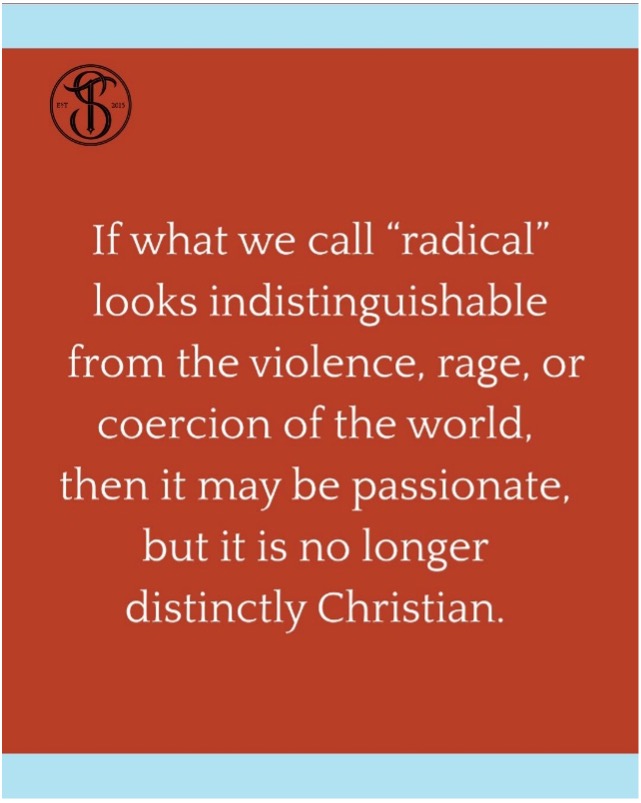
If what we call “radical” looks indistinguishable from the violence, rage, or coercion of the world, then it may be passionate, but it is no longer distinctly Christian. Jesus was radical enough to forgive those who crucified Him and holy enough to tell the truth without hatred.
This combination is rare. It is also transformative.
The Cross Shapes Our Witness
This matters deeply when we talk about global missions.
From the earliest days of the church, the gospel spread not through force, but through faithfulness. The first Christians had no political leverage, no military strength, and no cultural dominance. Yet the message of a crucified and risen Messiah moved across borders, languages, and empires.
Why?
Because it was embodied.
Believers cared for the sick during plagues. They welcomed the poor. They refused to abandon infants. They told the truth about sin and salvation while living lives that reflected a different allegiance. Their faith was costly, and it was compelling.
Missiologist Lesslie Newbigin described the gospel as public truth. Not private opinion. Not coercive ideology. Public truth embodied in a community shaped by the cross.
That same calling remains today.
Whether through business as mission, workplace witness, church planting, or long-term cross-cultural engagement, the credibility of the gospel is inseparable from the character of Christ reflected in His people. We do not advance the kingdom by winning arguments at the expense of love. We bear witness by taking up our cross and following Jesus into the real places where people live and work.
A Better Definition of Radical
Jesus never diluted the call to repentance. He simply refused to weaponize it.
He spoke truth without hatred. He extended mercy without compromising holiness. He confronted sin while moving toward sinners. That kind of love still offends the world. It still calls people to repentance. It still changes hearts. It just does so without abandoning the character of Christ.
Theologian N. T. Wright reminds us that the cross is not merely the means of salvation; it is the pattern of Christian life. We are not only saved by Jesus’ self-giving love. We are formed by it.
This is the scandal and beauty of the gospel.
A crucified Messiah. A victorious surrender. A kingdom that advances through faithfulness rather than fear.
Living This Out
So what does this mean for us, practically?
It means we ask hard questions of our own hearts before we speak loudly to the world. Are our convictions producing the fruit of the Spirit, or just heat? Are we more concerned with being right, or with being faithful?
It means we refuse shortcuts to influence that compromise the way of Jesus. The ends do not justify the means in the kingdom of God. The means are the message.
It means we live and work in such a way that our neighbors, coworkers, and global partners encounter not just our beliefs, but the character of Christ through us.
At The Stone Table, we believe the gospel takes root where faith becomes embodied. In boardrooms and break rooms. In factories and farms. In neighborhoods and nations. The call is not to be less committed, but to be more Christlike.

Bill Tibbetts
Bill Tibbetts is the Vice President of Education and Multiplication at The Stone Table, bringing over two decades of experience in higher education to his role. As the former Dean of the College of Business and Technology at North Central University, he developed a deep passion for mentoring, missions, and business consulting. Bill's extensive expertise uniquely positions him to lead initiatives that encourage marketplace believers and college students to actively engage with the Great Commission. He also serves on the board of the Community Reinvestment Foundation and is based in Minneapolis, MN, supporting The Stone Table's expansion into new regions.