Is Your Career an Idol? (Work, Identity, and the Gospel)
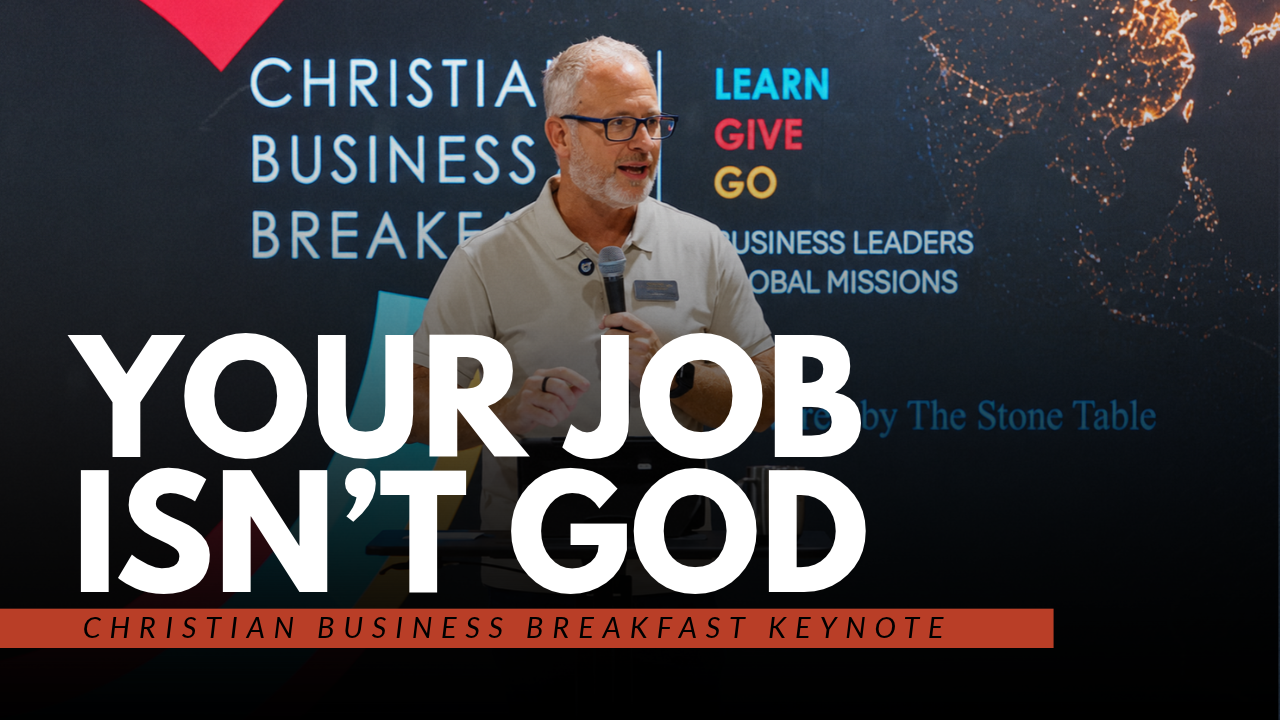
Your Job Makes a Terrible God: How Everyday Work Becomes Worship
Have you ever had a job you hated?
Maybe it was a butcher shop. Maybe it was digging ditches. Maybe it was your first job out of college, the one that made you wonder what you had done to deserve such a punishment.
Most of us have been there. And even when we like our work, many of us still struggle with a quieter question: What does my job actually have to do with my faith?
Here is the surprising answer. The reason your work feels empty may have nothing to do with the job itself. It may be that you are asking your work to give you something it was never designed to give.
The Problem Is Older Than Your Job
Remember the Israelites in Exodus? They watched God split the Red Sea. They followed His presence in a pillar of cloud and fire. They woke up every morning to food lying outside their tents.
And the moment Moses climbed the mountain, they melted their jewelry into a golden calf and worshiped the work of their own hands.
It is easy to read that story and shake your head. But as Erik Cooper of The Stone Table puts it, this is not an Exodus problem. It is a human problem.
An idol is not just a statue in a backyard. Here is a better definition:
An idol is anything we place our trust in and find our identity in outside of God Himself.
At the root of sin is not simply bad behavior. It is wrong worship. And the most dangerous idols are rarely bad things. They are good things we quietly promote to the top of our lives.
Why Work Becomes a Golden Calf
Tim Keller famously described idols as good things that become ultimate things. In Counterfeit Gods, he wrote that the human heart takes good things like a successful career, love, material possessions, even family, and turns them into ultimate things.
Work is one of the easiest good things to deify. Think about how often we measure ourselves by:
- The paycheck. It matters. But it makes a fragile foundation for hope.
- Status. How others see our title, our company, our career.
- Performance. First one in the office. Fastest inbox. Most overtime hours.
- Comparison. How our line of work makes us feel next to everyone else’s.
When work becomes our identity, it starts defining our worth, our acceptance, our pride, and sometimes our shame. That is a weight no job can carry. So the job collapses under it, and we call the result burnout or meaninglessness.
The Receipt Stamped “Paid in Full”
The gospel breaks this cycle at the root.
When Jesus died on the cross, He cried out, “It is finished.” The Greek word is tetelestai. Some scholars suggest the word may have appeared on ancient receipts to mark a debt as paid in full.
Erik carries that word with him. He had it tattooed on his arm in the Old City of Jerusalem, and it hangs over his office desk. For someone who spent much of his life believing he had to earn his value, it is a daily reminder:
Jesus’ finished work is the starting point for all of my work.
This changes the direction of everything. We do not work for acceptance, significance, or a name. We work from them, because in Christ, they are already settled.
Keller called the striving to justify ourselves “the work beneath our work.” In Christ, that work is done.
When Work Turns Outward
Once work no longer has to fill the hole in your soul, it is free to do what God designed it to do.
In Matthew 22, Jesus named the greatest commandment: love God with all your heart, soul, and mind, and love your neighbor as yourself. All the Law and the Prophets hang on those two commands.
Here is the connection most of us miss. You will likely spend more waking hours working than doing anything else. Russell Moore and Andrew Walker make the case in The Gospel and Work that work is meant to be fruitful, creating value for others, which makes it fundamentally about love.
That leads to a liberating idea:
We honor God and love our neighbor not only through acts of charity, but through acts of commerce.
Your spreadsheet, your sales call, your shift, your service ticket: each one is an opportunity to obey the greatest commandment.
Work, Worship, Service: One Word
The Hebrew Scriptures make this connection beautifully. The word avodah and its root carry a rich range of meaning.
- In Psalm 104:23, it describes ordinary labor: people go out to their work until evening.
- In Exodus 8:1, the same root describes worship: “Let my people go, so that they may worship me.”
- In Joshua 24:15, it describes service: “As for me and my household, we will serve the Lord.”
Work. Worship. Service. The Old Testament refuses to separate them.
That gives us a fuller definition:
- Work is labor. It creates value for other people.
- Work is worship. It glorifies God.
- Work is service. It uses our gifts to bless others.
Sounds a lot like the great commandment, doesn’t it?
“We Wash Feet”
The Stone Table began as a family real estate business in the apartment industry. Over the years, its team developed a simple motto, one that even employees who were not followers of Christ began repeating:
We wash feet.
They could have said, “We collect rent” or “We fix air conditioners.” They did both. But their identity was rooted in honoring God and serving people. They did not just rent apartments. They washed feet.
That is what work looks like when it turns outward.
Common Myths About Faith and Work
Myth 1: Only “ministry” jobs matter to God. Scripture uses the same word family for labor and worship. Your daily work is not a lesser calling.
Myth 2: If I hate my job, it cannot be meaningful. Meaning does not come from what you pull into yourself from work. It comes from what you push out toward God and others through it.
Myth 3: Business is inherently secular. The marketplace has been distorted by culture, not designed that way by God. Commerce can be an act of love.
Practical Application: One New Question
Most of us start the workday asking, How do I make money?
Try a different question tomorrow morning:
How can I honor God and add value to other people through my work today?
It works in the C-suite. It works at entry level. It works in the job you love and the job you can’t wait to leave.
A few ways to practice it:
- Before work: Name one person your work will serve today.
- During work: When stress spikes, ask whether you are working from acceptance or for it.
- After work: Reflect on one moment where your work turned outward.
Conclusion: Tear Down, Then Rebuild
The gospel disassembles in order to put things back right. It tears down the idol of work, then renews work as something better: a daily opportunity to love God and your neighbor.
Your job makes a terrible god. But it can make a beautiful act of worship.
Want to go deeper? Watch Erik’s full keynote from The Stone Table’s Christian Business Breakfast, and join us at the next CBB as we explore work in the Great Commission.
Watch the full CBB After Party conversation on The Stone Table’s YouTube channel, and share your story with us. We want to hear what God is doing in your marketplace.
Full Transcript
Erik: The gospel restores. It renews. It disassembles in order to put things back right again. That’s part of what we want to do through these Christian Business Breakfasts. Go ahead and flip to that next slide.
We run our framework through what we call the four legs of The Stone Table. Each of the four CBBs we do through the year walks through one of them.
The first pillar is the great separation: the sacred-secular divide, and how we have to tear down this understanding of our work as something secular, apart from our faith. Then we talk about work in the great story. Where does everyday marketplace work fit in the metanarrative and story arc of Scripture and the gospel?
Today, in quarter three, we’re talking about work in the great commandment. How is our everyday work a daily opportunity to do what Jesus said was the most important thing? And finally, work in the great commission. How does our work allow us to make Jesus known in all the earth?
So that’s the flow. Today we’re asking: how can our everyday work, our day jobs, help us worship God and love our neighbor as ourselves?
As you look around this hot mess of a room, I want you to think of it as a visual. Today, let the Lord tear down some false understandings of who He is, who you are, and how your everyday work fits into His work in the world. But the Lord doesn’t just tear things down. He renews them. He restores them. The gospel is about new life and restoration, and that’s ultimately what today is about.
So let’s get this kicked off. How many of you have ever had a job that you hated? Fair enough. If you’re here with your boss and your current job is the one you hate, maybe don’t answer this question. But throw it out. What was that job you hated?
[Audience responds]
Erik: A butcher shop. Yes, I get that. My father-in-law is waving his arm back there. He had a little tussle with a meat grinder back in the day. You can ask him his story later.
Anybody else? You dug ditches. Wow. That is some serious labor.
[Audience responds]
Erik: Some of us have jobs where it’s a little easier to connect them to our faith. But those jobs you hate? I remember my first job out of college. I thought, what did I do to get this eternal punishment from God?
Today I want to share a way of thinking about our work that I pray helps you see your day job in a new and renewed way. Will you pray with me?
Let’s invite the Holy Spirit to do in our hearts what we can’t do for ourselves. Lord, we invite You here today. Thank You that You said where two or three are gathered in Your name, You are there. We ask that You would illuminate, that You would make Jesus known in this room. Help us tear down some bad ideas about the marketplace and our work so that we can embrace Your design and Your glory in and through our day jobs. In Jesus’ name, amen.
If you’ve been here before as we’ve walked through this cycle, some of this may feel a little repetitive. We wanted to run a couple of cycles and repeat some things because we think they’re foundational.
As we talk about the great commandment, one of the greatest dangers we face as human beings is that we make idols. I’m not talking about little golden statues. I’m guessing you don’t have those in your backyard. Your HOA probably wouldn’t appreciate it. I’m talking about objects of worship: things we elevate to the place of God in our lives.
Has anyone ever read the story of the Israelites in Exodus and thought, these people are idiots? If you haven’t read it in Scripture, maybe you saw the old Charlton Heston movie. They used to play it every spring on ABC.
What always amazed me is this. The Israelites are in slavery in Egypt for about 400 years. Then miraculous plagues begin to happen. Crazy things. After ten plagues, Pharaoh finally lets them go. They come to the Red Sea, Pharaoh changes his mind and chases after them, and God splits the sea open. They walk through on dry ground.
On the other side, they’re in the wilderness. They don’t know where to go or what to do. But God shows up, literally, in a pillar of cloud by day and fire by night. They just go where He goes. His presence is literally in their midst. They wake up every morning and breakfast, lunch, and dinner is lying outside their tents. All of this miraculous stuff.
And yet, as soon as Moses goes up the mountain to get the Ten Commandments, they take off their gold jewelry, melt it down, make a golden calf, and bow down to worship it. You think, what is wrong with these people? The very presence of Yahweh Himself was miraculously in their midst every day. And at the drop of a hat they turned and worshiped the work of their own hands.
I always thought, how dumb are these people? And then the Lord says, you’re a dumb person. No, He doesn’t say it that way. But He does whisper quietly in our ears: this is not an Israel-in-Exodus problem. This is a human problem.
Write this down: An idol is anything we place our trust in and find our identity in outside of God Himself.
A lot of people think the root of sin is bad behavior. But at the core of sin is idolatry. It’s wrong worship. It’s elevating the wrong things to the place of God in our lives. If I’m honest, I fight this battle in my own life every day.
These idols are sneaky. And they’re not just bad things. In fact, they’re often good things. Pastor Tim Keller calls idols good things that we allow to become ultimate things. In his book Counterfeit Gods, Keller put it this way: the human heart takes good things like a successful career, love, material possessions, even family, and turns them into ultimate things. Our hearts deify them as the center of our lives because we think they can give us significance, security, safety, and fulfillment if we attain them.
Do you want to know why your everyday work can feel purposeless? Why it can feel meaningless? Why you struggle to connect the dots between your work, your faith, and God’s kingdom work in the world? It may be because you’re asking something of your job that it is not capable of giving you.
We often look to our work to fill something in our lives it was never designed to fill. And so our work easily becomes one of these golden calves. We place our ultimate trust and hope in our paycheck. My paycheck’s pretty important, right? But I don’t want my ultimate hope to be in it.
We find our identity and significance in the social status of our work, in how other people see our careers. We define ourselves by what we do. How early we get to the office. I’m the first one in every day. How fast we clear our inboxes. I would fail at that. If I have emails from you I haven’t answered, I apologize. How many overtime hours we’re willing to put in. How our line of work makes us feel compared to other people.
The gospel changes all of that. The gospel smashes our idols.
Write this down. When Jesus died on the cross, He cried, “It is finished.” The Greek word here is one of my favorites: tetelestai. It means “it is finished.” Some scholars speculate it may have been a business term stamped on ancient receipts to mark them paid in full. Tetelestai. It is finished. Paid in full.
My family gets tired of me telling this story. A few years ago, I did something I swore I would never do. I got a tattoo.
I was almost 50 years old. We were in the Old City of Jerusalem with my family and a group of students, and a friend told me about a 700-year-old tattoo tradition run by the 28th generation of the same family. It’s called Razzouk, and it’s about half a kilometer from where Jesus was crucified and resurrected.
My kids started in on me. Dad, we have to get a tattoo. I said, I am old and wrinkly. I am not getting a tattoo. But I thought, if I’m ever going to get one, this is the place. So we went to Razzouk and got the word tetelestai tattooed on our arms. Emma has it on her arm. My son has it in Hebrew on his, because he wanted to put a flex on it.
This word is deeply meaningful to me. It’s on my arm, and it’s hanging over the desk in my office. It’s Jesus’ last word when He took all of our sin on Himself and said, it is finished.
I’m a guy who has struggled much of his life with an inner drive that says I have to earn my value. That I’m only worth what I accomplish. That how others see me defines who I am. Because of that, I never want to forget this. Write it down: Jesus’ finished work is the starting point for all of my work.
We do not work to make ourselves right with God. We do not work to earn a name for ourselves or to create meaning or significance. We work from Jesus’ declaration that it is finished, paid in full. We don’t work for it. We work from it.
Tim Keller calls this the work under our work: that striving to create meaning, purpose, and identity for yourself. Friends, in Christ, that work is done. It is over.
When I find my identity where it belongs, in Jesus Christ alone, when I let His finished work fill the gaping hole in my soul that nothing else can fill, then and only then can my everyday work become what God always designed it to be: a daily opportunity to fulfill the great commandment.
What is the great commandment? Matthew 22:36 to 40. They came to Jesus and asked, “Teacher, which is the greatest commandment in the law?” Jesus replied, “Love the Lord your God with all your heart and with all your soul and with all your mind. This is the first and greatest commandment. And the second is like it: Love your neighbor as yourself. All the Law and the Prophets hang on these two commandments.”
When work is my idol, when my career is my identity, my job defines my worth, my value, my acceptance, my status, my pride, or maybe even my shame. We ask it to play a role it was never designed to play and can’t fill.
But when the gospel redeems my life and work, my identity, worth, and status are grounded eternally in Jesus Christ. Then my work, no matter how wonderful or menial it feels, can turn outward instead of inward. It becomes what God always intended: a way to worship God and love my neighbor.
There’s a great quote from Russell Moore and Andrew Walker in their book on work. I really want you to grab this. The main purpose of work is to be productive, what the Bible calls fruitful. Our work should create value for others. That means work is fundamentally about love, because we will spend more waking hours at work than in any other activity.
How scary is that? Stats say you’ll spend more than half your waking hours at work over your lifetime. Work is the main way we carry out the great commandment to love God and our neighbor. That’s from their book The Gospel and Work.
Write this down: We don’t just honor God and love our neighbor through acts of charity. We can honor God and love our neighbor through acts of commerce as well.
That may sound controversial, because we’ve let the culture, through a false distortion, define what business and the marketplace are. That’s part of what we have to tear down. Put the caution tape up, blow it up, and recreate it in the image of God. The marketplace is an opportunity to fulfill the great commandment.
Let’s look at this one more way. How would you finish this sentence? Work is ____.
Maybe you just need to leave the blank there because of some things that ran through your head just now. Have you ever wondered how God might fill in that blank?
When we talk about work in the great story, we go back to Genesis 2:15 and see that God made us to work and keep His creation. When He did that, what did He have in mind? If we dig into the original Hebrew, I think we find a clue.
I’m going to teach you the only Hebrew word I know. I’m not a Hebrew scholar. The word is avodah. Write it down. Avodah is an Old Testament Hebrew word for work. It paints a beautiful word picture, as Hebrew often does, with a richness our English translations can’t fully pull out. I believe it appears around 145 times in the Old Testament. Let’s look at just three, and let them sink into your soul.
Psalm 104:23: “Then man goes out to his work, to his labor until evening.” That’s our traditional understanding of work. The alarm goes off. You hit snooze twice, three times, seven times. There are people who aren’t here because they’re still hitting snooze. You get up, have some coffee, maybe do your devotions, and off you go to your avodah, your labor for the day.
But avodah is much deeper. In Exodus 8, this same word means worship. “Then the Lord said to Moses, go to Pharaoh and say to him, this is what the Lord says: let my people go, so that they may worship me.” Same word. Work and worship.
Scripture isn’t done. Joshua 24:15, a verse my mom had on the wall in our home growing up: “But as for me and my household, we will serve the Lord.” Same word again.
Work. Worship. Service. Write this down:
- Work is labor. It creates value for other people.
- Work is worship. It’s a way we glorify God.
- Work is service. It uses our gifts to bless and help others.
Work is how we provide for ourselves and our families and pay our bills, while giving glory to God and loving and serving our fellow man. That’s the Old Testament, but it sounds an awful lot like the great commandment, doesn’t it? The thing Jesus said sums up all the Law and the Prophets.
There are some young folks here still in college. I wish someone had talked to me about this before my first job out of school. I wasn’t digging ditches, but it wasn’t a job I wanted long term, and I never found any value in it. I was looking for what I could pull into myself from it, rather than what I could push out toward God and others through it. You can have a job you hate and still do that.
At the core of The Stone Table is a business. It was started almost 35 years ago by my father, who’s sitting back there. I can’t get him to retire. He’s still adding value well into his 80s. We started as a real estate company in the apartment business.
Ryan, whom you’ll meet in a minute, was our operations director for a number of years. We’ve since sold most of those apartments and closed our management company. But Ryan oversaw our staff and helped us build a culture, and the team talked about this idea constantly. Even our employees who weren’t followers of Christ started saying it: We wash feet.
I always loved that. In the apartment business you’d expect them to say, we collect rent, or we fix air conditioners. And we did those things. But what our team kept front and center was that we honor God and serve others through our work. We worship God through our work and add value to others through it. We wash people’s feet. We don’t just rent apartments.
I want to leave you with this before I turn it over to Bill. We usually think about our jobs in terms of how we make money. What if we pivoted? Instead of how do I make money, what if we asked: How can I honor God and add value to other people through my everyday work? How can I fulfill the great commandment through the work of my hands today?
We don’t worship the work of our hands. That’s trying to make it something it was never designed to be. But we can push our work outward. Whether you’re in the most menial job, in the C-suite, or at entry level, you can ask the same question today: How do I worship God and love my neighbor as myself through my job?
So put some caution tape around your understanding of your work today. Let the Holy Spirit do some ripping out and tearing down. And then let the gospel renew, restore, and put it back together again.

Darren Cooper
After spending years on the creative staffs at multiple churches and even starting a business of his own, Darren joined The Stone Table team to help in all things creative. He is also a producer and composer and loves to speak through the medium of music. Find out more at darrencoopermusic.com.