
The Courage to Be Wrong
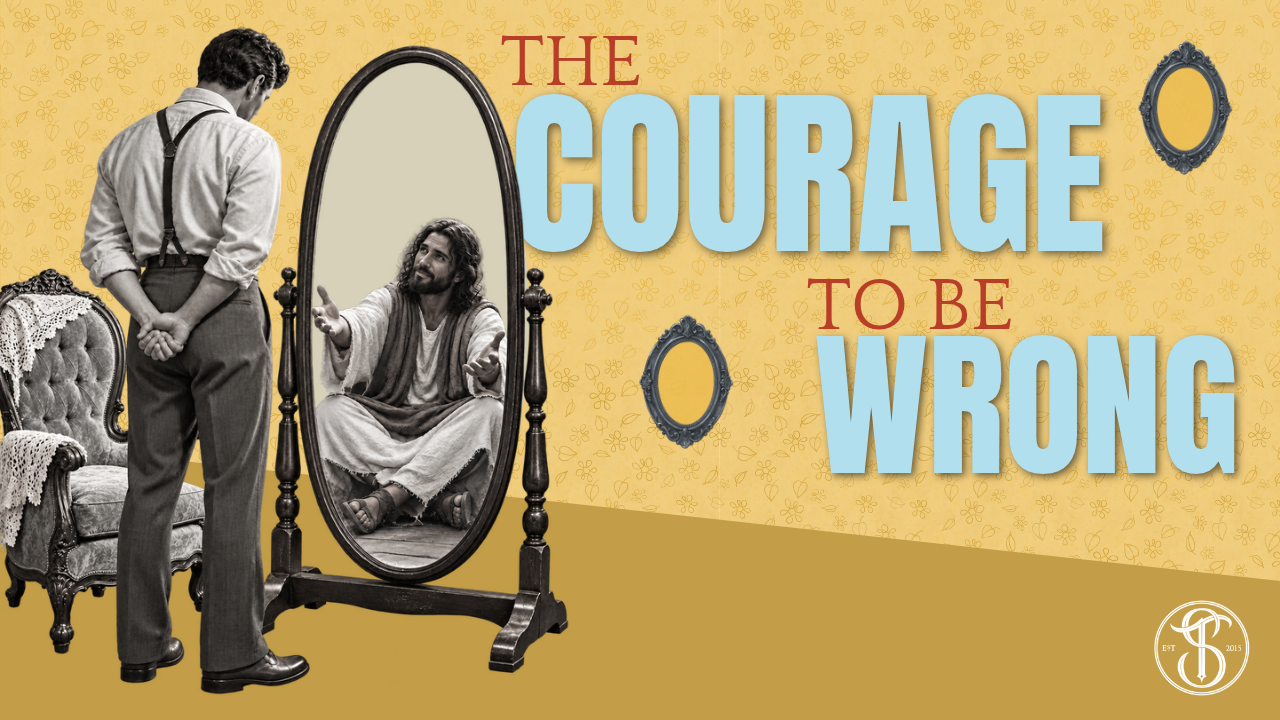
Why are we so good at defending ourselves and so reluctant to admit we’re wrong?
One of the most dangerous things about us is how easily we can convince ourselves that we’re right.
We have an extraordinary capacity to explain our behavior in ways that preserve our self-image. We minimize what we’ve done, exaggerate what others have done, and construct explanations that allow us to remain the “good guy” in our own story.
And most of the time, we don’t even realize we’re doing it.
The stories we tell ourselves are rarely neutral. They’re shaped by our need to protect the person we believe ourselves to be.
The King Who Could See Everyone’s Sin but His Own
Few biblical accounts expose this tendency more powerfully than David’s confrontation with the prophet Nathan in 2 Samuel 12.
The context matters.
In 2 Samuel 11, David sees Bathsheba bathing and sends messengers to bring her to him. Scripture emphasizes David’s position as king and Bathsheba’s identity as the wife of Uriah, one of David’s soldiers. This is more than a story of sexual temptation; it’s more an account of a powerful leader abusing his authority.
When Bathsheba becomes pregnant, David attempts to conceal what happened. He summons Uriah home from battle, hoping Uriah will sleep with his wife and unknowingly provide an explanation for the pregnancy.
But Uriah refuses the comforts of home while his fellow soldiers remain in battle.
The irony is difficult to miss. Uriah demonstrates the loyalty and integrity David has abandoned.
When the deception fails, David arranges for Uriah to be placed in the front lines of the war. There, Uriah dies, and David proceeds to take Bathsheba as his wife.
Then comes the final sentence of chapter: “But the thing David had done displeased the LORD” (2 Samuel 11:27).
Chapter 12 begins with God sending Nathan to confront the king.
Nathan doesn’t begin with an accusation. He tells David about a wealthy man who owns numerous sheep and cattle but steals a poor man’s only lamb to feed a guest.
David is furious.
He declares that the man deserves death and must repay four times the value of the lamb.
Then Nathan responds: “You are the man!” (2 Samuel 12:7).
David could recognize injustice immediately when someone else was responsible for it.
But he was blind to his own.
Nathan’s approach is remarkable. By placing David outside the situation, he allows the king to exercise moral judgment without the interference of self-protection. David condemned the very abuse of power he had committed.
The issue wasn’t that David lacked a moral compass. His response to Nathan’s story demonstrates that he understood injustice.
The problem was his failure to apply that same standard to himself.
Why Our Brains Rush to Our Defense
Psychology offers a helpful explanation for why David’s experience is so familiar.
Researchers use the term self-serving bias to describe our tendency to interpret information in ways that preserve a favorable view of ourselves. We often attribute our successes to personal qualities while explaining failures through circumstances beyond our control (Corra, 2018).
This bias becomes especially powerful when our character is questioned.
When someone tells us we’ve hurt them, our brains may interpret the criticism as a threat to our identity. If we believe ourselves to be compassionate, ethical, or spiritually mature, evidence that contradicts that identity creates psychological discomfort.
Psychologist Leon Festinger called this cognitive dissonance: the tension that arises when our beliefs, behaviors, or self-perceptions conflict.
When confronted with information that challenges our self-image, we generally have two options. We can reconsider our behavior, or we can reconsider the information that makes us uncomfortable.
The second option is often easier – I didn’t mean it that way. They misunderstood me. You don’t know what I was dealing with.
What’s interesting is that these explanations might all be true. We may have had good intentions. Someone may have misunderstood us. Our circumstances may have genuinely influenced our decisions.
But here’s where self-justification becomes dangerous: We selectively emphasize the details that defend us while minimizing those that implicate us.
An explanation helps us understand why something happened. A justification attempts to establish why we shouldn’t be held responsible for it.
And when protecting our self-image becomes more important than understanding our behavior, we lose the opportunity to learn from it.
When Pride Becomes Self-Protection
Scripture identifies another dimension of this struggle: pride.
We tend to associate pride with arrogance, superiority, or maybe an inflated sense of importance. But pride can be considerably more subtle.
Sometimes pride is simply our unwillingness to be seen as wrong.
Let that statement sink in.
Proverbs 12:15 says, “The way of fools seems right to them, but the wise listen to advice”.
Notice the distinction. Wisdom isn’t described as always knowing what’s right. It’s demonstrated by a willingness to receive correction.
Pride, on the other hand, can turn correction into a threat.
For leaders, this becomes particularly dangerous. The more authority we possess, the easier it becomes to surround ourselves with people who affirm our perspectives. Eventually, disagreement feels like disloyalty, and accountability feels like an attack.
The longer we go without being challenged, the easier it becomes to confuse our perspective with reality.
In Unoffendable, author Brant Hansen challenges the assumption that our anger is necessarily evidence of our righteousness. His argument invites an uncomfortable question: Are we upset because something is genuinely wrong, or because something has challenged our sense of being right?
David’s anger toward Nathan’s fictional wealthy man was morally justified. Yet that anger coexisted with his unwillingness to confront his own behavior.
Being passionate about what’s right doesn’t guarantee we’re practicing it.
But there is hope in Jesus.
The late theologian Tim Keller wrote, “The gospel is this: We are more sinful and flawed in ourselves than we ever dared believe, yet at the very same time we are more loved and accepted in Jesus Christ than we ever dared hope.”
That tension changes how we approach correction.
If our worth depends on being competent, respected, or morally superior, admitting wrongdoing threatens the foundation of our identity.
But if our identity rests in Christ, we can acknowledge our failures without believing they define our entire existence.
This helps explain the significance of David’s response to Nathan. After the prophet exposes his sin, David finally acknowledges, “I have sinned against the LORD” (2 Samuel 12:13).
Repentance makes something possible that self-justification never can.
Change.

Bill Tibbetts
Bill Tibbetts is the Vice President of Education and Multiplication at The Stone Table, bringing over two decades of experience in higher education to his role. As the former Dean of the College of Business and Technology at North Central University, he developed a deep passion for mentoring, missions, and business consulting. Bill's extensive expertise uniquely positions him to lead initiatives that encourage marketplace believers and college students to actively engage with the Great Commission. He also serves on the board of the Community Reinvestment Foundation and is based in Minneapolis, MN, supporting The Stone Table's expansion into new regions.