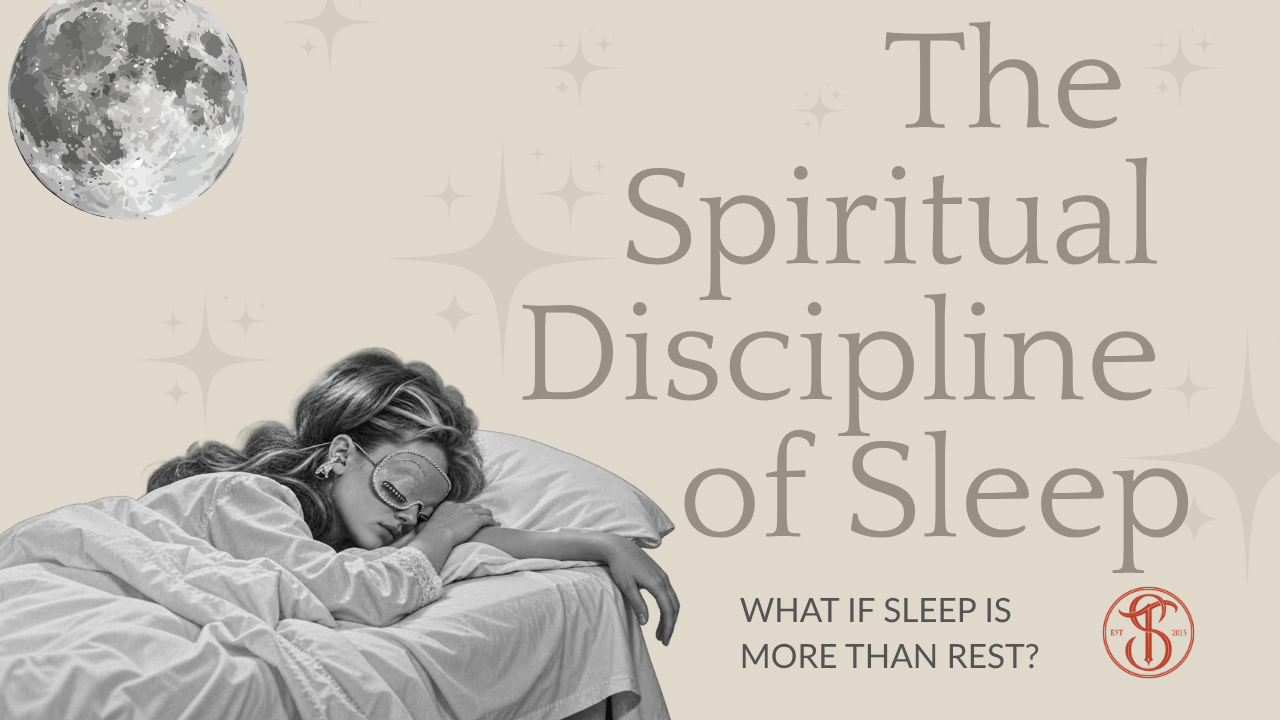
The Spiritual Discipline of Sleep
When I was a kid, I had a sleeping superpower. On any given Saturday morning or during the long summer breaks from school, it was nothing to sleep right through breakfast and hardly even rollover until Bob Barker was announcing the Showcase Showdown.
Assuming my mom didn’t have to drag me out of bed for some weekend sporting event or piano recital, I could sleep 10 to 12 hours without even trying. Sleep was magical.
Somewhere along the way though, sleep became elusive. Responsibilities grew. I graduated and got a real job. I got married and started sharing my life, and my schedule, with my wife. We had kids, and it was nothing to wake up with a four-year-old foot in my chin at 3 o’clock in the morning. (Nowadays, it’s a dog’s paw, but that’s a complaint for another day)
The Pride of Sleeping Less
Then at some point, not sleeping became a discipline. I longed to be a responsible adult and a godly leader, so spending those first hours with Jesus in the morning became essential. I wanted to stay healthy, and all the in-shape guys I admired hit the gym in the wee hours.
I prided myself on being up before the sun and avoiding the snooze button. Too much sleep was a sign of weakness or laziness. Real leaders sacrificed sleep for the more important things (and posted it on Instagram to prove it). I read stories about famous people like Winston Churchill, Jay Leno, and Bill Clinton, who only slept 4-5 hours a night, and aspired to their circadian rhythms.
That magical sleep that used to be so easy to come by, became a luxury to be limited. Somewhere deep down inside I believed good leaders, godly leaders, overcame those lazy Saturday mornings. I actually got a little prideful about sleeping less than other people.
As I’ve gotten older, not sleeping became less of a discipline and more of a biological challenge. Our ability to sleep for long hours changes as our bodies age. Nowadays, it’s not abnormal for me to wake up at 3 or 4am ruminating about both rational and irrational stresses of the day (for the record, trying to problem solve in the middle of the night is a fool’s errand).
I used to be proud of waking up at 6am. Now I’m grateful if I can actually make it to 6am.
Sleeping as a Spiritual Discipline
So here is something I’ve been pondering lately: We understand sacrificing sleep to engage in spiritual disciplines like scripture and prayer. But what if sleep itself actually is a spiritual discipline? What if embracing my need for sleep is a sign of spiritual maturity?
I recently heard an interview with Dr. Kyle Strobel, the Director of Spiritual Formation at Talbot School of Theology, where he referred to sleeping as a spiritual discipline. He mentioned it in passing amid a long dialogue about spiritual formation, but that phrase—the spiritual discipline of sleep—has been rolling around in my mind ever since.
Why in the world would sleeping be a discipline? Disciplines are supposed to be hard work. Sleeping is the definition of no work!
Spiritual disciplines are meant to move us against the grain of our fallen fleshly desires and toward God’s ways and God’s design.
- Reading the Scriptures takes us out of our self-oriented perspectives into the depths of God’s mind, heart, and order for reality.
- Prayer takes our misaligned instincts and desires and melts them into God’s Kingdom and His will.
- Fasting reminds our selfish nature that God is our sustenance and that our provision truly comes from Him.
But sleep?
In much the same way, our need for sleep humbles our flesh and reminds us we were not designed to sustain ourselves. Our need for sleep points us to our need for God.
As His Image Bearers, we are deeply loved but completely dependent beings. Every night, our bodies scream: you’re not God, you have limits, you cannot sustain yourself!
Sleep is a Gift from God
The Wisdom Literature in the Bible presents sleep as a blessing from God to His people, not as a distraction or punishment as part of a fallen world. Here’s just a few examples:
“It is in vain that you rise up early and go late to rest, eating the bread of anxious toil; for he gives to his beloved sleep.” (Psalm 127:2)
“If you lie down, you will not be afraid; when you lie down, your sleep will be sweet.” (Proverbs 3:24)
Here’s one I remember my mom praying over me as a kid:
“In peace I will both lie down and sleep; for you alone, O Lord, make me dwell in safety.” (Psalm 4:8)
I could go on. The point is this: God designed human beings who have to stop. That’s not a curse, it’s a gift. From the earliest chapters of Genesis, we see rest wasn’t a product of the Fall. It was always embedded in God’s good creation.
Awakening to our need for rest is certainly not a new idea, but framing sleep as a spiritual discipline has confronted some prideful, self-reliant tendencies in me.
The Gospel of Going to Bed
The crux of the Gospel is this: You can’t, so God did.
You can’t fix what’s wrong with you. You can’t work your way to salvation. You can’t cross the gap between where God is and where you are. You can’t save yourself.
The Gospel drives us to the end of ourselves and requires us to throw our lives on the mercy and grace of Jesus. It’s easy to confess that spiritually, but leaders—especially in the business world—can spend our lives practicing a different gospel: I must, so I will.
Deadlines loom. Pressures mount. People need us. And it becomes easy to sacrifice our dependence on Jesus.
But going to sleep is a nightly act of surrender. Falling asleep requires relinquishing control. So what would happen if I actively approached my nightly slumber as a spiritual discipline—a daily act of defying the self-sufficiency of my own flesh?
God Works the Night Shift
Here’s some comforting news: God works nights.
“…the one who watches over you will not slumber. Indeed, he who watches over Israel never slumbers or sleeps.” (Psalm 121:3-4)
While we sleep, God is at work; and we wake to join Him in what He is already doing.
God doesn’t slumber or sleep, we do. That’s not an unfortunate difference between us and God, it’s the whole point. I sleep because I’m not God.
When we embrace sleep as a spiritual discipline, the morning becomes less “it’s time for me to go make things happen,” and more: God is already at work, now I get to go join Him there.
The Sleep Under Your Sleep
Tim Keller talks about the “work under your work,” that internal striving to prove ourselves and secure our own identities that is always running underneath our efforts.
But what about the rest under your rest? The sleep under your sleep?
We can get a full eight hours and still not be at rest. True rest won’t come from a temperature-controlled mattress, finding your perfect circadian rhythm, or landing that perfect Oura ring sleep score.
The rest under your sleep can only come through Christ.
We don’t have to hold the world together. We don’t have to justify ourselves through relentless productivity. We don’t have to finish it all today because the work of Christ on our behalf is already finished.
It’s been said that we need to hear the gospel every day, because we forget it every day. Perhaps the simple act of going to sleep is a way of reminding ourselves that that work is His before it’s ever ours.
Sweet dreams.

Erik Cooper
Erik began his career in the business world before spending twelve years in full-time ministry, serving on staff at a large suburban church and later as a church planter in downtown Indianapolis. Today, he serves as the President of a family of business-oriented nonprofit organizations that work together to mobilize the marketplace to make Jesus known in the world. He leads The Stone Table, which equips marketplace believers and invests in global mission initiatives, and Community Reinvestment Foundation, a nonprofit real estate company providing high-quality affordable housing in Indiana and directing its profits to missions through The Stone Table.