How to Keep Your Faith Strong When Work Falls Apart
What Stress at Work Really Reveals About Your Faith
You hang up the phone with your CPA. Or your attorney. Or that key client. And in the silence after the call, you realize something uncomfortable.
You just spent the last forty-five minutes thinking, talking, and reacting like Jesus was nowhere in the room.
Erik Cooper, who leads The Stone Table, named this in a recent Christian Business Breakfast roundtable. “I’ll hang up the phone with our attorney or our CPAs or something, and I’m like, oh my gosh, I just disconnected my faith from this moment, this moment that God gave me to be a representative of him in the marketplace.”
That admission is the entry point to a question every marketplace believer eventually has to answer.
What Work Reveals About Your Faith
Most marketplace believers think of work as the application of faith. Faith is what you do on Sunday. Work is where you live it out Monday through Friday.
The Stone Table conversation flipped that frame. Work isn’t where faith gets applied. Work is where faith gets exposed.
Pressure doesn’t build character. It reveals it. The CPA call doesn’t break your faith. It shows you where your faith was already cracked.
And here’s the trap: the cracks show up in two completely different ways depending on whether your business is winning or losing.
The Hard-Season Trap: Asking Without Abiding
Trent, one of the panelists, named this with surgical precision. When work goes sideways, his prayer life intensifies. “God, I have this problem, I’m stressed, I need help in this. God, would you come alongside me?”
But here’s what he noticed in his own life. As his asking went up, his abiding went down.
Asking is transactional. It assumes a problem and requests a solution. Abiding is relational. It requires sitting still long enough to be present with someone, not just to extract something from them.
Crisis turns most of us into spiritual vending-machine operators. We input prayers and wait for outputs. We don’t sit with God. We deploy Him.
Josh, a documentary filmmaker on the panel, told a story about two brides who came back with twenty edit changes each. His first instinct was not grace. It was defense.
In that moment, Josh’s prayer was layered. “God, give me grace to show them, and to listen and hear them out.” But also the grace to advocate honestly when a creative call mattered to the integrity of the story.
That’s the line. Asking God to fix the bride is one prayer. Abiding with God so you can be the artist and the servant in the same conversation is a different prayer entirely. Most of us only know how to pray the first one.
The Good-Season Trap: “I Got It From Here”
If hard seasons drive you to ask without abiding, good seasons do something more dangerous. They make you forget you ever needed to ask at all.
Steve, another panelist, described it like this: “I have this tendency to rely on God until I have to get to a certain point and then I’m like, okay, I got it from here.”
Read that sentence twice. That’s the entrepreneur’s confession. The reliance that built the company starts to feel like a phase. Like training wheels. Like something you needed before the deal closed, before the cash flow stabilized, before you proved you could do this.
Steve’s diagnosis was honest. “What got you here was reliance on God. And it’s hard to remember, especially as an entrepreneur. Things are going good and you start making some money, or your ego kind of gets puffed a little bit.”
Then God uses circumstances to reel us back.
The Principle That Reframes Everything
Here is where Erik delivered the line that anchors the entire conversation.
“Anything that makes us more dependent on Jesus is our friend, even if it stinks to high heaven as we’re going through it.”
Sit with that for a second.
Most of us spend our prayer lives asking God to remove the very pressures that are forming us. The slow-paying client. The funding gap. The team member who isn’t working out. The market shift you didn’t see coming.
Erik named the instinct in his own words: “Jesus, I just want you to take away everything that makes me feel dependent on you.” And then the Lord’s reply, in his experience: “I love you too much to do that, because it’s not how you were designed.”
When we’re abiding, we are most fully human. When we’re white-knuckling it on our own, we become less than we were created to be.
That’s the marketplace believer’s reorientation. Pressure is not the enemy of your faith. Self-reliance is.
What to Actually Do With This
Three practical moves come out of this conversation.
First, audit your last hard week. When the pressure hit, did you ask, or did you abide? Asking is fine. Asking without abiding is where the disconnect lives. Build a five-minute window into the front of the next stressful day where you sit, not just speak.
Second, audit your last good month. Where did you quietly slip into “I got it from here”? Name the specific decision, deal, or season where you stopped consulting God because things were working. That’s the ego puff Steve named. Confess it specifically, not generically.
Third, build abiding rhythms in both seasons. Most of us only develop spiritual practices when crisis forces them. The believers who finish well are the ones who keep abiding when business is booming and nothing requires them to.
Trent put it well. When things are going well, God gives him a humility check: “Look what I’ve done in your life so far. Look how present I have been and how I’ve moved.” Those moments draw him back to abiding in the good times. Not just the bad ones.
The Stone Table Invitation
The marketplace is not the place faith goes to die. It is the place faith gets revealed, refined, and reformed. Your work is sacred ground. Your CPA call is a faith laboratory. Your bride with twenty edits is a sanctification opportunity.
The question isn’t whether work will test your faith. It will. The question is whether the test will drive you toward dependence or away from it.
If you want help building the kind of marketplace faith that holds in both seasons, start with our free five-day devotional at thestonetable.org/start. It’s the on-ramp to thinking like a believer who actually integrates Sunday and Monday.
Full Transcript
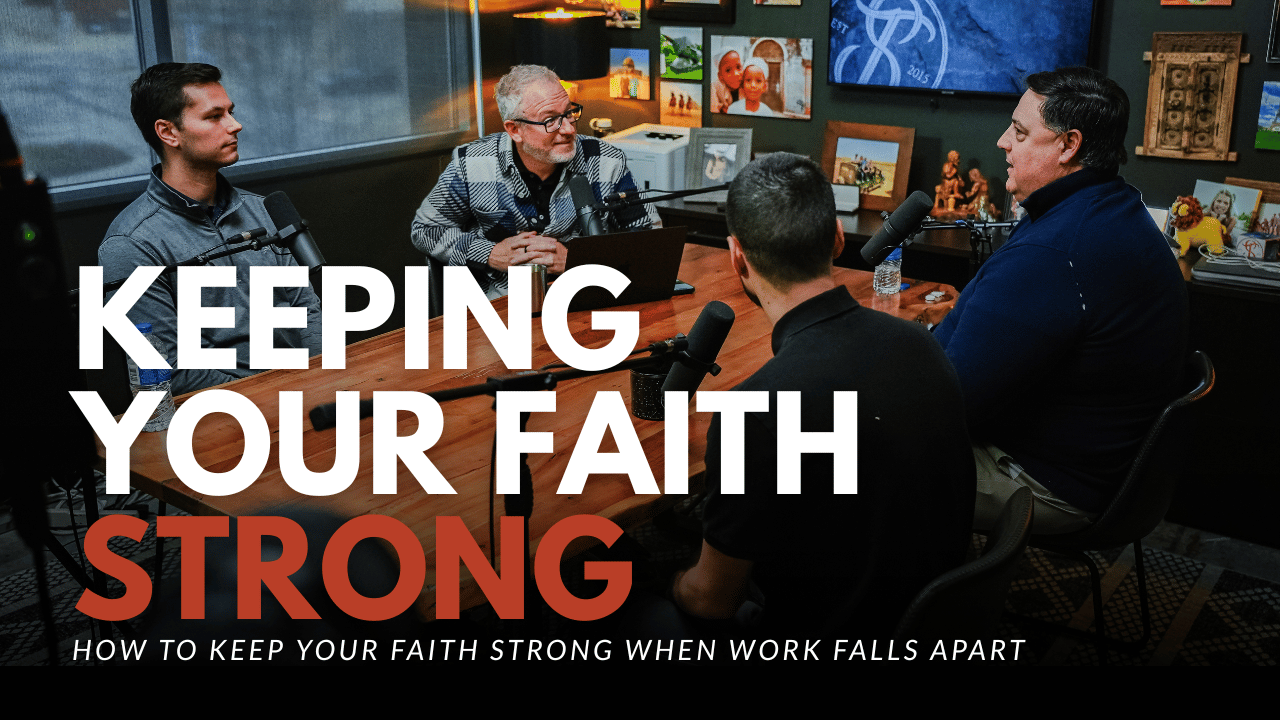
Erik: When work is going well, or when work is going poorly, what does it do to your faith? I’ll throw some things out. We’ve had some stress in our housing, in the housing side of our business. Some programs that we’ve relied on and depended on have not come through, and they’ve created financial stress. I don’t always like what comes out of me in those moments. And I’m like, I’m the guy up preaching about this.
I’ll hang up the phone with our attorney or our CPAs or something, and I’m like, oh my gosh, I just disconnected my faith from this moment, this moment that God gave me to be a representative of him in the marketplace. Do you guys ever wrestle with that? Or when work is going really, really well, what does it do to your faith? I don’t know, Josh.
Josh: Sure. I guess I’ll do the “whenever it’s going poorly or whenever there’s difficulty.” I’ve definitely learned that it creates a deeper dependence on God in those moments, because I see my flesh, my natural instinct, come out. So this past year, we used to shoot a lot of weddings. We’ve kind of scaled back a little bit in weddings. As a documentary filmmaker, it’s kind of fun because I feel like it’s documentary boot camp. It’s a real situation that you have no control over. You can’t tell them, “Hey, can you walk down the aisle again? Can you do the kiss again?” You have to get these moments when they’re happening. So it’s good because it helps us when we’re in documentary work.
I find brides and their moms are really chill. They’re so easy to work with.
Erik: Yeah, exactly.
Josh: What’s cool is, within our work, we’ve gotten not as many brides as some of my filmmaker friends. I think that’s partially because we don’t go to the galas. We don’t sell our work. If someone resonates with our work, then they’ll work with us. Our work, I feel, just reflects who we are: more down to earth, easygoing, story-driven.
Most wedding films, you send them over and there are one to three comments, like, “Hey, can you switch out these people? We don’t really know them.” Last year, to start off our year, the first two weddings we did, both brides had like 20 changes. My initial instinct and reaction was not good. It’s just like, what? Some of them you see and think, “I understand what they’re saying.” Others you’re like, “What are you talking about?”
In that process I was just like, “God, give me grace to show them, and to listen and hear them out.” But also to see if there’s any room for me advocating: “Hey, I think the shot should stay in there. I think it’s important to the story or important to the day.”
I’ve definitely seen that in filmmaking. I have control over a certain amount of it when it’s a client-based project. But when there are changes they’re wanting that I don’t agree with, that’s where I have to depend on God to show grace, to truly listen, and to put the interests of others above my own. That’s a very hard thing to do as a human. So in the editing process, putting the client’s interests above my own is definitely a thing that I’ve seen is hard for me.
Erik: So your desire as an artist, the way you’d want to approach it, is different than the way the client would want it. That’s really interesting. Anybody else? Steve, what do you think?
Steve: For me, usually it’s when things are going bad that I’m more aware of my faith, my need, my dependence on God. For whatever reason, I have this tendency to rely on God until I get to a certain point, and then I’m like, “Okay, I got it from here.” I forget that what got me here was reliance on God. And it’s hard to remember, especially as an entrepreneur. Things are going good, and you start making some money, or your ego kind of gets puffed a little bit. You’re doing here, and things get rolling. And then I think God uses circumstances to reel us back in and remind us that we do need to rely on Him.
Erik: Yeah, it’s really interesting. You said the dependence thing as well. I always tell people: anything that makes us more dependent on Jesus is our friend, even if it stinks to high heaven as we’re going through it. When we are dependent, when we are leaning into Jesus, when we are abiding in Jesus, I think that’s when we’re actually fully human in those moments. When we’re trying to do it on our own, we actually become less than what we were created to be. So it’s really interesting. I feel that too.
It’s like, “Well, Jesus, I just want you to take away everything that makes me feel dependent on you. All the circumstances that make me feel dependent on you, please, would you remove those from my life?” I think sometimes the Lord reminds me that He loves me too much to do that, because it’s not how I was designed.
So Trent, talk to us.
Trent: Yeah, no, I feel very similarly. I’ve realized in the hardship and the difficulty, my level of asking goes up quite a bit. “God, I have this problem, I’m stressed, I need help in this. God, would you come alongside me?” But I’ve also found that in that time, my abiding goes down. Just sitting humbly before the Lord and being in His presence and taking a slow moment with Him, those moments shrink quite a bit.
And I totally agree: as things are going well, I forget easily those moments where God was present and He did help. He answered my prayers and calls. So it’s another reminder that, when things are going well, God likes to give me a little humility check and say, “Look what I’ve done in your life so far. Look how present I have been and how I’ve moved.” Those moments draw me back to abiding once again in the good times, and inviting God into the celebration of feeling light and rested and present. It’s a difficult but a joyful circle of difficulties and overcoming, and letting God partner in both seasons.

The Stone Table
The Stone Table is a global missions organization rooted in the marketplace. We leverage the profits from our marketplace businesses to fund strategic global missions projects around the world. We also equip and encourage marketplace Christians to make Jesus known at work and around the world.