
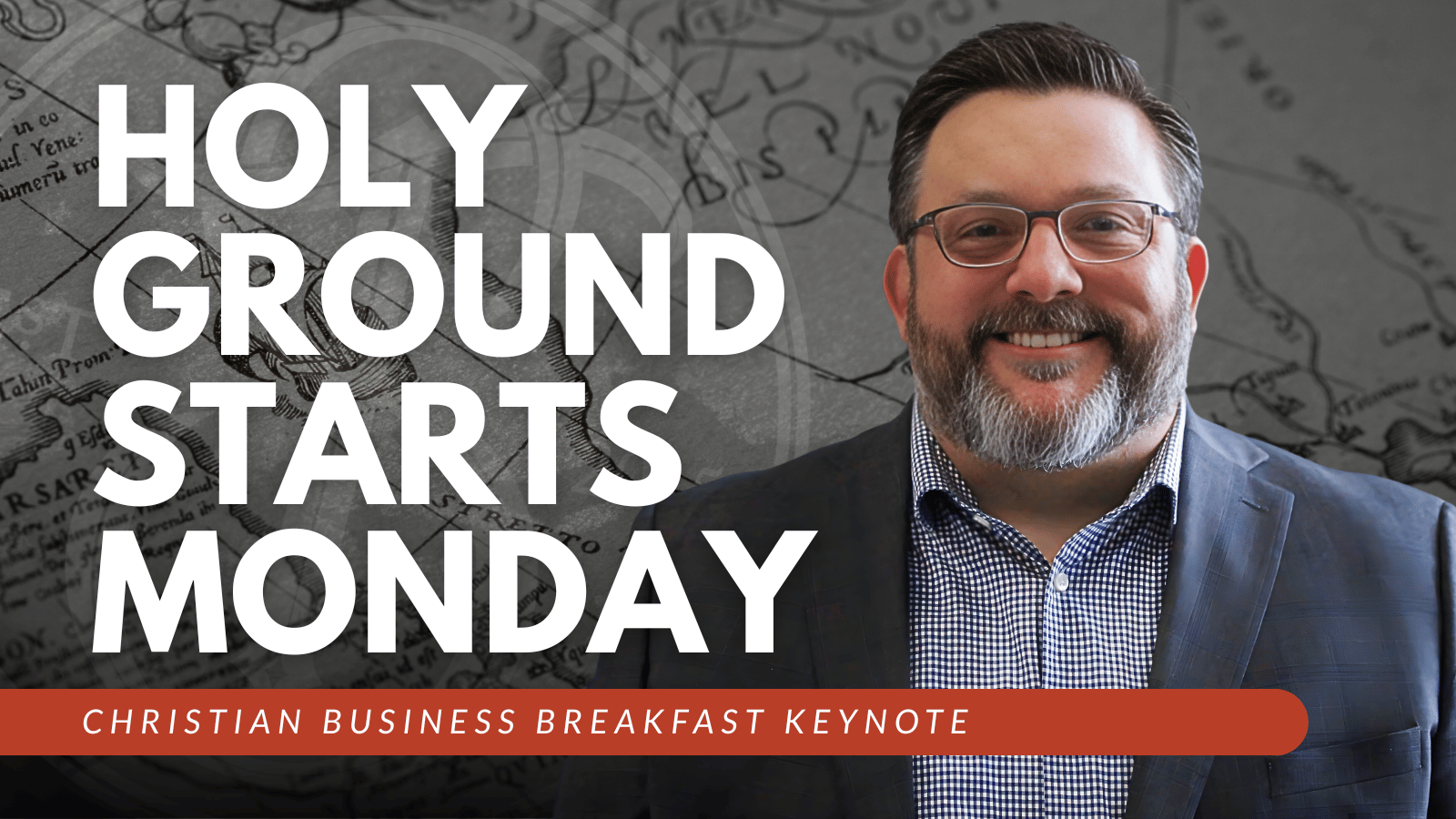
The Weight of Monday | Bill Tibbetts Keynote
Your Work Is Holy Ground: The Biblical Case Against the Sacred-Secular Divide
The sacred-secular divide has shaped how Christians think about work and calling for nearly a century. Here is where it came from and the theology that tears it down.
The Guilt Most Christians Never Name
Most Christians have felt it at some point. That low-grade guilt of spending 50 hours a week on work that doesn’t feel spiritual enough. The quiet assumption that real ministry happens in a pulpit, on a mission trip, or behind a church building, while Monday through Friday is at best a necessary distraction from what God actually cares about.
That feeling has a name. It’s called the sacred-secular divide, and it has been quietly shaping how Christians think about work, vocation, and calling for nearly one hundred years.
A Courtroom in Tennessee
The year is 1925. The country is already stretched between tradition and modernity, faith and progress. The post-World War I economic boom is reshaping American life. Consumerism is rising. The suburbs are being born. And America is asking a question it hasn’t fully faced before: Can you be modern and still believe?
Into that charged atmosphere walks a high school biology teacher named John T. Scopes, charged in a small Dayton, Tennessee courthouse for violating the Tennessee Butler Act, a law prohibiting the teaching of evolution in public schools. The Scopes Monkey Trial becomes a national spectacle.
Former U.S. presidential candidates show up as legal counsel. International news outlets cover the proceedings. The cultural collision of old versus new thinking has found a courtroom, a judge, and a jury.
But the real damage isn’t in the verdict. It is in the vocabulary. What starts as a debate between old thinking and new thinking quickly becomes a battle between good and bad, spiritual versus unspiritual. Christians feel that the engines of modern America, specifically education, science, and the marketplace, are not neutral ground but enemy territory.
The response is retreat. Faith-based institutions pull out of cities and into suburbs. The arts, the marketplace, and the academy are left behind. Serving God becomes something you do inside the church building, and everything outside is treated as spiritually second-tier.
That framework, once it takes root, doesn’t let go easily. Nearly a hundred years later, many Christians still feel it. The assumption that some callings are closer to God than others. The language of “full-time ministry” that quietly implies everything else is part-time obedience. Treating Sunday as sacred and Monday as spiritually thin.
This Isn’t New. It’s Ancient.
Here’s the thing: the sacred-secular divide didn’t start in a Tennessee courtroom. It has been raising its head throughout history.
The first-century church dealt with an early version of this in the form of Gnosticism, the belief that the spiritual world was good and the physical world was evil. The Apostle Paul pushed back hard. In Colossians 2:9, he declares that “in Christ lives all the fullness of God in a human body.” The Word became flesh. Physical reality is not beneath God’s concern. It is the arena of his redemption.
Yet the Gnostic tendency kept resurfacing. Constantine elevated the clergy to privileged status in 300 AD. The monastic movement of the Middle Ages treated religious vocations as the highest calling. Martin Luther pushed back against this in 1517 when he nailed his 95 theses to the church door in Wittenberg, preaching the priesthood of all believers and insisting the Bible creates no two-tiered Christianity. But the divide kept returning. The Enlightenment privatized faith. Certain end-times theologies painted creation as disposable. Each era found a new way to separate the sacred from the secular, the spiritual from the ordinary.
The Scopes Monkey Trial didn’t create the sacred-secular divide. It just gave it a very loud American accent.
What Jesus’s First 30 Years Tell Us
Before his first miracle, before his first sermon, before the first time he said “follow me,” Jesus worked. He was a tecton, a carpenter or stonemason. He got tired. He laughed. He sweated through long hours in the marketplace.
And he did it for thirty years.
It’s easy to skip past this. But sit with it for a moment. The fully divine Son of God spent the vast majority of his earthly life doing the kind of work most Christians consider spiritually ordinary. If the ordinary wasn’t sacred, why did he live there so long? If the marketplace was enemy territory, why did he call it home for three decades before beginning public ministry?
The ordinary is part of God’s design. The idea of separation between sacred and secular is not biblical. It is not theologically founded. It is a cultural inheritance, not a scriptural one.
The Temple Was Always Bigger Than You Thought
To understand where this is all going, you need to understand what a temple actually is.
A temple is not just a religious building. A temple is a place where heaven and earth overlap, a point of contact between the divine and the physical, a place where God takes up residence.
Many scholars believe the six days of creation in Genesis 1 and 2 actually reflect a temple-building narrative. God builds, furnishes, and orders creation across six days. Then on day seven, he rests. Not because he’s tired, but because in the ancient Near Eastern context, rest meant taking up residence to rule. He moved in. Creation itself was the temple.
Genesis 2:15 goes even further. When God tells Adam to “work and keep” creation, the original Hebrew words are the same ones used in Numbers to describe priestly service. Adam wasn’t just a gardener. He was a priest. All of humanity was meant to be priests of God’s sacred creation, cultivating, guarding, and extending the holy into every corner of the world.
Sin broke that overlap. It created the separation that every version of the sacred-secular divide has been trying to name ever since.
The Gospel Is Bigger Than You Think
When Jesus died on the cross, the veil in the temple was torn from top to bottom. That was structural, not just symbolic. The location-based overlap between heaven and earth was giving way to something larger.
The Apostle Paul makes it explicit: you are now the temple. You carry the sacred presence of God into every room you enter, every meeting you sit through, every transaction you make.
Colossians 1:19-20 says it plainly: “God in all his fullness was pleased to live in Christ, and through him God reconciled everything to himself. He made peace with everything in heaven and on earth by means of Christ’s blood on the cross.”
Everything. Not just spiritual things. Not just Sunday things. Everything.
The gospel isn’t only saving souls for a future heaven. It is restoring all of creation to its original design. That means your workplace is not spiritually neutral ground. It is mission territory, and you are a priest.
The Goal Isn’t to Diminish Ministry
Let’s be direct: the goal here is not to flatten or dismiss vocational ministry. Pastors, missionaries, and church leaders carry a vital, irreplaceable calling.
The goal is to restore every form of work to its rightful place under the redeeming reign of Christ. The problem with the sacred-secular divide is not that it elevates vocational ministry too highly. It’s that it leaves everything else too low. Every form of obedience belongs under Christ’s lordship. Sunday is sacred. Monday is sacred. The pulpit is holy ground. So is the construction site, the cubicle, the coffee shop counter.
What Changes When You Believe This
Imagine walking into work on Monday morning and genuinely seeing it as holy ground, not as a spiritual metaphor, but as a daily reality. Every customer interaction is priestly work. Every decision made with integrity is worship. Every act of excellence is an extension of God’s redemptive work in the world.
That changes how you treat people. It changes what you’re willing to compromise. It changes the weight of your witness and the quality of your effort.
And if the whole church started believing it? We would look quite different in this world today.
The sacred-secular divide has cost the church a century of marketplace influence. It has kept believers on the sidelines of education, business, science, and culture, convinced that ordinary work was beneath God’s concern.
It wasn’t then. It isn’t now.
Tear down the divide. Show up Monday like it matters.
Because it does.
Start here: grab our free five-day devotional at thestonetable.org/start.
Full Transcript
Bill: Good morning, everyone. We are at Real Life Church in Greenfield. The power went out last night while we were there, though it waited until after I was done preaching, so God held off for that. It’s good to see you. I love seeing the students here. Thank you, students, for getting up so early.
Would you have loved to go back and be 20 again and do it right instead of taking the long road that most of us took? But we have all these 20-somethings here today who are doing it right, and I think that’s incredible. Good to see you all. Familiar faces everywhere. This is wonderful.
This morning we’re going to be talking about what Erik shared, and there’s a term we use around here called the sacred-secular divide. That one takes us back almost a hundred years, to 1925.
I’m a teacher, so I really appreciate pen and paper or fingers on laptops. Open your notebooks. Erik does a fill-in-the-blank, and there’s space in the margins and a worksheet in the back for extra notes. Take notes. Good students take notes.
So in 1925, the nation was divided between culture and belief, which doesn’t sound too unfamiliar from 2025. This great divide between what’s happening culturally and what’s happening with traditional belief systems. The U.S. economy in 1925 was booming. It was right after World War I, and consumerism exploded. Because of that, we started seeing the beginnings of what we call today the modern-day suburb. The suburbs existed, but they started growing rapidly during this time because the economy was strong. People were moving out of urban settings and into this new thing called the suburbs.
Prohibition was also in full effect. The illegal sale of alcohol, because alcohol was considered bad and dangerous. That’s also where we get the term “bootleggers,” people who were going against prohibition. A bootlegger is just what it sounds like: someone who wore long boots and stuck bottles of alcohol down the side. That’s where the term comes from.
Fun fact, Erik, I don’t think I’ve ever told you this: the Tibbets family wealth started with bootlegging. Grandpa Charles Tibbets started the family wealth with bootlegging in Kentucky and Indiana. I’m proud of that. Not really.
Also around 1925, women’s right to vote had been recently enacted, around 1920. Yet racial segregation and discrimination were still being legally enforced. So 1925 is this incredible convergence of dichotomies. Old versus new. Tradition versus progress. Faith versus modernity. And in the cultural conversation, everything was in opposition. The message was: you cannot believe in advancement and still believe in faith.
And in the middle of all of this, in 1925, there was a tiny little courthouse in Dayton, Tennessee, where a case was about to begin that captured both national and international news. Remember, this is 1925. It took a long time for something to hit national news, let alone international. For it to travel that far meant it was significant.
A high school biology teacher by the name of John T. Scopes was legally charged for violating the Tennessee Butler Act, a law that said you must teach creationism and cannot teach evolution. As a biology teacher, he bucked the system and taught evolutionary theory in the public classroom. It was a massive case.
Can you already see where this story goes? We have 1925, a cultural collision between old thinking and new thinking, and now you have a man pushing it even further. What he would call old thinking: creationism. New thinking: evolution.
Legally, the case was fairly narrow. But culturally, it was explosive. It made national news. Huge names were engaged as legal counsel. Former candidates for the U.S. presidency were involved. And it turned out not to be simply about old versus new thinking. It became about good versus bad. That is a very important point.
Because the shift moved from “old thinking versus new thinking” to “bad versus good, faith versus lack of faith, spiritual versus unspiritual.” This wasn’t entirely new in the U.S., but this case accelerated that language more than ever before.
Scopes was found guilty. He was later technically cleared on a technicality. But the deeper verdict had already been rendered in the national imagination. This idea of spiritual versus unspiritual, good versus bad.
From that moment forward, many Christians began to feel that the engines of modern America, especially in three areas, were not simply neutral but spaces to retreat from. Those three areas were education, science, and the marketplace.
When Christians at the time looked at these areas, they saw: we are good, these things are bad. We are traditional. But these spaces, education, science, and industry, are where modernity exists. And what happened was retreat. A lot of the marketplace and industry were in urban settings and cities. Faith-based organizations started leaving urban environments. There are a few of us here from Minneapolis, and there are five prominent Christian universities in the Twin Cities. Around 1925 to 1930, four of them moved out of the urban setting into the suburbs. Only one stayed in the city. That was part of this great migration away from what was perceived as evil and into what was perceived as good.
This had profound consequences, because these spaces were now viewed as fundamentally evil. It narrowed the practical meaning of discipleship. Serving God became associated primarily with church-based activities, while everyday vocation, work, marketplace, the sciences, the arts especially, were treated as spiritually secondary.
You can see how that happened. If we view these things as evil, the natural inclination is: what we do in the church is good, and everything else is at best secondary, if not bad.
That framework has a name. We call it the sacred-secular divide. Write this down. That is where this term comes from.
Here is the simplest definition: the sacred-secular divide is the belief that God is present in spiritual activities, but distant or absent in ordinary work and life. I’ll say that again. God is present in spiritual activities, but distant or absent in ordinary life.
You know what’s interesting? A few of us were talking yesterday about the first 30 years of Jesus’s life. We don’t talk much about it because there isn’t a lot known. But if you study the history and culture of the time, this is mind-blowing.
Before the very first miracle Jesus performed, before the very first message, before the very first “follow me,” Jesus worked in the marketplace. He worked. He got tired. He laughed. He had fun. And here’s the thing: it wasn’t like when he turned 30 he suddenly became God. He was born into it. And he lived it for 30 years. He lived in the ordinary.
If we can’t look at that and say the ordinary is equally validated, I don’t know what other argument we can present. The ordinary is part of God’s design. This idea of separation is truly not biblical. It’s not theologically founded. And nearly a hundred years later, we are still living out the consequences of this movement from 1925.
There are many of us who still assume some callings are closer to God than others. That certain callings are better, that certain callings seem elevated, and everything else is neutral. Sometimes we still treat Sunday, which is an incredible day, as sacred and Monday as spiritually thin.
Every place I step is holy ground. But we use language that says otherwise. And many still talk about full-time ministry, which is a beautiful and awesome calling, as if the rest of life is part-time obedience.
Our goal today is not to diminish vocational ministry in any way. Our goal is to restore every form of work to its rightful place under the redeeming reign of Christ. Not to bring vocational ministry down, but to recognize that Scripture calls us to elevate everything under the redeeming power of Christ.
I cannot say this enough. If the church grasped this single point, I firmly believe the world would look different than it does today. We talk about revival. We talk about wanting to see Christ at work across this world. If we could break away from bifurcated thinking and application of God’s Word, it would look different.
If I could preach on one thing about the gospel, it would be this. Because if I walked into work on Monday morning and saw that cubicle, that construction site, that truck, that counter at a coffee shop as holy ground, it massively transforms how I think, act, perceive, and treat the world. And imagine if the whole church did.
I think we would look quite different in this world today. I’m going to hand this over to Erik. He’s the smart one. I’m the dog and pony show. He’s going to take you down through some of the theology.
Erik: Thanks, Bill. That was awesome.
Are you guys ready to dive into some deep thinking for about 10 minutes? Ten minutes, and then we’ll have some interaction around the tables. You can put a clock on it.
Bill just talked about this idea of the sacred-secular divide, the belief that God is present in spiritual activities but distant or absent in ordinary work and modern life. He gave us a brilliant, more modern example, though it’s a hundred years old now, of the sacred-secular divide taking root in our culture.
But this great separation, as we call it here at The Stone Table, is nothing new. The Bible even tells us there’s nothing new under the sun. It just takes on new forms. The early church did not have Scopes Monkey Trial issues. The early church did not have a sacred-secular divide. After all, they followed Jesus, the Word that became flesh. The Spirit merged with the physical to become flesh. And Jesus himself spent 30 years, as Bill mentioned, as a tecton, a carpenter or stonemason. He only spent three years in full-time itinerant ministry.
So the early church did not struggle with this. But the first century did have the emergence of something. Have you heard this word before? Gnosticism.
The first-century church dealt with an influx of Gnosticism. The Gnostics believed they had a special knowledge. That’s where the word comes from: gnosis, or knowledge. Write this down: Gnostics believed the spiritual world was good and the physical world was evil. Sound familiar? It kind of sounds like the Scopes Monkey Trial, doesn’t it?
But this Gnostic sacred-secular divide was not the theology and practice of first-century Christians. The Apostle Paul pushed back hard on Gnosticism in his letters. Colossians 2:9 is just one example: “For in Christ lives all the fullness of God in a human body.” Paul said Jesus was both spiritual and physical. The Word became flesh and dwelled among us. So the early church naturally believed that all of life was sacred, and they fought back against this underlying Gnostic heresy.
But these Gnostic seeds, this Gnostic tendency, would continue to raise its head throughout history. This is by no means a complete historical account, but here are some examples.
Constantine, in 300 AD, nationalized Christianity and elevated the clergy to privileged status. Over time, as the world moved into the Middle Ages, this instinct hardened. The monastic life was considered spiritually superior. Religious vocations were higher callings. Lay work became spiritually second-tier. The sacred and secular divided again.
Then in the 1500s, a man named Martin Luther pushed back hard when he nailed his 95 theses to the door of the church in Wittenberg. He preached the priesthood of all believers. He said the Bible doesn’t elevate some to sacred status. All of Christ’s followers are the priesthood.
History continued to march on. We arrived at the Enlightenment in the 1700s and 1800s. Faith privatized again. All of public life became fact and science oriented. The sacred and secular divided once more. And as we moved into the 18th and 19th centuries, a certain version of end-times theology emerged that painted a picture of a disposable creation, that one day it would all be burned up and destroyed anyway. So dualism found a whole new lane. Why polish the brass on a sinking ship? And the sacred-secular divide happened again. On and on it goes until we see it emerge in the 20th-century examples Bill has shared today.
But it’s all rooted in these Gnostic tendencies that go all the way back to the beginning. Where does this come from? I believe it’s rooted in Genesis, when man’s sin caused all of creation to be separated from God.
If we want to understand the brokenness and deception behind these sacred-secular tendencies, we need to understand what God’s original design and intent was.
So do you know what a temple is? When I say the word “temple,” what do you think of? A building? A place to meet with God? Your body? Good. You’ve studied.
Write this down: a temple is actually a place where heaven and earth overlap. A place where heaven and earth overlap.
We know the temple from the Old Testament, built on the Temple Mount, the place where the Holy of Holies was. It was a place where God came and dwelt among his people. But did you know that scholars actually believe God’s original intent was for all of creation to be the temple? Many scholars believe that the six days of creation in Genesis 1 and 2 reflect a temple-building narrative. Six days of building, furnishing, and ordering creation, and then on day seven, God rests. Because temples are where gods dwell, and to rest means taking up residence to rule. He moved in.
And then in Genesis 2:15, when God tells Adam to work and keep creation, those are the same words used for priestly service in the book of Numbers. So write this down: all of creation was designed to be sacred and set apart for the glory of God. And mankind was meant to be priests of this sacred temple of all creation.
All creation was meant to be this place of overlap between heaven and earth. Sin broke that connection. Then God began putting it back together, starting with the tabernacle, a temporary temple structure, and then the permanent temple on the Temple Mount. It became a location-based overlap.
But when Jesus died on the cross, what happened to the veil in the temple? It was torn from top to bottom. And now the Bible says that you and I are the temple. We are the overlap of heaven and earth. We go into the world every day as image-bearing priests to cultivate, guard, and make sacred all of creation once again. That is the intent of this story.
God made a temple of all creation. Sin broke the overlap and created a separation. And Jesus is resurrecting and restoring all things to their original design, including your everyday work as priests, working, keeping, cultivating, and caring for his sacred creation in every sphere of this life.
This brings me to what may be one of my favorite verses in all of Scripture: Colossians 1:19-20. “God in all his fullness was pleased to live in Christ, and through him God reconciled everything to himself. He made peace with everything in heaven and on earth by means of Christ’s blood on the cross.”
Jesus brings creation back together again as it was originally designed. Jesus was the author of the original creation, and Jesus is the author of the renewed creation. There is nothing that is not consecrated to God in Christ. You are a priest in God’s temple. You carry his sacred space as you work and keep his creation, even through your everyday marketplace jobs.
There is no sacred-secular divide. Write this down: the gospel is redeeming and restoring all things. All things. So let’s drop this Scopes Monkey Trial ideology and tear down this sacred-secular divide that plagues us in our workplaces, and bring all things back together again as God originally designed and intended. That is our calling as believers in every sphere of this life.

The Stone Table
The Stone Table is a global missions organization rooted in the marketplace. We leverage the profits from our marketplace businesses to fund strategic global missions projects around the world. We also equip and encourage marketplace Christians to make Jesus known at work and around the world.