Pressure Reveals the Identity Gap
Pressure Reveals the Identity Gap
“I think you’re completely wrong.”
As the words came out of my mouth, even in the heat of the moment, I could visualize myself in slow motion trying to grab them and shove them back to the recesses of my soul.
Too late.
What’s that you hear? A pin drop? Yes, because that’s how silent the Zoom call got.
Here’s what made it worse…
I wasn’t talking to a familiar face or adversary.
I was talking to a consultant our CEO had hired to help us with strategy.
Objectively, there wasn’t anything wrong with bringing him in. Organizations should invite outside perspectives. Healthy leaders aren’t threatened by fresh thinking.
Right?
Unfortunately, my reality at the time was different.
But here was my excuse…
Strategy wasn’t just another responsibility on my job description. It was an area I had been studying, researching, writing about, and presenting to our executive team for well over a year. I’d invested hundreds of hours trying to help shape where we were headed.
So when our CEO announced we were bringing in a strategy consultant, something snapped inside of me.
The mental spiral was real, people.
Have they not been listening?
Had I not repeatedly brought grounded, irrefutable research to the table?
Had I freaking lost all influence on this team?
Side note: What’s fascinating is that nobody had actually said any of those things. My mind filled in all the blanks.
Then the meeting started.
The consultant began explaining his framework.
I hated it.
(It was clearly wrong…cough cough.)
It just didn’t make sense to me. Worse, it seemed disconnected from everything I had been advocating for over the previous year.
Then it happened. That stupid moment.
“I think you’re completely wrong.”
(Deep breath.)
If I’m honest, it wasn’t the sentence as much as it was the accompanied attitude.
I wasn’t curious. I wasn’t humble. I wasn’t trying to understand. I was reacting. And reacting badly.
I have a better understanding of that moment from years ago.
It had nothing to do with the consultant. And it had very little to do with our CEO.
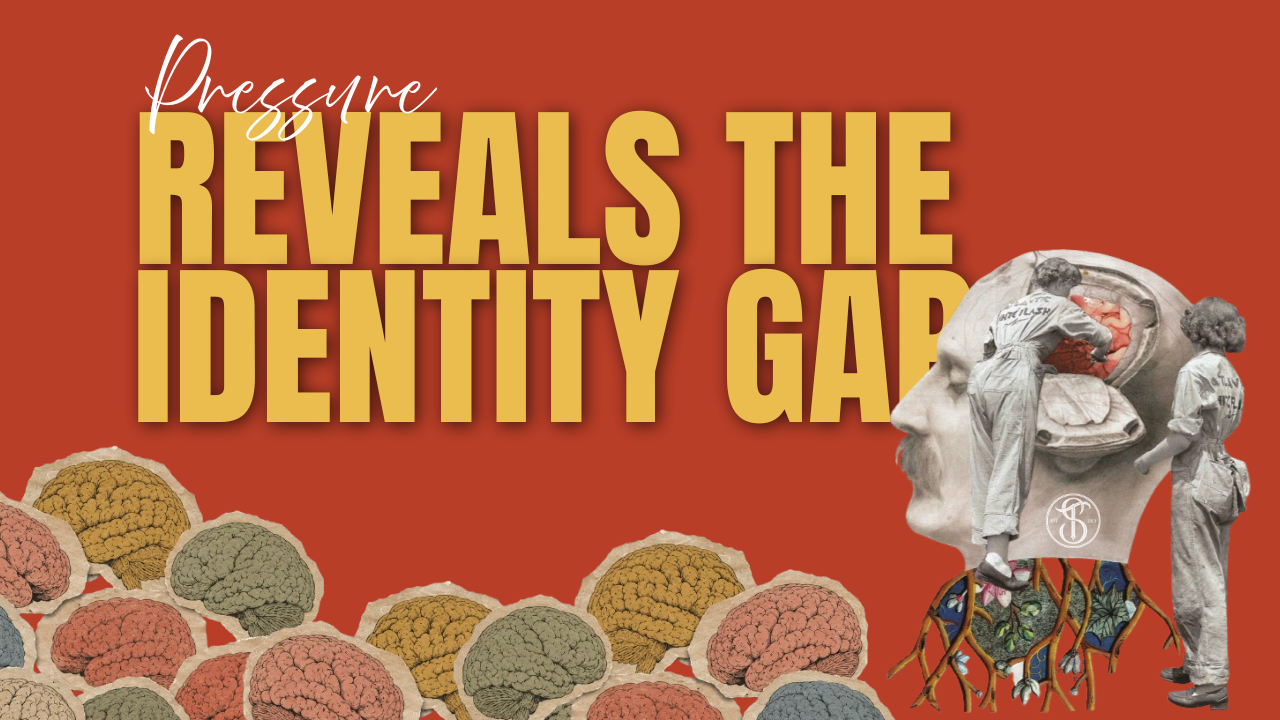
Pressure revealed my identity gap.
IDENTITY FORMATION
I’ve been thinking about that phrase a lot lately.
Not because I think pressure creates identity.
I think pressure reveals the identity we’ve actually been living from.
That’s an important distinction.
(That’s a pause-worthy moment. Let that soak in.)
Psychologists have long understood that pressure changes the way we process information. As stress increased, our cognitive bandwidth narrows. Meaning, we have less to pull from to make a good decision.
The prefrontal cortex, the part of the brain responsible for critical decision-making, begins surrendering ground to more instinctive patterns of thinking. The term counselors use for phenomena is an “amygdala hijack.” In other words, when pressure rises, we don’t usually become someone new. We become someone familiar.
We fall back on whatever has most deeply formed us.
That’s why pressure is such a terrible place to fake maturity.
Eventually, formation wins.
WORLDVIEW ON IDENTITY
Here’s where I think our culture can get identity formation wrong.
We’re told identity is something we discover by looking inward or something we build by looking backwards. So we sift through our lives, collecting memories, relationships, successes, disappointments, wounds, and failures, hoping they’ll eventually answer one of life’s most fundamental questions:
Who the heck am I?
Here’s the hard part. The process is subtle; we rarely notice it happening. Experiences don’t simply become memories, they become interpretations. And those interpretations quietly shape the lens through which we see ourselves.
A father walks out, and a child unconsciously wonders, “Maybe I’m not worth staying for.”
A coach says, “You’ve got what it takes,” and confidence begins to grow.
Every experience leaves behind a story, and if we’re not careful, we start believing those stories are telling us the truth about ourselves.
Psychologists call this narrative identity. It’s the idea that we don’t simply remember our lives; we organize them into stories that explain who we are. Those stories become beliefs, and over time, those beliefs become the identities we live from.
Here me out. I don’t think Scripture disagrees with any of that.
I just don’t think Scripture lets those stories have the final word.
BIBLICAL WORLDVIEW OF IDENTITY
The Gospel enters the conversation with an astonishing claim.
It doesn’t merely offer a healthier perspective on our past or invite us to write a better story moving forward. It announces that, in Christ, something fundamentally new has happened.
Paul writes, “Therefore, if anyone is in Christ, he is a new creation” (2 Corinthians 5:17).
Notice the grammar. He doesn’t tell us to become a new creation through enough obedience, enough spiritual disciplines, or enough life experience. He declares that we already are one because of what Christ has accomplished on our behalf.
That’s what makes Christianity so radically different from every identity project our culture offers.
The world tells us to discover ourselves.
Jesus tells us to receive our new selves.
The world says identity is earned, uncovered, or constructed over time.
The Gospel says it is declared.
That doesn’t mean our old stories suddenly disappear. Most of us know they don’t. The voices of shame, insecurity, pride, fear, and performance can be stubborn companions. They continue whispering long after Christ has spoken something better.
Spiritual formation, then, is not the process of creating a new identity. It’s the lifelong journey of learning to believe and live from the identity Jesus has already given us…especially on the days when our experiences still feel more convincing than His promises.
WHAT’S DISCIPLING OUR HEARTS
I think that’s why Jesus says something so profound in Luke 6:45, “Out of the abundance of the heart the mouth speaks.”
Since I was a teenager, I’ve read that verse as a warning about speech. Now I think it’s a window into formation.
Jesus isn’t merely saying our words matter. He’s saying our words reveal. Our reactions reveal. Our defensiveness reveals. Our need to be right REVEALS.
Pressure has an uncanny way of exposing whatever has been discipling our hearts.
That’s why Peter’s denial has become so fascinating to me.
Peter loved Jesus; I don’t question that for a second. He affirmed, “Lord, I am ready to go with you both to prison and to death” (Luke 22:33).
I believe he meant every word.
Then pressure arrived.
Not persecution or torture. Pressure.
A servant girl asked one simple question: “Aren’t you one of His disciples?”
Peter folded three times.
Don’t miss this…pressure didn’t suddenly make Peter fearful. It exposed the gap between the identity Peter believed he possessed and the one he was actually living from.
Then something beautiful happens after the resurrection.
Jesus doesn’t begin by restoring Peter’s assignment. He restores Peter’s heart!
“Do you love me?” (x3)
Notice the order: Relationship before responsibility. Identity before assignment. Love before leadership.
Jesus was rebuilding Peter from the inside out.
Dallas Willard famously wrote, “Grace is not opposed to effort; it is opposed to earning.”
I think many of us understand that intellectually.
Living it is another story.
When Paul writes, “Your life is hidden with Christ in God” (Colossians 3:3), he’s making a staggering claim. The truest thing about me is no longer the story I’ve spent my life constructing. The truest thing about me is the story Christ has declared over me. My life is now hidden in His.
That’s the identity pressure can never take away.
START HERE
I still think about that Zoom meeting.
Not because of guilt, shame, or insecurity.
I think about it because God used an uncomfortable moment to expose a false identity I didn’t even know I was carrying. And He’s done it a thousand times since.
Pressure revealed the identity gap.
And every exposure to an identity gap is an invitation.
An invitation to put off the old stories we’ve accumulated over a lifetime and put on the new self (Ephesians 4:22).
If you’re wondering where to begin, don’t start with a personality test…even though I love them. Don’t start by looking inward. Don’t even start by looking backward.
Start with 1 John 3:1, “See what great love the Father has lavished on us, that we should be called children of God! And that is what we are.”
And that is what we are.
Not what we’re trying to become. Not what we’ll be after enough spiritual growth. Not what we’ll earn after enough obedience.
What we are.
If you are in Christ, before you are a leader, an entrepreneur, a parent, a pastor, a teacher, a student, or an executive…
You are a beloved son.
You are a beloved daughter.
That’s not just part of your identity.
It’s the identity from which every other assignment should flow.

Bill Tibbetts
Bill Tibbetts is the Vice President of Education and Multiplication at The Stone Table, bringing over two decades of experience in higher education to his role. As the former Dean of the College of Business and Technology at North Central University, he developed a deep passion for mentoring, missions, and business consulting. Bill's extensive expertise uniquely positions him to lead initiatives that encourage marketplace believers and college students to actively engage with the Great Commission. He also serves on the board of the Community Reinvestment Foundation and is based in Minneapolis, MN, supporting The Stone Table's expansion into new regions.