What the Bible Actually Says About Calling, Vocation, and Your Career
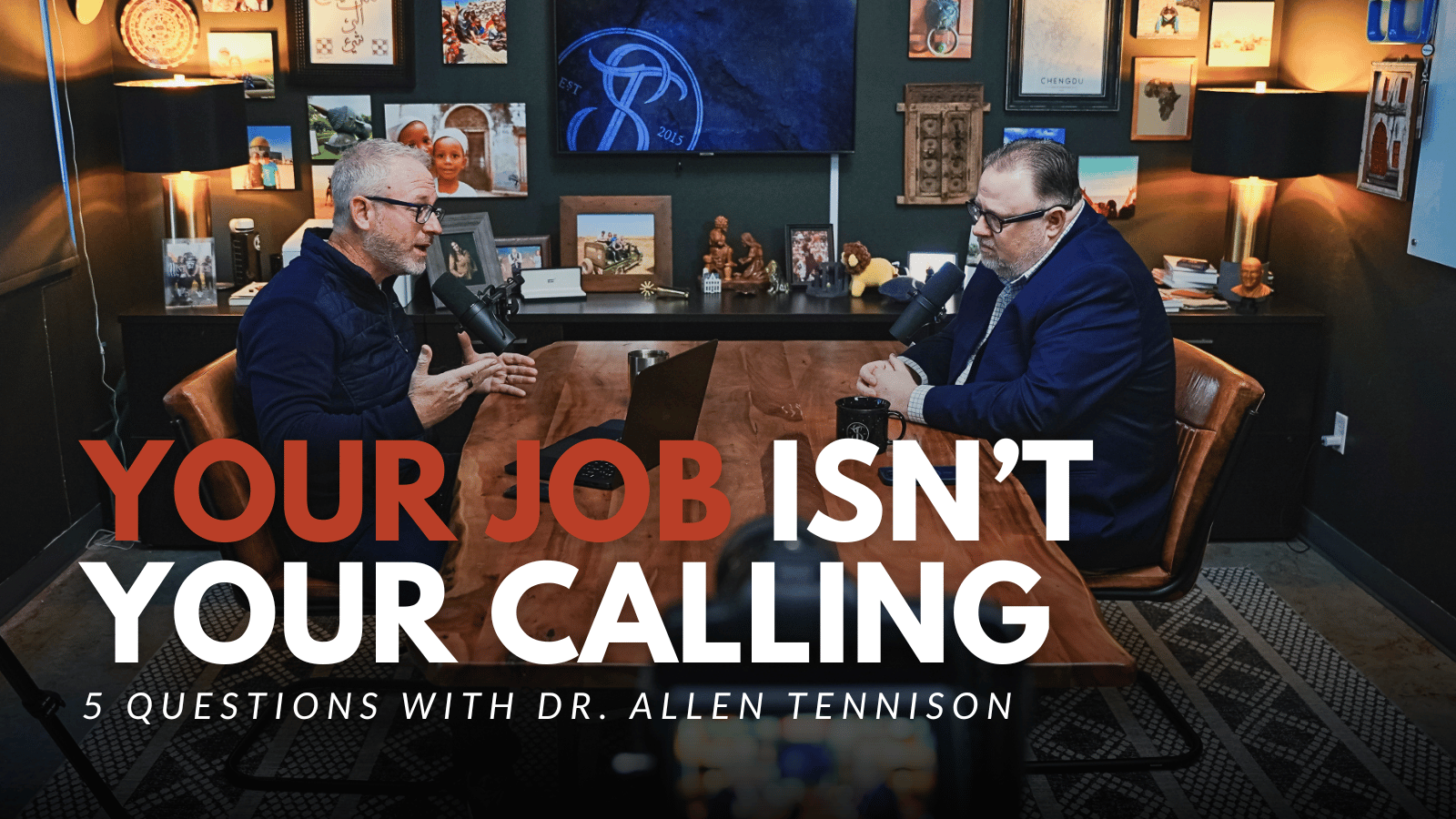
Your Job Is Not Your Calling (And That’s the Most Liberating Thing You’ll Ever Hear)
Most Christians have been handed the wrong map for understanding their work. Here’s the one that actually leads somewhere.
The Mix-Up That’s Costing You Everything
When a pastor leaves his church, why does it sometimes feel like he’s lost his entire sense of self? When a businessperson’s company fails, why does it sometimes feel like they have failed, not just the business? When someone shifts careers, why do so many people describe it like a crisis of identity?
The answer is almost always the same: they confused their calling with their assignment.
This is one of the most important distinctions marketplace believers can make — and most of us have never been taught it. In a recent conversation with Dr. Allen Tennison, chief theologian and Assemblies of God scholar, this framework became crystal clear.
Three Words You Need to Know
Dr. Tennison introduced a distinction that changes everything about how we see our work.
Calling is who you are in Christ Jesus. It is large. It is deep. It does not change based on what industry you work in, what title you carry, or whether your company survives. In the New Testament, the word “calling” almost always simply referred to being a disciple of Christ. That’s it. That’s the calling.
Assignment is the specific role, job, business, or position through which you’re currently fulfilling that calling. Assignments are temporary by nature. A pastor’s assignment at a particular church is not his calling — it’s the vehicle he’s using to live out his calling right now. A founder’s startup is not her calling — it’s her assignment for this season. Assignments can close. New ones open.
Identity is the dimension most people ignore until a transition blows it up. Your identity is never your assignment. The moment you begin to treat your title, your company, or your role as the definition of who you are, you’ve built your life on something that was always meant to be temporary.
As Dr. Tennison put it, “If someone doesn’t call me pastor, I don’t know who I am anymore — that is the warning sign. Your identity is who you are in Christ Jesus, and that stays the same.”
Why This Matters for Marketplace Believers
The Church has historically done a poor job of handling the word “vocation.” By the Middle Ages, calling had been reduced to mean only priests and monks. The Protestant Reformation pushed back hard, with Luther famously saying that God milks the cows through the milkmaid — that ordinary work in the world is sacred service to God.
But then something shifted again. The modern world took the word “vocation” and stripped it of all theological content. Today when someone asks, “What’s your vocation?” they simply mean, “What do you do for a paycheck?”
Dr. Tennison identified the collision: “The Church has struggled with understanding vocation as God’s calling and how it connects to everyday work. The modern world struggles with understanding vocation as everyday work and how that connects back to God’s calling.”
That gap is exactly where The Stone Table exists. And it’s exactly the gap marketplace believers need to close in their own thinking.
The Foundation Under Everything
None of this calling-assignment-identity framework works if the foundation is wrong. And the foundation is tetelestai.
In the conversation, Dr. Tennison made a sharp observation about how most Christians actually relate to Jesus’ finished work. “We sometimes treat ‘it is finished’ as nothing more than Jesus opening the door,” he said, “not realizing that it is finished is the foundation for the entire house we’re walking into.”
That’s the theological ground under everything. Your calling isn’t something you earn or prove. Your identity isn’t something you perform. Both are already secured in Christ. The grace by which you were saved on day one is still the grace you’re living in today. At no point does God say, “Okay, now the ball’s in your court.”
This matters for marketplace believers because so many of us are still striving — working as if our value depends on our output, our company’s success, or whether our assignment is going well. The finished work of Christ says otherwise.
What This Looks Like in Practice
Consider Erik Cooper’s story. He started in the marketplace, became a pastor and church planter for 12 years, and has now spent over a decade in what he calls “the brackish water between ministry and the marketplace.” That’s three distinct assignments across vastly different seats.
His observation: “Who I am and what I’m called to has not changed just because my seat changed. I am called to the glory of Jesus as a staff pastor, as a worship leader, as a church planter, and as a real estate owner and developer. My calling has been consistent across all of those seats. My assignment has changed.”
That’s what freedom from the confusion of calling and assignment actually looks like in a real career arc.
A Note on Broken Systems
One more application worth naming: what about when your assignment is inside a system that’s broken or unjust?
Dr. Tennison pointed to two models. Joseph and Daniel — people who operated inside corrupt systems and changed the culture of those systems through faithful excellence. “God always calls us to excellence,” he said, “because whatever we do, we’re doing it as unto the Lord. And when work is unto the Lord, it becomes worship.”
The alternative is this: if the system is so compromised that faithful excellence is no longer possible, that may simply be God’s signal that it’s time for a new assignment. Either way, your identity — who you are in Christ — remains unchanged.
The Liberating Bottom Line
Your job is not your calling. Your title is not your identity. Your current assignment is not the whole of your life.
This doesn’t make your work less meaningful. It actually makes it more so. Because when your work is freed from having to carry the weight of defining you, it can finally be what it was always meant to be: an act of worship done for the glory of God, in service of the people around you, and as part of a calling that no assignment can contain.
That’s what it means to work as a marketplace believer.
If you want to go deeper on connecting your faith to your everyday work, start with our free five-day devotional at thestonetable.org/start.
Full Transcript
Erik:
I have some random free-for-all questions that are still in the marketplace space. The word tetelestai — Jesus’ last word as He dies on the cross. I actually have it right above the TV here, and if I had short sleeves on, you’d see I have it tattooed on my arm. It’s the only tattoo I have. I got it in the old city of Jerusalem at Razzouk’s.
Dr. Allen Tennison:
Was it the oldest tattoo parlor? Yeah, I know exactly what you’re talking about. I couldn’t not do it.
Erik:
Absolutely. That’s a story for another day. But I’ve always heard conflicting commentary on the word tetelestai, because some people have preached — and if you look at the picture I have behind it, it says “paid in full” — that this was actually a business term, that it was stamped on ancient receipts to mark them paid in full. For those of us in marketplace ministry, we kind of like that idea. Is there any truth to it?
Dr. Allen Tennison:
I honestly don’t know if that’s true. The word itself simply refers to something that has been accomplished, completed, fulfilled. Could it have been stamped on receipts? It could have. I just don’t want to pretend I know for certain.
But I do want to highlight a comparison. We find that word from Jesus on the cross. We also find it in the book of Revelation, when God brings about judgment of the world. The angels declare that it is finished — now the judgment comes. I always make that comparison because if we aren’t wanting to face His judgment there, we can face His judgment here at the cross. What Christ has done on the cross becomes our judgment, and through it we can be redeemed. There are two times where God says it is finished. Which one do I want to be part of?
To answer your question about the marketplace — Paul uses multiple metaphors from different parts of human life in order to exclaim the gospel. What Christ has done on the cross is so profound that it’s almost impossible to capture with one word alone. From the world of economics and finance, he uses the word redemption — which we also think of in terms of slavery and setting a slave free, though even today we use it to refer to redeeming a coupon. It is a great economic word. From the world of law, he talks about justification. From military science, he uses language of soldiering and victory. From relationships, he talks about reconciliation and adoption.
All of this language is real. We think of it as religious because it’s in the Bible, but it’s just ordinary everyday language Paul is incorporating so we can understand how profound it is — that God has, in Christ, reconciled the entire world to Himself. And if we will accept that, then it’s already finished here.
Erik:
And it doesn’t have to be finished for us at the judgment. Regardless of whether tetelestai is a business term or not, that word has profoundly changed my life. I always tell people to really grasp the “It Is Finished” of Jesus, because it changes everything when we realize all our hearts are longing for — all we’re striving for — we all know there’s something inherently wrong with us and with the world. We’re all trying to figure out how we can fix it ourselves. When you really grasp that Jesus has done for us what we could never do for ourselves, it changes everything.
Even some of us who grew up in the church, it was almost like, “Jesus got us in, and now it’s all up to me.” Some of us are still striving. That tetelestai reminder is just a leaning back into the finished work of Christ. We all need to hear it.
Dr. Allen Tennison:
We sometimes treat “it is finished” as nothing more than Jesus opening the door, not realizing that it is finished is the foundation for the entire house we’re walking into. The grace by which I was saved on day one is still the grace I’m living in today. At no point is it ever my own effort. At no point does God say, “Okay, now the ball’s in your court.” It’s always the foundation of Jesus on which I do everything.
Erik:
You’ve got little kids at home. I always use the analogy that our goal with our kids is for them to grow up into independence. But I always tell people, the gospel is the opposite — we actually grow deeper down into our dependence on Christ. That’s how we become mature. Is it almost like a reversal?
Dr. Allen Tennison:
I think even when we say independence, what we really mean is that we want our children to become fully mature — not that we want them to disown the family. Independence doesn’t mean we’re sending them away. It means they fully develop into the person they’re capable of being.
One of the kids in our home is a special needs child. My goal for that child can’t be something that isn’t achievable for them in this life. But it is that they fully develop into the person God created them to be. And that’s what deepening in Christ looks like. I will never be who God created me to be unless I’m dependent on Him, because I was never meant to live my life without Him. He’s always the ground. He’s always the foundation.
This is also how I like to talk about Spirit baptism as a Pentecostal. Being baptized in the Holy Spirit is simply learning to live in greater dependence on God — a dependence that continues for the rest of your life. The fact that we identify speaking in tongues as the initial sign of Spirit baptism is because in that moment, even my words are entirely dependent on the Spirit of God. From my mouth to the rest of my life, I learn to live in greater dependence on Him. And that is so liberating.
Erik:
I just want everyone to understand what we have in Christ. It’s a powerful thing to unpack.
Okay, here’s another one. Sometimes I see the scripture of Jesus turning over the tables in the temple as Jesus being anti-marketplace or anti-business — that this was His vendetta on the business world, that greed in the marketplace was an evil He was fighting against. This has been my take, and I’d love your perspective. What we really see here is not Jesus being anti-business, but that these marketplace people had moved into the court of the Gentiles. The closest place the nations could get to worshiping God was that court. They couldn’t go into the temple. So the marketplace was actually blocking the nations from worship. Jesus quotes Isaiah: “My house will be called a house of prayer for all nations.” The business activity was consuming the space meant for prayer. But then there’s the second line — “you’ve turned it into a robber’s den” — meaning they weren’t just selling there, they were selling at exploitative prices. Like going to an airport and paying twenty dollars for a soda because you have no other option.
Dr. Allen Tennison:
Jesus comes into the temple as if He’s in charge — because the whole point of the temple is that it is the place where we know for certain the presence of God is. The entire hierarchy of the temple was built around proximity to that presence. But Jesus is the very embodiment of God’s presence. When He comes into the temple, the presence of God has returned. He doesn’t go into the Holy of Holies. He goes to the court of the Gentiles, where they are praying. And what is He doing? He’s setting things right.
It is not a problem to sell things. If it were, Paul wouldn’t be a tentmaker while doing his mission. The issue is that they had taken advantage of worshipers while preventing others from worshiping at all. The temple was meant to be the place of God’s presence, and instead it had become a place of exploitation.
Erik:
That’s why, in business as mission, we say we utilize the marketplace so that the nations can worship God. In this story it’s the exact opposite — the marketplace is blocking them. Whereas Paul’s tent making was the reverse. And I’m convinced Paul didn’t just support his ministry through tent making. I’m convinced Paul made very good tents. Tent making is affordable housing. Paul made the best tents he could because that in itself matters to God. But he also did it so that it would be a service to the church — and as he explains it, so that no one would ever think he was trying to exploit them.
Dr. Allen Tennison:
The reason Paul even has to defend his work is that the sacred-secular divide was creeping into the church. Other apostles were coming in and not doing business. Paul was, so some thought that made him less of an apostle. Paul’s answer was the opposite. He worked so that no one would think they were being exploited. This is business that isn’t just not exploiting — it’s doing the exact opposite. It’s doing it for the sake of the kingdom.
Jesus wasn’t speaking against the marketplace. He was speaking against a distortion of the marketplace — an exploitation that stands in the way of the worship of God. What Paul was doing was utilizing the marketplace so that people would know they weren’t being exploited and could be free to worship.
Erik:
And that’s what we are called to do.
[Sponsor: If you’re new to The Stone Table, visit thestonetable.org/start for a free five-day devotional on connecting your faith to your everyday work.]
Erik:
I want to dive into a big one here. One of the things I’ve really wrestled with: some Christians read Scripture about the end times and see the trajectory of the story as evacuation and abandonment of this world. Others read those same scriptures through the lens of restoration and renewal. It seems to me there is a connection between the abandonment interpretation and the sacred-secular divide — because if heaven is just about evacuation and destruction of the earth, why polish brass on a sinking ship? None of this really matters anyway. Our perspective on eschatology impacts our theology of work. Would you agree?
Dr. Allen Tennison:
Our perspective on eschatology impacts everything. The Greek word eschatos — which we define as “last things” — really refers to that thing on the horizon, the furthest point you’re walking toward. Whatever that is determines how you walk.
I used to give this analogy to my students. I had a friend, not a believer, who used to say that whenever he was on a first date and didn’t want a second one, he would always try to kiss her before the night was over just to get something out of it. Versus knowing people who are dating because they’re genuinely looking for someone to marry. Those are two very different ends in mind. And whatever that end is will shape the way you live.
As Christians, it’s important that we have a Christian eschatology, because it determines how we walk today. We are walking toward whatever end we have in mind. So yes — our eschatology absolutely impacts our theology of work. It impacts everything about our discipleship.
Erik:
So I’m not crazy.
Dr. Allen Tennison:
You’re not crazy. And yes, we would believe that there are things we are working on and building today that may matter into eternity.
When the church first started using the sacred-secular distinction, it wasn’t meant to be negative. Secular comes from the word for “this age” — what’s temporal. Sacred referred to work that had been set apart. The bread a baker bakes today will eventually get moldy. But we still pray for daily bread, and today that bread matters. The distinction was never meant to devalue ordinary work.
Here’s the key: everyone you serve in your so-called secular work is still someone who will last in eternity. The bread will get moldy, but the person who ate that bread today is still someone you can spend eternity with. In that sense, there is nothing we do — if done in love for our neighbor, in service of creation — that isn’t going to survive, because who we’re serving survives.
Erik:
The work we do makes a difference. I’ve always felt that if we understand the trajectory of the meta-narrative as ultimately the restoration of God’s original design, it changes the way we see even the menial tasks we do each day.
Dr. Allen Tennison:
Even the major tasks. The United States of America is not going to exist for eternity. We can look at great presidents and realize how small they appear in light of eternity if we’re only thinking in terms of legacy. But if we think in terms of how this country served people for the time it existed — living up to its principles of equality and freedom — then it has value. Even if America doesn’t survive, what America did for the time it was here still mattered.
No business I build is going to last forever. Otherwise we would still have Sears or J.C. Penney. If I’m working for a statue of myself that I think is going to last, that statue isn’t. But if I’m working for the good I can do in the time I’m here, for whoever I can serve through what I build — that’s what matters. That’s what lasts. In that sense, it isn’t secular at all. It’s sacred, because its good consequences are going to survive.
Erik:
One last question. The word vocation — what’s my vocation, I’m an engineer, I’m an accountant — comes from the Latin word for calling. We love to tell marketplace Christians: you are not the B team. God didn’t pass out all of His callings to pastors and missionaries and you just didn’t get one. We believe all Christians carry the same calling but have different assignments within that. Do you like that framing?
Dr. Allen Tennison:
I think that’s right. In the New Testament, calling is almost always simply used for a disciple of Christ. What you’re called to is to be a disciple. Over time, that word started to take on the meaning of religious work, so that by the Middle Ages, calling only referred to being a priest or someone with a monastic vocation.
Protestants tried to recapture calling and say that everything you do can be in service to God — as Luther famously put it, God is milking the cows through the milkmaid. But then in the modern world, we disconnected vocation entirely from God’s calling. Now it simply means, “What do you do to get a paycheck?”
The Church has struggled with understanding vocation as God’s calling and how it connects to everyday work. The modern world struggles with understanding vocation as everyday work and how that connects back to God’s calling. It’s a great space for the Church to step in and say: everything you do can be understood in light of your calling as who you are in Christ Jesus.
You will have different assignments, different roles. A pastor may feel genuinely gifted as a shepherd — but that assignment isn’t going to last forever. That’s an assignment. You might feel an assignment for a business. Your calling is something much larger and much deeper. You’re doing this assignment as your way of fulfilling that calling. And if that assignment closes, there’s another assignment you can step into.
Erik:
I really wrestled with that in my own career arc. I started in the marketplace, then took what I call an unexpected detour into full-time vocational ministry — on staff at a church as a pastor and church planter for 12 years. Then since 2012, almost 14 years now, I’ve been in what I call the brackish water between ministry and the marketplace. But the conviction I’ve carried through all of it is that who I am and what I’m called to has not changed just because my seat changed. I am called to the glory of Jesus as a staff pastor, as a worship leader, as a church planter, and as a real estate owner and developer. My calling has been consistent across all of those seats. My assignment has changed.
Dr. Allen Tennison:
Let’s introduce a new word: identity. Too many times when we confuse calling with assignment, we start to think the assignment is our identity. If someone doesn’t call me pastor, I don’t know who I am. If I don’t have this space to do my assignment, I feel like you’ve taken away how I see myself.
But your identity is never your assignment. Your identity is who you are in Christ Jesus — and that stays the same. Your assignment is just how you’re fulfilling your calling as someone who is in Christ. Those assignments can change, and there’s something liberating about knowing that no assignment is permanent and your identity will never be based on that. Don’t treat your assignment as if it’s the whole of your life, because your life is still found in Christ.
Erik:
That’s powerful. How would you encourage Christians to think about faithfulness at their job if their work exists inside a broken or unjust system that they didn’t create but have to operate in?
Dr. Allen Tennison:
First, understand the value of your work beyond the ends of your own company. Your company may define success a certain way. But internally, you can be working for the glory of God, for the common good, for the kingdom. And should your company tell you that you’re not meeting their ends by doing that, that may be God’s calling to find a different assignment.
It’s possible you’re in a company whose unwritten business plan is to exploit. You’re doing your work in a way that serves the common good, and they say, “You’re just not a good fit here anymore.” That’s okay. But what could also happen is what happened with Joseph — whatever they gave him, he succeeded at. Or like Daniel — he was simply better than everyone else there. You can actually change the culture of the community you’re a part of, because they get to see what it looks like when someone does this for the right purpose and in the right way.
God always calls us to excellence because whatever we do, we’re doing it as unto the Lord. And when work is unto the Lord, it becomes worship.
Erik:
Dr. Tennyson, thank you. This has been incredibly rich. I hope people listen and resonate with every word of it. But worst case scenario, you have enriched my life today. Thank you so much.
Dr. Allen Tennison:
Thank you.

The Stone Table
The Stone Table is a global missions organization rooted in the marketplace. We leverage the profits from our marketplace businesses to fund strategic global missions projects around the world. We also equip and encourage marketplace Christians to make Jesus known at work and around the world.